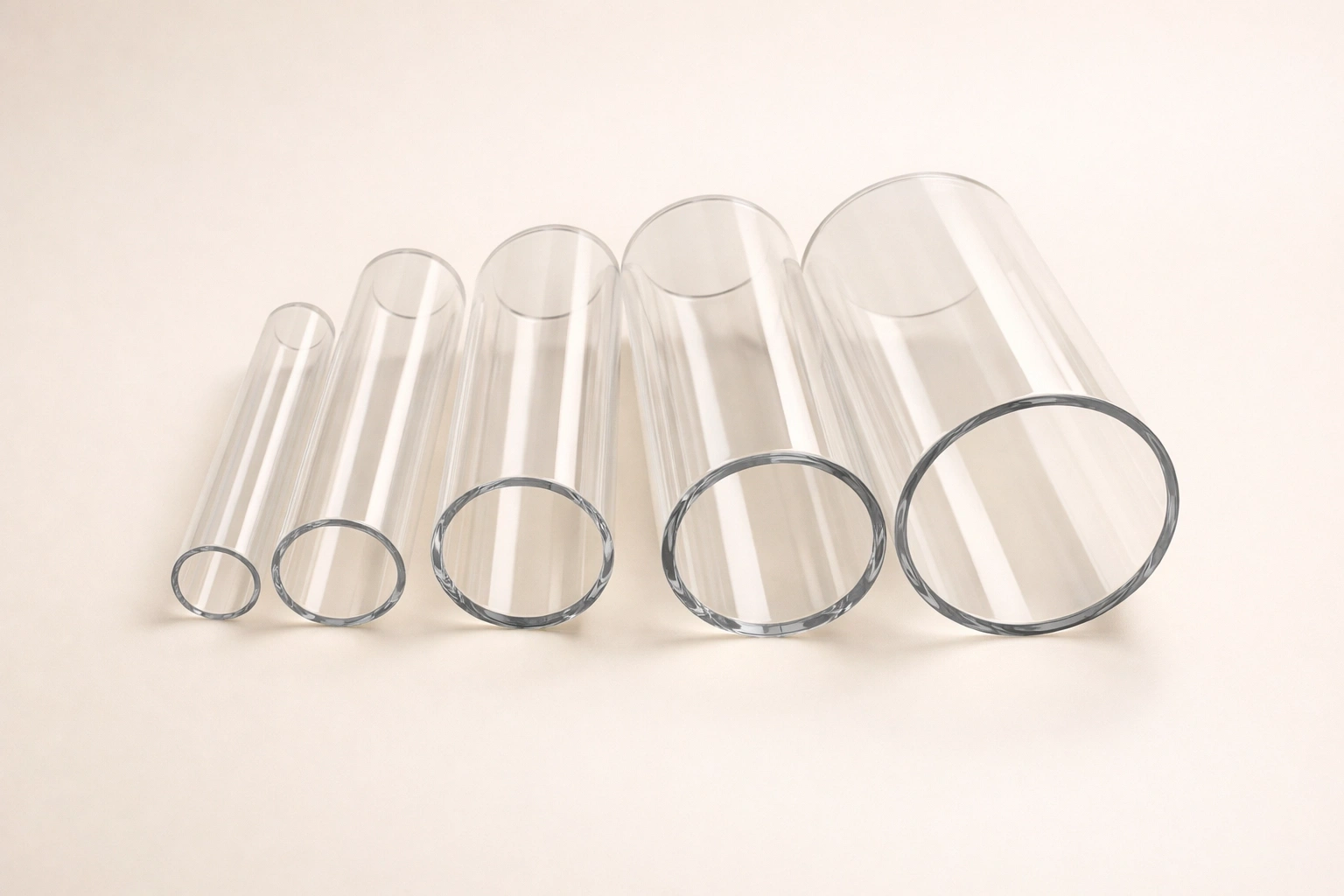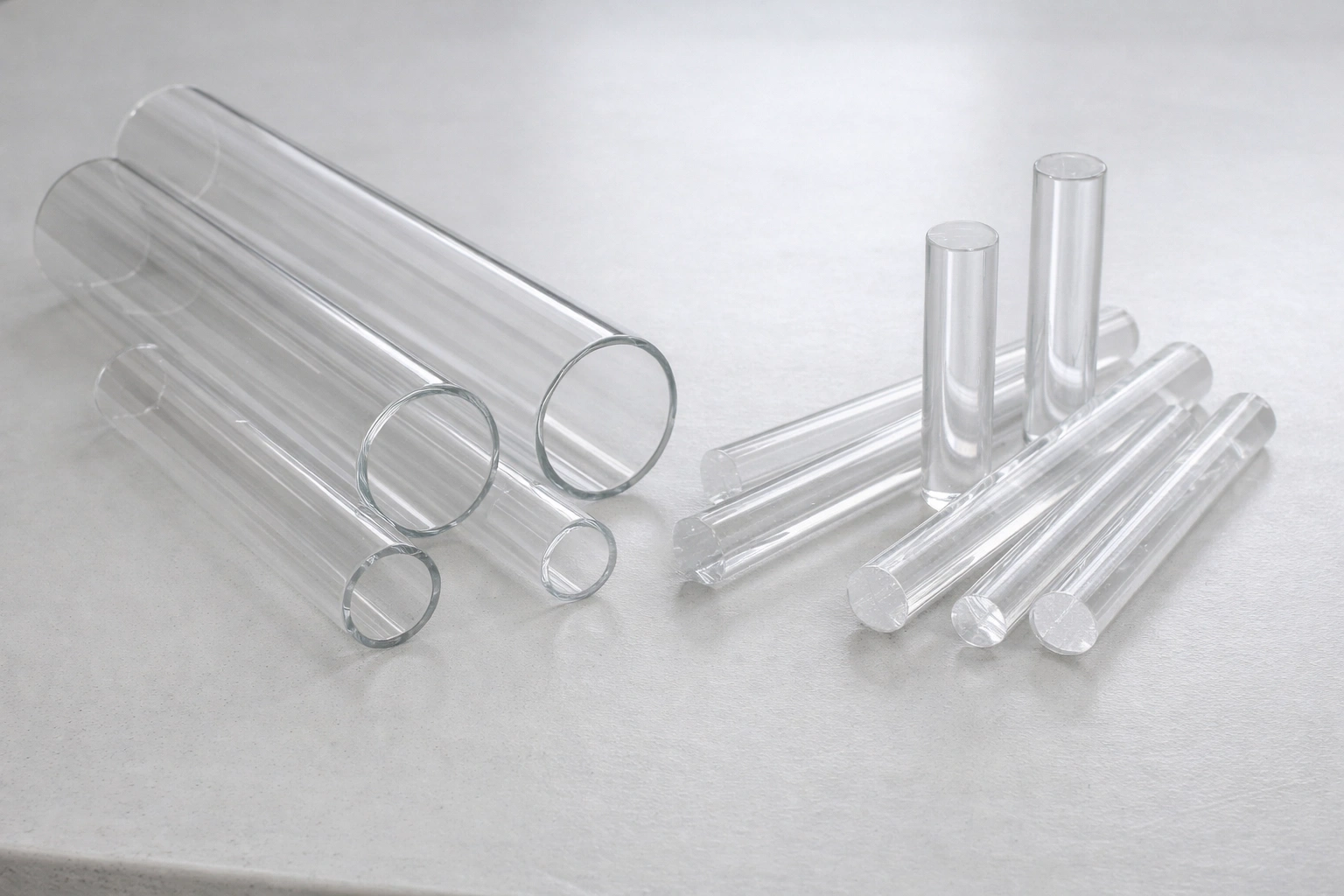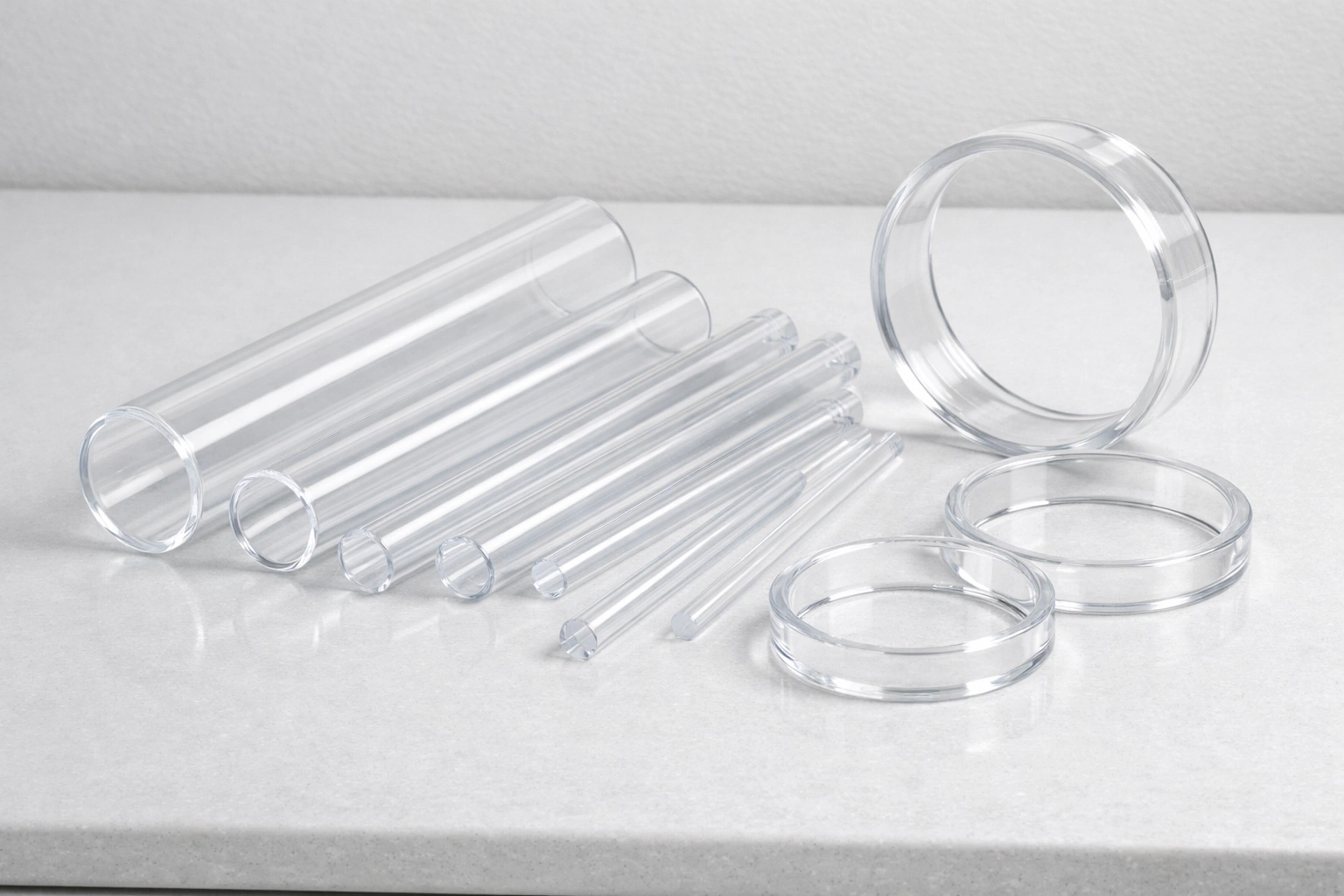

Quartz discs performance specifications optical windows define the foundation for high quality optical windows in scientific, industrial, and aerospace settings. Engineers focus on refractive index, Abbe number, density, and transmission properties to select windows that deliver high light transmission and durability. The following table highlights the most important specifications that influence quality, longevity, and performance across diverse applications:
Specification | Value |
|---|---|
Refractive Index | nd ≈ 1.523 |
Abbe Number | vd ≈ 58 |
Density | ~2.55 g/cm³ |
Transmission Rates | Typically >91% in visible spectrum |
Surface Quality | Scratch-dig |
Compliance Standards | ISO 10110, MIL-PRF-13830B |
Mechanical Strength | Required for tempered glass |
Thermal Stability | Important for applications |
Chemical Resistance | Necessary for durability |
Coating Adhesion | Relevant for performance |
Environmental Durability | Long-term requirement |
Matching the correct specifications to each application helps ensure system accuracy, reliable transmission, and lasting performance of optical windows.
Key Takeaways
Select quartz discs based on application needs to ensure optimal performance and durability.
Prioritize specifications like transmission rates and surface quality for reliable optical windows.
Request validation data from suppliers to confirm that quartz windows meet required standards.
Use a structured approach to rank performance parameters based on operating conditions and critical requirements.
Understand the importance of compliance with industry standards for safety and reliability in demanding environments.
What Performance Specifications of Quartz Discs Are Required for Laser Beam Delivery Window Applications?

Laser beam delivery window applications demand precise quartz discs performance specifications optical windows to ensure accuracy and reliability. Engineers must balance optical surface specifications with mechanical and thermal requirements to maintain system performance. The following section explains how each specification impacts laser beam delivery and highlights the standards that guide quality and consistency.
Parallelism Tolerance Calculations for Beam Pointing Stability
Parallelism tolerance plays a critical role in maintaining beam pointing stability in laser systems. When the parallelism of windows deviates by more than 5 arc-seconds, the resulting angular error can cause the laser beam to shift by up to 0.11 mm at a 10-meter distance, which reduces machining precision by 8-12%. ISO 10110-2 recommends parallelism below 5 arc-seconds for high-precision applications, ensuring that beam deviation remains within 25 μrad and supporting stable, repeatable laser processes.
Specification | Effect on Beam Stability | Recommended Value |
|---|---|---|
Parallelism | Minimizes beam deviation | <5 arc-seconds |
Flatness | Maintains wavefront quality | λ/4 or better |
Thickness | Reduces wedge effect | Uniform across disc |
Precision in parallelism directly affects the accuracy of laser cutting and welding, making it a top priority for engineers.
Surface Flatness Impact on Laser Beam Quality (M² Parameter)
Surface flatness determines the quality of the transmitted laser beam and its focus. A flatness of λ/4 ensures the transmitted wavefront error stays below λ/4 RMS, which keeps the M² parameter under 1.3 for most industrial laser applications. For systems requiring diffraction-limited performance, λ/10 flatness is necessary to achieve an M² value below 1.1, supporting high-quality, tightly focused beams.
Summary of flatness impact:
λ/4 flatness: Suitable for most industrial lasers, maintains beam quality.
λ/10 flatness: Required for precision optics, supports diffraction-limited focusing.
Wavefront error: Directly linked to M² parameter and system performance.
Engineers select flatness specifications based on the required beam quality and application demands.
Laser Damage Threshold Requirements by Wavelength and Pulse Duration
Laser damage threshold defines the maximum energy density a window can withstand without surface degradation. For most laser beam delivery windows, ISO 21254 specifies a minimum threshold of 10-20 J/cm² at the operating wavelength, which ensures long-term durability even under high-power or pulsed laser exposure. The required threshold varies with wavelength and pulse duration, so engineers must match the window’s capability to the laser’s output to prevent premature failure.
Parameter | Typical Requirement | Standard |
|---|---|---|
Damage Threshold | >10-20 J/cm² | ISO 21254 |
Surface Quality | 40-40 to 10-5 scratch-dig | ISO 10110-7 |
Transmission | >91% visible, material dependent | ASTM E903 |
Selecting the correct laser damage threshold protects the window and maintains consistent optical performance throughout the system’s life.
What Performance Specifications of Quartz Discs Are Required for Vacuum Chamber Viewport Applications?
Vacuum chamber viewport applications demand quartz discs that balance optical and structural requirements. Engineers must select windows that resist pressure, maintain seal integrity, and deliver reliable optical performance. These specifications ensure system reliability and safety in demanding environments.
Pressure-Thickness Calculation Methods per ASME Standards
Engineers calculate window thickness using ASME standards to ensure safety under vacuum pressure. The formula t = D × √(P/σ) × SF helps determine the minimum thickness needed for quartz discs, where D is diameter, P is pressure, σ is tensile strength, and SF is safety factor. A 200mm diameter window facing 1 bar pressure requires at least 15mm thickness, with a safety factor of 4-6 for reliability.
Parameter | Calculation Method | Resulting Specification |
|---|---|---|
Diameter | Measured in mm | 200mm typical |
Pressure | Measured in bar | 1 bar |
Thickness | Calculated | ≥15mm |
Safety Factor | Applied | 4-6 |
This approach prevents catastrophic failure and ensures the window withstands repeated pressure cycles.
Seal Surface Specifications for Ultra-High Vacuum Applications
Seal surface quality is critical for ultra-high vacuum systems. Engineers specify a surface finish of Ra <0.8 μm on the seal contact area to prevent leaks, with diameter tolerance of ±0.1-0.2mm for proper O-ring compression. These requirements help maintain leak rates below 1×10⁻⁹ std·cc/s, which is essential for high-performance vacuum chambers.
Seal surface finish prevents leaks
Diameter tolerance ensures proper fit
Low leak rates maintain vacuum integrity
A smooth seal surface and precise dimensions protect the vacuum environment and support long-term system operation.
Optical vs. Structural Performance Balance in Viewport Design
Designers must balance optical surface specifications with structural needs in viewport applications. Quartz discs offer superior UV transmission and thermal shock resistance, which are vital for both optical clarity and durability. Structural reliability ensures the window maintains hermeticity, while optical windows require flatness and parallelism for clear observation.
Feature | Description |
|---|---|
Material | Quartz and fused silica |
Optical Performance | Superior UV transmission |
Structural Performance | High reliability and hermeticity |
This balance allows windows to perform in both scientific observation and industrial monitoring without compromising safety or clarity.
What Performance Specifications Are Required for High-Temperature Furnace Window Applications?

High-temperature furnace windows must withstand extreme heat while maintaining clear visibility and structural integrity. Engineers select quartz discs for these optical windows because of their high thermal stability and resistance to chemical attack. The following sections explain how key specifications affect performance, durability, and reliability in furnace environments.
Thermal Stress Calculation and Thickness Optimization for Furnace Windows
Thermal stress calculations help engineers determine the right thickness for furnace windows.
Quartz discs with a low thermal expansion coefficient of 5 × 10⁻⁷ and high compressive strength of 1.1 × 10⁹ N/m² resist cracking and deformation during rapid temperature changes.
Proper thickness optimization ensures the window survives repeated thermal cycling and maintains flatness for clear observation.
Key Factor | Effect on Window Performance |
|---|---|
Temperature Gradients | High gradients increase local stress and risk of fracture |
Shear Stress | Significant in furnace window geometry, can cause failure if not managed |
Axial Gradients | Higher gradients tolerated, but require experimental validation |
Engineers use these calculations to balance safety and optical clarity in demanding furnace conditions.
Devitrification Prevention Through Temperature Management
Temperature management prevents devitrification, which can cloud or weaken quartz windows.
Maintaining low hydroxyl content below 30 ppm and SiO₂ purity above 99.99% reduces the risk of devitrification, while controlling furnace temperature below 1100°C limits the growth of cristobalite crystals.
Thermal cycling through critical temperature ranges can damage structural integrity, so careful control is essential.
Summary of best practices:
Low hydroxyl content: Reduces devitrification risk
High purity quartz: Enhances durability
Stable temperature: Prevents crystal growth and maintains optical surface specifications
These practices help maintain good chemical stability and long-term transparency in high-temperature environments.
Cooling System Design for Extended High-Temperature Window Life
Cooling system design extends the service life of furnace windows.
Forced air or water cooling keeps the surface temperature below the devitrification threshold, while maintaining transmission above 80% at monitoring wavelengths and flatness within 2-4λ for reliable observation.
A well-designed cooling system also supports good radiation resistance and protects anti-reflective coating performance.
Cooling Feature | Result |
|---|---|
Forced air or water cooling | Surface temperature stays below 1080°C |
Stable transmission | >80% at visible and near-IR wavelengths |
Maintained flatness | 2-4λ for clear viewing |
Engineers rely on these systems to ensure the durability and optical quality of furnace optical windows.
What Performance Specifications of Quartz Discs Are Required for UV Spectroscopy and Analytical Window Applications?
Quartz discs play a vital role in UV spectroscopy and analytical window applications. Engineers must select windows that deliver high transmission, excellent surface quality, and precise flatness. These specifications ensure accurate measurements and reliable performance in demanding laboratory environments.
UV Transmission Requirements for Deep-UV Spectroscopy Applications
UV spectroscopy demands quartz discs with high transmission across the deep-UV range. Many UV-grade quartz windows achieve transmission rates of 80% or higher from 190 nm to 2500 nm, which supports sensitive detection in analytical instruments. This high transmission allows scientists to measure low concentrations and detect subtle changes in samples.
Specification | Causal Impact |
|---|---|
Transmission >80% at 190 nm | Enables accurate deep-UV measurements |
Transmission >90% at 254 nm | Improves sensitivity for trace analysis |
Material: UV-grade quartz | Maintains high quality optical windows |
Engineers should always verify that the selected quartz discs meet the required transmission values for their specific wavelength range.
Surface Quality Impact on Stray Light and Photometric Accuracy
Surface quality directly affects stray light and photometric accuracy in UV spectroscopy. Poor surface quality increases stray light due to scattering and reflections, which can cause errors in concentration measurements and lead to deviations from the Beer-Lambert law. Clean quartz surfaces also prevent contamination from fingerprints, which could otherwise introduce measurement errors.
Summary of surface quality effects:
Reduces stray light: Ensures reliable photometric readings
Prevents measurement errors: Supports accurate analysis
Maintains clarity: Essential for high quality optical windows
Selecting quartz discs with excellent surface quality helps maintain the accuracy and reliability of analytical results.
Flatness Specifications Preventing Interference Effects in Spectral Measurements
Flatness is critical for preventing interference effects in spectral measurements. Engineers use methods like laser interferometry, monochromatic sodium light, and profilometry to assess flatness and ensure the window does not introduce unwanted fringes or distortions. Tactile methods can also help verify that the surface remains within specification.
Flatness Test Method | Purpose |
|---|---|
Laser Interferometry | Measures surface deviations precisely |
Optical Flat with Sodium Light | Detects interference patterns |
Profilometry | Creates a detailed surface profile |
Maintaining proper flatness ensures that quartz discs performance specifications optical windows support accurate and repeatable spectral measurements.
Tip: Engineers should create a specification matrix for their application, ranking UV transmittance, surface quality, flatness, and purity by importance. Requesting validation data from suppliers, such as transmission curves and flatness reports, helps confirm that the selected windows meet all requirements for good chemical stability and long-term performance.
What Performance Specifications Are Required for High-Pressure Reactor Observation Window Applications?
High-pressure reactor observation windows must meet strict safety and performance standards. Engineers select quartz discs that deliver mechanical strength, chemical resistance, and optical clarity. These specifications ensure reliable operation and clear visibility in demanding reactor environments.
Pressure-Thickness Design with Safety Factor Analysis per ASME Standards
Engineers calculate window thickness using ASME standards to prevent failure under high internal pressure. They use the formula t = D × √(P/σ) × SF, where D is diameter, P is pressure, σ is tensile strength, and SF is a safety factor, often set between 5 and 6 for critical applications. This approach ensures the windows withstand repeated pressure cycles and maintain structural integrity.
Specification | Importance for Safety and Reliability |
|---|---|
Pressure Ratings | Must match or exceed system limits to prevent catastrophic failures. |
Mechanical Strength | Withstands internal forces, crucial for high-pressure applications. |
Thermal Stability | Maintains integrity under high temperatures, preventing failure. |
Engineers rely on these calculations to achieve both safety and long-term durability.
Edge Design and Mounting Specifications for High-Pressure Sealing
Edge design and mounting specifications play a vital role in achieving a reliable seal for high-pressure reactor windows. Beveled, drilled, or grooved edges help distribute stress and prevent leaks, while compliance with standards like ISO 3585 or DIN 7080 ensures consistent quality. Engineers also select compatible sealing materials, such as Kalrez O-rings, and match flange designs to ANSI or DIN standards for secure mounting.
Summary of critical edge and mounting features:
Edgework customization: Reduces stress concentration and improves sealing.
Sealing material compatibility: Ensures chemical resistance and leak prevention.
Surface quality: Scratch-dig <40-20 per MIL-PRF-13830B supports reliable sealing.
Proper edge and mounting design protects the reactor environment and extends window service life.
Fatigue and Long-Term Creep Considerations in Reactor Window Design
Fatigue and long-term creep can affect the performance of reactor observation windows over thousands of pressure cycles. Engineers validate fatigue resistance through hydrostatic testing and use finite element analysis to predict stress distribution and creep behavior. This process helps ensure the windows maintain optical clarity and mechanical strength throughout their operational life.
Specification | Importance for Safety and Reliability |
|---|---|
Optical Clarity | Ensures reliable, distortion-free visibility in high-pressure environments. |
Chemical Resistance | Protects against aggressive media, reducing risk of material degradation. |
Thermal Shock Resistance | Prevents stress from rapid temperature changes, ensuring longevity. |
Long-term reliability depends on careful design and thorough validation.
What Performance Specifications of Quartz Discs Are Required for Aerospace and Defense Optical Window Applications?
Aerospace and defense systems rely on windows that maintain performance in extreme environments. Engineers select quartz discs for these optical windows because they offer stability, clarity, and durability under harsh conditions. Each specification addresses unique operational challenges, ensuring mission success and long-term reliability.
MIL-STD-810 Environmental Testing Requirements for Optical Windows
MIL-STD-810 sets the standard for environmental testing of aerospace and defense windows. These tests include thermal cycling from -55°C to +125°C, vibration from 5 to 500 Hz, and shock resistance up to 40G, which simulate real-world stresses during flight and launch. Engineers use these tests to confirm that windows retain their optical clarity and structural integrity after exposure to demanding conditions.
Test | Requirement | Purpose |
|---|---|---|
Thermal Cycling | -55°C to +125°C | Ensures stability across temperature swings |
Vibration | 5–500 Hz, 0.04 g²/Hz | Verifies resistance to mechanical vibration |
Shock | 40G, 11 ms half-sine | Confirms durability under sudden impacts |
Passing these tests demonstrates that quartz windows meet the quality and reliability standards required for aerospace missions.
Thermal Expansion Management in Aerospace Window Mounting Design
Thermal expansion management prevents stress and distortion in aerospace window assemblies. Quartz discs have a low coefficient of thermal expansion, which helps maintain their shape and fit even when temperatures change rapidly during flight or re-entry. Engineers design mounting systems with compliant materials and flexible seals to accommodate small dimensional changes and avoid constraint stress.
Summary of effective design strategies:
Low expansion quartz: Reduces risk of cracking or warping
Flexible mounting: Absorbs movement and prevents stress buildup
Precision engineering: Maintains window alignment and surface quality
These strategies ensure that windows continue to perform reliably, even in the most challenging aerospace environments.
Optical Performance Maintenance Across Extreme Temperature Ranges
Maintaining optical performance across extreme temperatures is essential for aerospace and defense applications. Quartz windows transmit more than 90% of light in the UV and visible range, and their refractive index remains stable up to 1000°C, which preserves image quality and sensor accuracy. High thermal shock resistance also prevents defects and discoloration, supporting long-term clarity.
Property | Value | Impact |
|---|---|---|
Transmission | >90% (200–2500 nm) | Enables clear imaging and detection |
Refractive Index Stability | Minimal drift up to 1000°C | Maintains focus and accuracy |
Thermal Shock Resistance | High, due to purity | Prevents surface quality degradation |
These properties allow aerospace systems to rely on quartz windows for consistent, high-quality performance in every mission.
How Should Engineers Prioritize Performance Specifications for Application-Specific Quartz Windows?
Engineers face many choices when specifying quartz windows for different applications. Each environment places unique demands on the material, so prioritizing the right performance specifications is essential. A structured approach helps ensure that optical windows meet both functional and reliability goals.
Creating Application-Specific Performance Requirement Hierarchies
Engineers begin by identifying the primary function of the windows in their system. They consider whether the main need is structural protection, high optical transmission, or resistance to environmental factors. This first step sets the foundation for all further specification decisions.
Next, engineers rank performance parameters based on the application's operating conditions and critical requirements. They examine factors such as temperature range, thermal cycling, chemical compatibility, and required optical transmission. By requesting certified test data and lab certificates, they confirm that each batch of windows meets the necessary standards for quality and consistency.
A summary table helps clarify how each specification type supports application success:
Specification Type | Why It Matters |
|---|---|
Operating Temperature Envelope | Ensures windows survive expected temperature extremes |
Thermal Cycling Frequency and Duration | Confirms durability under repeated heating and cooling |
Optical/UV Transmission Requirements | Guarantees accurate measurements or imaging |
Chemical/Atmospheric Compatibility | Prevents material degradation in harsh environments |
Certified Test Data | Provides proof of performance and reliability |
By following this hierarchy, engineers can match the right quartz windows to each application, ensuring optimal performance and long-term reliability.
Quartz discs performance specifications optical windows define the foundation for reliable optical windows in advanced systems. Engineers should always match windows to application needs, focusing on transmission, quality, and durability.
Review standards and request validation data before selecting windows
Compare supplier documentation to ensure quality
Prioritize specifications based on system requirements
By following these steps, engineers and technical buyers can select windows that deliver consistent performance and long service life.
FAQ
What makes quartz discs suitable for high-transmission optical windows?
Quartz discs offer high purity and excellent light transmission. These properties allow them to perform well in demanding environments, such as laboratories and industrial settings.
A transmission rate above 91% in the visible spectrum supports clear imaging and accurate measurements.
Summary:
High purity: Enables superior clarity
Excellent transmission: Supports sensitive detection
Durability: Withstands harsh conditions
What is the typical lifespan of quartz windows in high-temperature applications?
Quartz windows can last over 5,000 thermal cycles when engineers maintain surface temperatures below 1,080°C. Proper cooling and thickness optimization extend service life.
Field data shows that windows in glass furnaces often exceed five years of continuous use.
Factor | Effect |
|---|---|
Cooling | Extends lifespan |
Proper thickness | Prevents cracking |
Low surface temperature | Reduces devitrification |
What standards guide the manufacturing of optical windows for aerospace use?
Aerospace optical windows must meet MIL-STD-810 for environmental testing. These standards require thermal cycling, vibration, and shock resistance.
Manufacturers also follow ISO 10110 for optical quality and ASME codes for structural integrity.
Summary:
MIL-STD-810: Ensures environmental durability
ISO 10110: Maintains optical quality
ASME codes: Support structural safety
What testing methods validate the quality of quartz windows?
Engineers use interferometry, pressure testing, and thermal cycling to validate quartz windows. These tests confirm flatness, strength, and resistance to temperature changes.
Suppliers often provide test reports with certified results for each batch.
Test | Purpose |
|---|---|
Interferometry | Checks flatness |
Pressure test | Confirms strength |
Thermal cycling | Validates durability |
What should engineers consider when selecting optical windows for UV spectroscopy?
Engineers should check UV transmission, surface quality, and flatness. UV-grade quartz ensures high sensitivity and accurate results.
A transmission above 85% at 193 nm supports deep-UV measurements.
Summary:
UV-grade quartz: Maximizes sensitivity
High flatness: Prevents interference
Clean surface: Reduces stray light