Selecting heat-resistant tubing shapes equipment uptime and total cost. Conflicting specs and unclear trade-offs can delay builds and increase downstream risk.
Choose opaque quartz tube when you need high infrared emissivity, very low thermal expansion (~0.55×10⁻⁶/K), and chemical inertness above ~1000–1100 °C. Specify purity (≥99.9% SiO₂), size tolerances, emissivity, and thermal-shock expectations; verify test reports and certifications before ordering.

The sections below progress from definitions and numbers to comparisons, then procurement and an actionable decision framework engineered for manufacturing teams.
What is an opaque quartz tube?
An opaque quartz tube is fused-silica tubing with controlled micro-bubble dispersion that scatters light, making it non-transparent while boosting mid-IR emissivity (~0.90–0.95) for efficient heating at high temperatures.
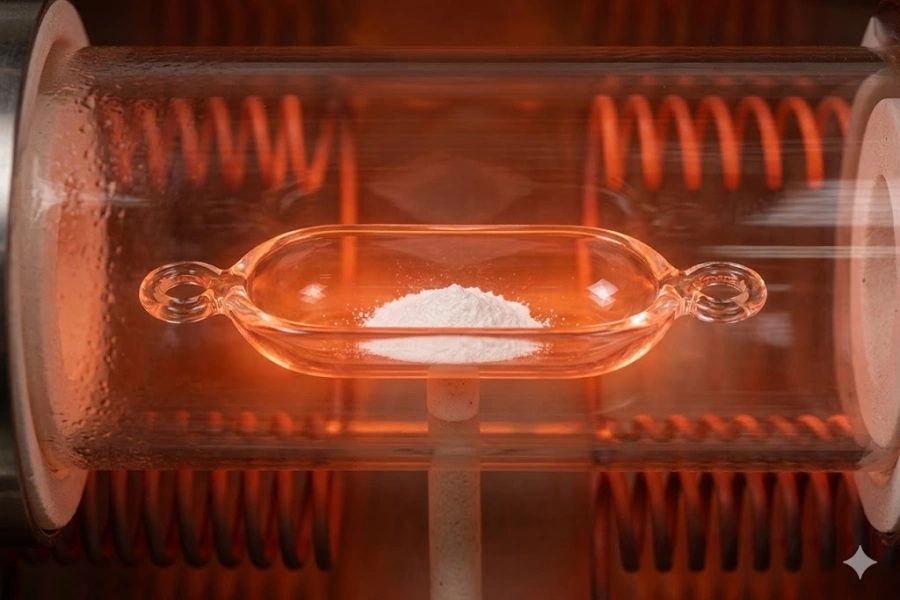
Opaque quartz (also called opaque fused quartz) is produced from high-purity SiO₂. Micro-bubbles formed during melting create translucency and raise hemispherical emissivity in the 3–14 µm band. Unlike transparent fused silica, its role is thermal rather than optical transmission.
Key points:
- Core entity: fused silica (amorphous SiO₂, density ~2200 kg/m³).
- Purity: typical ≥99.9–99.99 % SiO₂ to minimize contamination.
- Use case: radiative heaters, thermal shielding, furnace components where IR output and thermal stability matter more than visibility.
Technical Data of Opaque Quartz Tube
| Attribute | Typical Value / Range | Notes |
|---|---|---|
| SiO₂ purity (%) | 99.9–99.99 | High purity for clean processes |
| Softening point (°C) | ~1665–1700 | Material property of fused silica |
| Continuous service (°C) | ~1000–1100 | Application-dependent; design margin advised |
| Short-term exposure (°C) | ~1200 | Limited duration |
| Thermal expansion (×10⁻⁶/K) | ~0.55 (20–1000 °C) | Very low CTE |
| Thermal conductivity (W/m·K) | ~1.3–1.5 at 25 °C | Decreases with temperature |
| Emissivity (unitless) | ~0.90–0.95 (mid-IR) | Micro-bubbles increase IR output |
Why choose opaque quartz tubing for heat?
Thermal efficiency at temperature often hinges on surface radiation, not wattage. Opaque quartz tube delivers uniform heat, fewer hot spots, and improved thermal-shock tolerance via its high IR emissivity and low CTE—key advantages over metals or ceramics in radiative heater designs.
Because emissivity drives radiative heat flux, a surface near 0.9–0.95 can reduce ramp times or power draw at the same setpoint. The near-zero CTE limits stress at seals and supports, helping maintain geometry during thermal cycles.
Benefits:
- Faster warm-up at equal power due to higher radiative output.
- Dimensional stability that preserves alignments and seals.
- Clean chemistry avoiding metal oxidation or spallation.
Emissivity-Driven Heating Advantages
| Factor | Opaque Quartz (ε) | Impact at Set Temp |
|---|---|---|
| Mid-IR emissivity (–) | 0.90–0.95 | Higher radiative flux vs. low-ε surfaces |
| CTE (×10⁻⁶/K) | ~0.55 | Lower thermal stress at joints |
| Surface oxidation at 900 °C (qualitative) | Low | Inert SiO₂ surface chemistry |
What temperature can opaque quartz tubing handle?
Operating limits must differentiate continuous from short-term exposure. Design continuous use around 1000–1100 °C and short-term excursions near 1200 °C. Always validate with duty cycle, atmosphere, and mechanical loading to preserve lifetime.
Temperature capability depends on support spacing, wall thickness, and atmosphere (oxidizing, inert, vacuum). Long life requires derating for thermal gradients and external loads. The softening point (~1665–1700 °C) is not a working temperature; it marks viscous deformation onset.
Checklist for specifying limits:
- Define continuous setpoint and peak excursion (°C).
- Note time-at-temperature and cycle frequency.
- State atmosphere and mechanical constraints (cantilever, compression).
Temperature Capability
| Parameter | Recommended Value | Context |
|---|---|---|
| Continuous setpoint (°C) | 1000–1100 | Typical heater duty |
| Peak excursion (°C) | ≤1200 | Limited duration |
| Support span/Ø (ratio, –) | ≤40:1 | To limit sag at heat |
| Gradient across wall (°C) | ≤150 | Reduces stress |
How does opaque quartz radiate infrared effectively?
IR output correlates with surface properties and wavelength match. Micro-bubbles scatter visible/near-IR but sustain high mid-IR emissivity, aligning with process heating bands (≈ 3–14 µm), which improves uniformity and lowers energy per cycle.
Planck’s law1 dictates peak emission shifts with temperature; heaters around 600–1200 °C radiate strongly in mid-IR. Opaque quartz surfaces, with ε ≈ 0.9–0.95, couple efficiently to many substrates, improving soak uniformity.
Design tips:
- Target emissivity first; wattage is secondary once setpoint is fixed.
- Avoid polished shields that reduce view factor; maintain line-of-sight.
IR Emission
| Metric | Typical Value | Notes |
|---|---|---|
| Effective emissivity (–) | 0.90–0.95 | Hemispherical, heated surface |
| Dominant wavelength (µm) | ~2.4–3.5 at 800–1200 °C | From Wien’s law |
| View factor (–) | Design-dependent | Preserve radiative coupling |
Which industrial applications need opaque quartz tubes?
Common uses include infrared heaters, thermal shields in furnaces, preheater sleeves in processing lines, and quartzware for semiconductor thermal steps where optical transmission is not required.

In process equipment, engineers select opaque quartz when IR uniformity and chemical inertness outweigh transparency. In semiconductor lines, opaque components act as radiative baffles or liners; transparent tubes are reserved for optical/UV steps.
High-Temperature Industrial Heaters
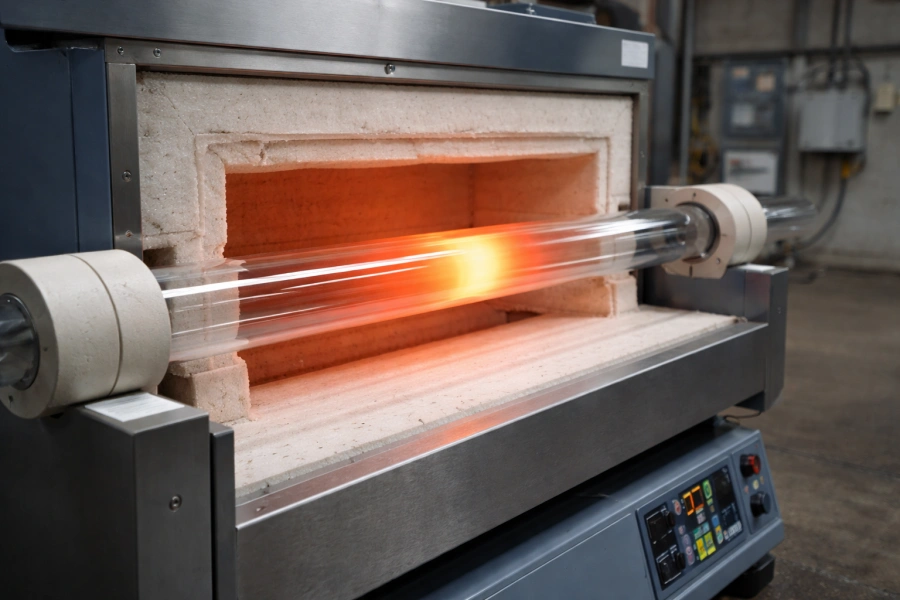
Opaque quartz tube is integral to industrial heaters, leveraging its high emissivity for efficient infrared radiation in applications like metal annealing furnaces. Its ability to absorb and re-radiate heat reduces energy consumption by up to 25% compared to metallic elements. Custom diameters from 10mm to 200mm accommodate various heater designs, ensuring uniform temperature distribution.
In operation, tubes withstand continuous 1200°C environments without sagging, thanks to their near-zero thermal expansion. This stability prevents hot spots in systems like ceramic kilns, enhancing product quality. Performance is verified through thermal imaging, with deviations monitored against ASME standards for industrial heating.
Maintenance protocols include quarterly inspections for micro-cracks using ultrasonic testing, as flaws can reduce radiation efficiency. Replacement intervals average 2-3 years under heavy use, but proper handling during installation extends lifespan. Case studies from steel plants show 30% lower downtime with opaque quartz versus ceramic alternatives.
Semiconductor Manufacturing Processes
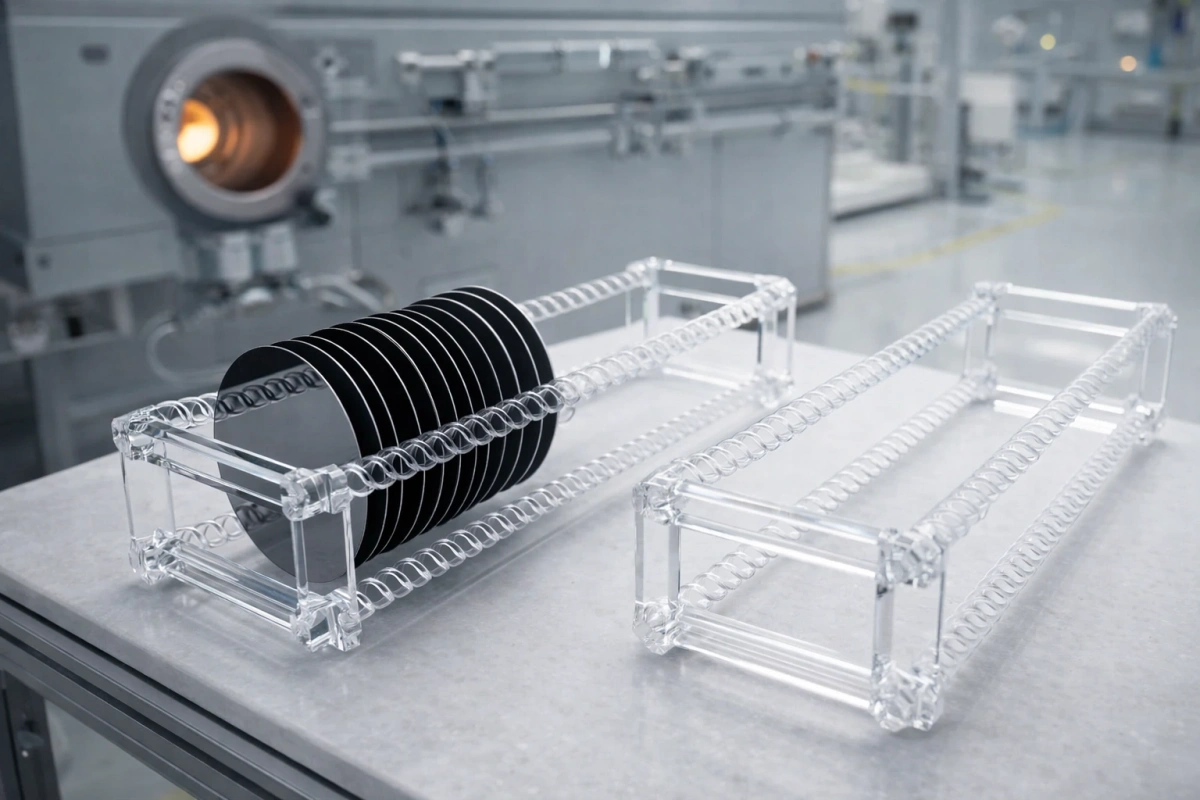
Opaque quartz tube is essential in semiconductor fabrication, particularly in diffusion furnaces for wafer processing, where it acts as reaction tubes. Its high purity prevents contamination, with SiO2 content exceeding 99.99% to meet SEMI standards. Tubes with diameters of 200-300mm handle standard wafer sizes, ensuring process uniformity.
Thermal properties enable rapid ramping from ambient to 1000°C in seconds, crucial for oxidation steps without wafer damage. Chemical inertness resists dopant gases like phosphine, maintaining tube integrity over 500 cycles. Performance is benchmarked against defect density metrics, with top-grade tubes reducing particle counts by 50%.
Lifetime optimization involves periodic etching with HF vapor to remove deposits, extending use to 1-2 years. Procurement should include leak-test certifications, as micro-cracks can cause gas leaks. Industry feedback shows 15% yield improvement in fabs using certified opaque quartz versus lower-grade variants.
Applications – Fit Matrix
| Application | Opaque Quartz Fit | Temperature (°C) | Notes |
|---|---|---|---|
| IR process heaters | Excellent | 700–1200 | High ε improves efficiency |
| Furnace baffles/liners | Excellent | 800–1100 | Chemically inert surfaces |
| UV systems | Limited | – | Prefer transparent fused silica |
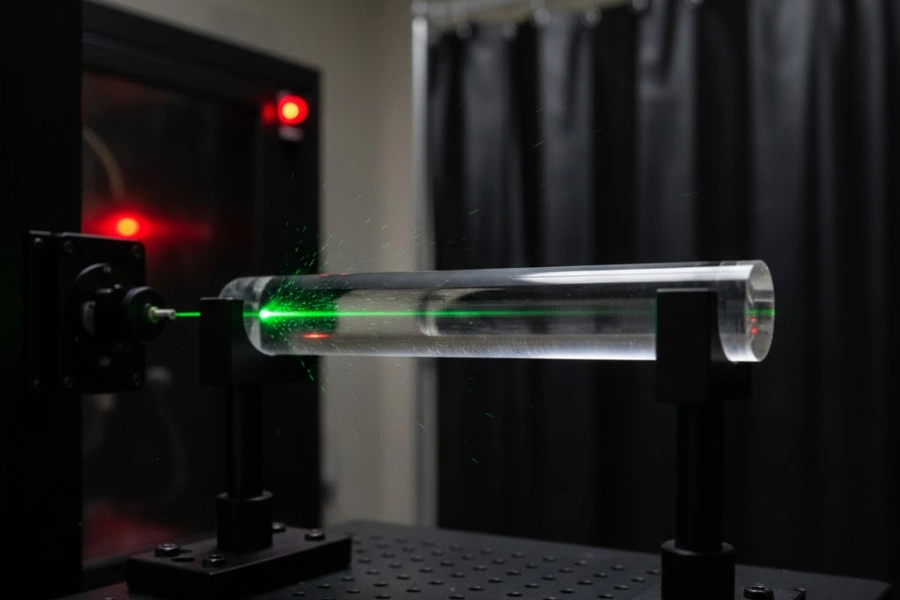
| Laser optics | Unsuitable | – | Requires optical-grade transparency |
When is opaque quartz not the right choice?
Avoid opaque quartz where optical access, visual inspection, or UV throughput is mandatory. Consider transparent fused silica or ceramics for abrasion-dominated wear without IR needs.
Use case exclusions include camera-based alignment, UV sterilization windows, and lamp sleeves. In high-erosion flows, dense alumina or SiC may offer better wear life at the expense of emissivity and thermal shock tolerance.
Alternative Pathways – Quick Guide
| Requirement | Suggested Material | Rationale |
|---|---|---|
| UV transmission | Transparent fused silica | High UV throughput |
| Visual inspection | Transparent fused silica | Clear wall |
| Severe abrasion | Alumina/SiC ceramics | Hardness & erosion resistance |
Opaque vs transparent quartz tubes: which fits your process?
Choose opaque for IR emission and shielding; choose transparent for optical transmission (UV/visible/laser). Both share low CTE and purity; select by function, not appearance.
Transparent fused silica transmits UV/visible and is used for lamp jackets, UV curing, and optical access. Opaque tubing limits light but radiates heat efficiently, ideal for heaters and thermal shields.
Quartz Tube Comparison – Function First
| Criterion | Opaque Quartz | Transparent Quartz | Typical Use |
|---|---|---|---|
| Optical transmission (UV/Vis) | Low | High | Optics/UV curing |
| IR emissivity (–) | 0.90–0.95 | 0.80–0.90 | Radiative heating |
| Visual inspection through wall | No | Yes | Process observation |
| Contamination risk | Low | Low | High-purity SiO₂ in both |
What specifications to include when ordering opaque quartz?
State purity, OD/ID/length with tolerances, wall thickness, straightness, ovality, emissivity expectations, thermal-shock handling, and surface finish. Attach drawings; request full inspection reports.
Dimensional clarity prevents assembly issues, while explicit handling of emissivity and shock expectations aligns manufacturing routes (e.g., bubble density).
RFQ Specification Fields
| Field | Typical Entry | Units / Limits |
|---|---|---|
| Outer diameter (OD) | e.g., 50.0 ±0.25 | mm |
| Inner diameter (ID) | e.g., 44.0 ±0.25 | mm |
| Length | e.g., 1000 ±1.0 | mm |
| Wall thickness | e.g., 3.0 ±0.2 | mm |
| Straightness | ≤0.3 | mm/m |
| Ovality | ≤0.5 | % of OD |
| Purity | ≥99.9 | % SiO₂ |
| Emissivity target | 0.90–0.95 | – |
| Shock expectation | Moderate/High | Define duty |
Which quality tests validate opaque quartz performance?
Request dimensional CMM, density/purity certificates, thermal expansion (dilatometry), emissivity or IR reflectance checks, and NDT2 (ultrasonic or X-ray) for bubble uniformity—reported with acceptance criteria.
Authority signals matter in audits: quality systems (e.g., ISO 9001) and process validations. For thermal data, labs often use dilatometry for CTE and flash methods for thermal diffusivity; IR methods can indicate emissivity trends for surface condition control.
Test Plan – Suggested Methods
| Test | Method/Standard | Typical Criterion | Units |
|---|---|---|---|
| Dimensions | CMM / caliper | As per RFQ (e.g., ±0.25 on OD) | mm |
| CTE | Dilatometry | ~0.55×10⁻⁶ (20–1000 °C) | 1/K |
| Emissivity | IR reflectance | ≥0.90 mid-IR | – |
| NDT internal flaws | Ultrasonic / X-ray | No critical defects ≥0.2 | mm |
| Purity | ICP-OES / certificate | ≥99.9 SiO₂ | % |
What drives opaque quartz tube cost and lead time?
Cost and lead time scale with diameter and wall, purity grade, tolerances, secondary machining, and order quantity. Early drawings and accepting standard sizes shorten schedules.
Large OD with thin walls demands slower forming and tighter QC. Tighter tolerances increase scrap risk and inspection time. Custom bends, end-seals, or slots require fixtures and thermal rework steps.
Commercial Factors – Planning Guide
| Factor | Typical Effect | Quantitative Signal |
|---|---|---|
| OD/ID & wall | ↑ Cost, ↑ Lead | Larger OD or thin wall increases cycle time |
| Tolerance | ↑ Cost | Tightening to ±0.1 mm raises inspection and scrap |
| Purity grade | ↑ Cost | 99.99% SiO₂ premium over 99.9% |
| Secondary ops | ↑ Cost/Lead | Bends, seals, slots add furnace cycles |
| MOQ | ↓ Unit cost | Larger lots amortize setup |
How to evaluate opaque quartz suppliers effectively?
Audit materials traceability, process controls, test capability, and documentation quality. Verify certifications, sample data reproducibility, and responsiveness on engineering changes.
Request process flow charts, control plans, and example CoCs. Confirm calibration status of measurement tools and training records. A short pilot lot with full data packs predicts production performance.
Supplier Evaluation – Evidence Map
| Dimension | Evidence to Collect | Target |
|---|---|---|
| Traceability | Batch IDs, melt logs | Lot-level linkage |
| Process control | Control plan, SPC charts | Stable Cp/Cpk |
| Test capability | In-house or accredited lab | Methods aligned to RFQ |
| Documentation | CoC, inspection records | Complete & consistent |
| Responsiveness | ECO turnaround time (days) | ≤5–10 days typical |
Decision framework: how to select opaque quartz tubing?
Use the checklist below to translate application needs into specs, tests, and commercial decisions, ensuring fit-for-purpose procurement.
This framework connects temperature, mechanics, and verification so teams can approve drawings quickly and order confidently.
Selection Checklist – From Requirement to Specification
| Requirement | Recommended Specification | Verification |
|---|---|---|
| Working temp (°C) | 1000–1100 continuous; ≤1200 peak | Duty profile review |
| Size & tolerances | OD/ID/Length with ±0.25 mm typical | CMM report |
| Emissivity | Target ≥0.90 mid-IR | IR reflectance trend |
| Shock expectation | Define cycle; specify handling class | Thermal-cycle trial |
| Purity | ≥99.9% SiO₂ | CoC / ICP-OES |
| Straightness/ovality | ≤0.3 mm/m; ≤0.5% | Gauge/fixture |
| Cleaning | Neutral detergents, DI water, bake-out | Procedure record |
| Supplier | Documented controls, ISO 9001 | Audit summary |
Conclusion
Opaque quartz tubing enables efficient, clean high-temperature heating when selected and verified with the right specifications.
Navigating the trade-offs of high-temperature heating presents a meaningful engineering challenge. Leverage TOQUARTZ’s factory-direct production and small-batch customization with engineering support to review your drawing and receive a fast, no-obligation manufacturability assessment.
FAQ (Frequently Asked Questions)
Q1. What thermal properties of opaque quartz matter most above 1000 °C?
CTE (~0.55×10⁻⁶/K), emissivity (~0.90–0.95 mid-IR), softening point (~1665–1700 °C), and thermal conductivity (~1.3–1.5 W/m·K) drive stability, uniformity, and lifetime.
Q2. How should buyers compare quotes for opaque quartz tubes?
Normalize specs first (OD/ID/length, tolerances, purity, straightness, ovality), then compare inspection scope, lead time, secondary operations, and data packages to ensure like-for-like pricing.
Q3. What information accelerates custom orders for opaque quartz?
Provide a dimensioned drawing, tolerance table, atmosphere and setpoint, duty cycle, support method, and any cleaning/packaging requirements. Request a first-article with full reports.
Q4. How does opaque quartz compare with transparent quartz in IR systems?
Opaque quartz typically shows higher effective emissivity and more uniform IR output, while transparent quartz is selected for optical access. Choose by function: thermal radiation vs. transmission.
References: