Selecting the correct quartz cuvette is essential for accurate UV-Vis spectroscopy and high-precision laboratory analysis.
Quartz cuvettes, made from fused silica, offer >90% transmission from 200–2500 nm and superior chemical resistance, outperforming glass and plastic alternatives in demanding experiments.

This guide provides a data-driven comparison, selection framework, and supplier evaluation checklist for engineers and scientists in 2025.
What is a Quartz Cuvette and Why is it Essential for UV Spectroscopy?
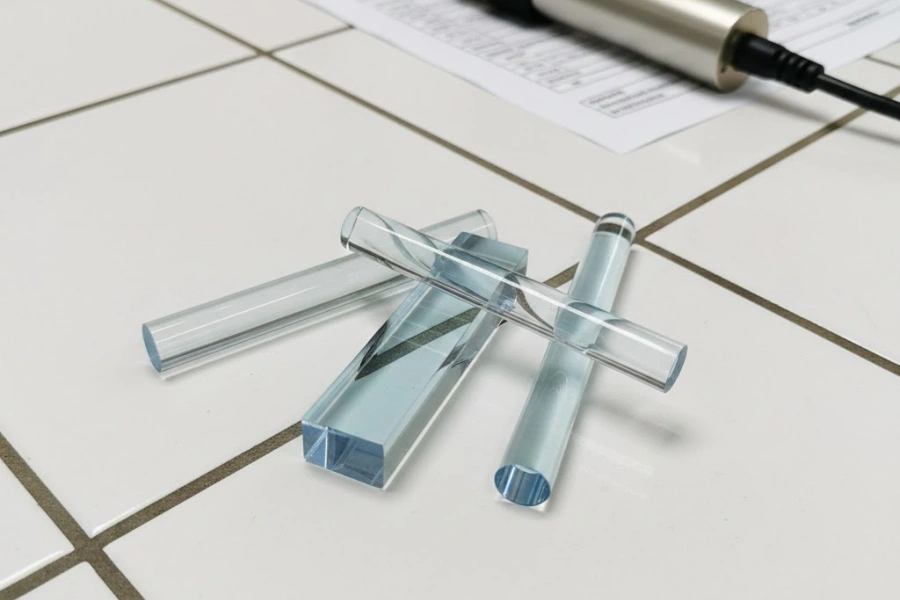
A quartz cuvette is a laboratory vessel made from high-purity fused silica, designed for use in spectrophotometers and analytical instruments.
Quartz is essential for UV spectroscopy because it transmits >90% of light in the 200–350 nm range, where glass and plastic absorb or distort signals.
Engineers and researchers rely on quartz cuvettes to ensure accurate, reproducible measurements in DNA/RNA quantification, protein analysis, and chemical assays.
Critical Optical Properties of Quartz Cuvettes: Transmission and Wavelength Range
The performance of a quartz cuvette is defined by its optical transmission, surface quality, and wavelength range.
| Property | Quartz Cuvette | Glass Cuvette | Plastic Cuvette |
|---|---|---|---|
| UV Transmission (220nm) | 90–92% | 10–30% | <5% |
| Wavelength Range (nm) | 200–2500 | 320–2500 | 340–900 |
| Surface Finish (RMS) | <5 nm | 10–20 nm | 20–50 nm |
Quartz cuvettes maintain high transmission and low background absorption across the UV-Vis-NIR spectrum. Always request batch-specific transmission spectra and surface finish data.
Optimal Applications for Quartz Cuvettes in Laboratory Settings
Quartz cuvettes are indispensable in applications requiring high sensitivity, purity, and repeatability.
- Nucleic acid quantification1: Accurate absorbance at 260 nm for DNA/RNA analysis.
- Protein crystallization2: Low background and chemical inertness support crystal growth.
- UV-Vis spectroscopy3: Reliable measurements across a wide wavelength range.
Engineers should match cuvette grade and path length to the specific assay and instrument.
How to Select the Right Quartz Cuvette Based on Your Experiment Type
Selecting the optimal quartz cuvette involves matching material, path length, and surface quality to your experimental needs.
- For UV assays, specify high-purity fused silica and request transmission data at target wavelengths.
- For high-throughput or disposable use, consider cost-benefit tradeoffs with glass or plastic.
- Always verify compatibility with solvents, acids, and cleaning protocols.
Expert Insight:
A common mistake is using standard glass cuvettes for UV applications, leading to up to 30% data error due to lower transmission; instead, verify quartz-specific certifications like ISO 13485 and always request spectral data sheets before purchase.
Key Advantages of Quartz Cuvettes Over Other Materials
Quartz cuvettes offer several advantages over glass and plastic, including:
- High UV transmission, enabling sensitive detection at low wavelengths.
- Superior chemical resistance, preventing leaching and contamination.
- High thermal stability, allowing repeated autoclaving and use in high-temperature protocols.
These properties make quartz cuvettes the preferred choice for critical laboratory and industrial applications.
Quartz vs. Glass vs. Plastic Cuvettes: A Performance Comparison Table
| Property | Quartz Cuvette | Glass Cuvette | Plastic Cuvette |
|---|---|---|---|
| UV Transmission (220nm) | 90–92% | 10–30% | <5% |
| Chemical Resistance | Excellent | Good | Variable |
| Max Temp (°C) | 1,200 | 500 | 120–150 |
| Reusability | High | Moderate | Low |
| Cost | High | Moderate | Low |
Quartz cuvettes are best for UV-sensitive, high-precision, and reusable applications. Glass is suitable for visible-light assays, while plastic is ideal for disposable, low-cost workflows.
Step-by-Step Guide to Choosing the Best Cuvette Material for Your Needs
- Define your assay wavelength: For UV (200–350 nm), choose quartz; for visible (400–700 nm), glass may suffice.
- Assess chemical compatibility: Use quartz for strong acids/bases or organic solvents.
- Consider reusability: Quartz is best for repeated use; plastic for disposables.
- Request supplier data: Always ask for transmission spectra, surface finish, and certification.
- Balance cost and performance: For critical assays, invest in quartz; for routine screening, glass or plastic may be adequate.
Key Factors to Consider When Purchasing Quartz Cuvettes
- Purity: Specify fused silica with OH content <10 ppm for UV work.
- Surface finish: Request RMS <5 nm and scratch-dig 10-5 or better.
- Certification: Require ISO 13485 or equivalent, plus batch-specific data.
- Supplier support: Look for technical consultation, rapid prototyping, and post-sale service.
How to Evaluate Suppliers for High-Quality Quartz Cuvettes
Supplier evaluation is critical for ensuring consistent quality and regulatory compliance.
- Certification: ISO 9001, ISO 13485, and relevant industry standards.
- Technical capability: Ability to provide custom path lengths, surface finishes, and grade certifications.
- Traceability: Batch numbers, production records, and test data for each delivery.
Reliable suppliers offer engineering consultation, rapid prototyping, and post-sale support.
Essential Quality Tests for Quartz Cuvettes Upon Delivery
- Transmission spectra analysis: Use spectrophotometry4 to verify UV-Vis-NIR transmission.
- Surface inspection: Check for scratches, chips, and surface roughness using profilometry.
- Dimensional accuracy: Measure path length and width to ensure instrument compatibility.
Transmission Spectra Analysis of Quartz Cuvettes
Request batch-specific transmission curves from suppliers. Compare measured data to specifications for your assay wavelength.
Cleaning Procedures for Different Contaminants
For routine cleaning, use acid baths (e.g., nitric acid) or ultrasonic cleaning. For organic residues, use hydrogen peroxide or piranha solution5. Rinse with deionized water and dry in a dust-free environment.
Avoid abrasive cleaners and HF unless specified. Inspect for microcracks and haze after each cleaning.
FAQ (Frequently Asked Questions)
What is the typical UV transmission rate for a quartz cuvette?
High-purity quartz cuvettes transmit 90–92% at 220nm and >90% at 254nm, far exceeding glass or plastic.
How do I clean and reuse quartz cuvettes?
Use acid baths or ultrasonic cleaning, rinse with deionized water, and inspect for cracks. Avoid abrasive cleaners and HF unless specified.
What certifications should I require from a quartz cuvette supplier?
Look for ISO 9001, ISO 13485, and batch-specific UV transmission and OH content data.
How does quartz compare to glass and plastic for UV assays?
Quartz offers higher UV transmission, lower background absorption, and greater durability, making it essential for demanding UV applications.
References:
-
Explore this link to understand various techniques for quantifying nucleic acids, essential for research and diagnostics. ↩
-
Explore this link to discover various techniques and tips for successful protein crystallization, essential for structural biology. ↩
-
Explore this link to understand the principles and diverse applications of UV-Vis spectroscopy in various fields. ↩
-
Understanding spectrophotometry is crucial for various scientific applications. ↩
-
Explore this link to understand the applications and safety measures associated with piranha solution, a powerful chemical mixture. ↩