
Quartz tube maximum pressure depends heavily on tube type. Standard quartz tubes reach an actual safe pressure of 30 MPa, while thick-walled quartz tubes withstand up to 49.3 MPa, according to manufacturer data.
Tube Type | Maximum Pressure (MPa) |
|---|---|
Standard Quartz | 30 |
Thick-Walled Quartz | 49.3 |
Safe use of quartz tubes requires attention to several factors:
Wall thickness and tube diameter
Operating temperature
Surface quality and certification
Engineers should always apply safety factors and consider real-world derating, not just rely on theoretical limits.
Key Takeaways
Standard quartz tubes can safely handle up to 30 MPa, while thick-walled tubes can withstand up to 49.3 MPa. Choose the right type based on your pressure needs.
Wall thickness and diameter significantly affect pressure resistance. Thicker walls provide better support for high-pressure applications.
Surface quality is crucial. Even small defects can reduce pressure limits by up to 50%. Regular inspections help maintain tube integrity.
Temperature impacts pressure resistance. At high temperatures, quartz tubes can lose up to 50% of their pressure capacity. Always check manufacturer guidelines.
Use safety factors of 3 to 5 times the expected pressure to ensure reliability. This helps protect against unexpected failures in high-pressure systems.
What Are the Standard Pressure Ratings for Common Quartz Tube Configurations?
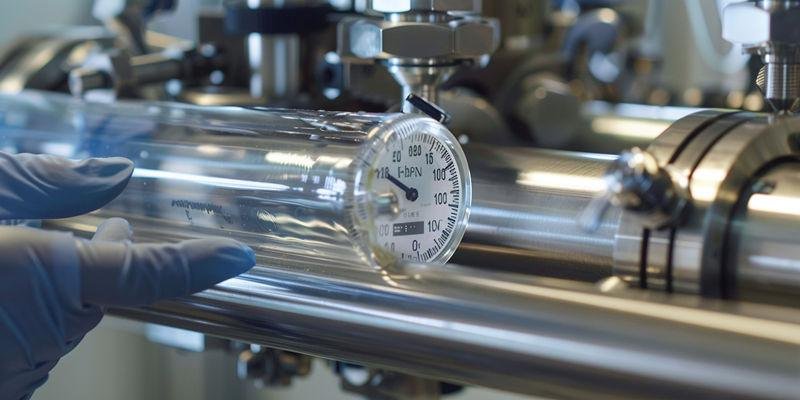
Quartz tube pressure ratings depend on wall thickness, diameter, and the intended application. Engineers use industry standards and formulas to determine the safe operating limits for each configuration. Understanding these ratings helps users select the right tube for high-pressure applications and ensures reliable performance.
Pressure Rating Categories: Low, Medium, and High-Pressure Tubes
Quartz tubes fall into three main pressure categories. Low-pressure tubes handle less than 1 MPa and serve in laboratory glassware and atmospheric furnaces. Medium-pressure tubes operate between 1 and 5 MPa, supporting controlled atmosphere processing and chemical vapor deposition reactors, while high-pressure quartz tubes exceed 5 MPa and suit sealed ampoule and research applications.
Engineers classify tubes based on pressure-handling capacity, which depends on wall thickness and diameter. Low-pressure tubes often use thin walls, while high-pressure applications require thick walls and smaller diameter-to-thickness ratios. These categories help users match tube selection to process requirements and safety standards.
Summary of Pressure Categories:
Low-pressure tubes: <1 MPa, thin walls, lab use
Medium-pressure tubes: 1–5 MPa, standard walls, reactors
High-pressure tubes: >5 MPa, thick walls, research
These categories guide users in choosing the right quartz tube for their specific pressure limits and applications.
Standard Wall Thickness Configurations and Their Pressure Limits
Wall thickness plays a critical role in determining quartz tube maximum pressure. Tubes with 2 mm walls typically withstand 0.5–0.7 MPa, while 5 mm walls support 1.5–3.5 MPa, according to industry standards and hoop stress calculations. High-pressure quartz tubes with extra-thick walls can reach maximum pressure ratings above 10 MPa for specialized uses.
Manufacturers provide tables showing pressure resistance for common wall thicknesses. For example, a tube with 3 mm wall thickness may have a static pressure limit of 5 MPa, while a 5 mm wall can handle up to 10 MPa. These ratings reflect both material strength and safety factors, ensuring reliable operation in high-pressure applications.
Wall Thickness (mm) | Maximum Pressure (MPa) | Typical Application |
|---|---|---|
2 | 0.5–0.7 | Low-pressure lab, furnace |
3 | 5 | Medium-pressure reactors |
5 | 10 | High-pressure processing |
8 | 0.4 | Specialized research |
This table highlights how increasing wall thickness improves pressure resistance and expands the range of high-pressure applications.
Diameter-to-Thickness Ratio Impact on Maximum Pressure
The diameter-to-thickness ratio directly affects quartz tube pressure resistance. Tubes with a low ratio (thicker walls compared to diameter) can handle higher internal pressures, while tubes with a high ratio (thin walls relative to diameter) have lower pressure limits. Engineers use the hoop stress formula, S = p × r / t, to calculate safe operating pressures.
Pressure resistance increases as wall thickness grows and inner diameter shrinks. For example, a tube with a 50 mm diameter and 5 mm wall thickness has a higher pressure-handling capacity than a tube with the same diameter and 2 mm wall thickness. This relationship guides tube selection for high-pressure applications, ensuring safety and durability.
Parameter | Description |
|---|---|
P | Maximum allowable internal pressure (MPa) |
t | Wall thickness (mm) |
D | Inner diameter (mm) |
σ | Tensile strength of quartz (~50 MPa) |
Engineers rely on these parameters to set pressure limits and optimize tube design for maximum pressure rating and reliable performance.
What Factors Reduce the Maximum Allowable Pressure Below Theoretical Limits?

Quartz tube maximum pressure often falls below theoretical values due to real-world conditions. Surface defects, high temperatures, and repeated pressure cycles all lower the allowable pressure of quartz tubes. Understanding these factors helps engineers select the right tube for high-pressure applications and maintain safe operation.
Surface Defect Severity and Stress Concentration Effects
Surface quality plays a major role in determining pressure resistance. Even small scratches or chips on a quartz tube can act as stress concentrators, causing local increases in dynamic stress and reducing the tube’s ability to withstand internal pressure. Deep scratches over 0.2 mm can lower pressure limits by 40-50%, making regular inspection essential for high-pressure applications.
Engineers have found that pristine tubes with a smooth finish (Ra <0.4μm) maintain higher pressure resistance, while tubes with visible flaws show a much lower allowable pressure of quartz tubes. Data from production testing shows that burst pressure drops from 3.2-4.5 times the working pressure in flawless tubes to just 1.8-2.3 times when surface defects are present. This reduction in pressure limits can lead to early failure, especially in high-pressure quartz tubes used for demanding processes.
Key Points:
Surface defects sharply reduce pressure resistance.
Deep scratches can cut pressure limits by up to half.
Routine inspection and careful handling extend tube life.
Temperature Derating Factors for Pressure Capacity
Temperature has a direct impact on pressure resistance and maximum temperature tolerance. As temperature rises, the quartz tube maximum pressure decreases due to changes in material strength and increased risk of deformation. At 1000°C, pressure limits typically drop to 40-50% of their room temperature value, and exceeding 1100°C for long periods can cause permanent deformation.
Manufacturers recommend derating pressure resistance at elevated temperatures. For example, at 500°C, pressure limits may decrease by 20%; at 800°C, by 35%; and at 1000°C, by 50%. High-pressure applications at these temperatures require thicker walls or lower operating pressures to maintain safety. Quartz tubes can handle up to 1100°C for long-term use and 1200°C for short-term use, but exceeding these limits risks structural failure.
Temperature (°C) | Pressure Resistance (% of Room Temp) | Causal Relationship |
|---|---|---|
500 | 80 | Higher temperature lowers pressure resistance |
800 | 65 | Material softening reduces pressure limits |
1000 | 50 | Deformation risk increases, pressure limits drop |
This table shows how temperature changes directly affect pressure resistance and pressure limits for high-pressure applications.
Pressure Cycling Fatigue Impact on Maximum Ratings
Repeated pressurization and depressurization cycles weaken quartz tubes over time. Each cycle introduces dynamic stress, which can cause microcracks and reduce pressure resistance. High-pressure applications that involve frequent cycling see a gradual drop in allowable pressure of quartz tubes.
Studies show that after 5,000 cycles, pressure resistance can decrease by 25-35%. Tubes exposed to more than 10,000 cycles may need a 15-20% reduction in pressure limits to prevent failure. Regular inspection and maintenance help detect early signs of fatigue and extend service life.
Summary for engineers:
Pressure cycling reduces pressure resistance over time.
High cycle counts require lower pressure limits.
Routine checks help maintain safe operation in high-pressure applications.
What Pressure Limits Apply to Vacuum Applications vs Positive Pressure?
Quartz tubes behave differently under vacuum and internal pressure conditions. Engineers must understand how compression and tension affect pressure resistance and safety margins. Comparing these two scenarios helps users select the right tube for high-pressure applications and maintain reliable performance.
Compression vs Tensile Stress in Vacuum Applications
Vacuum applications place quartz tubes under external pressure, causing the walls to experience compression instead of tension. This difference increases pressure resistance because quartz has a much higher compressive strength than tensile strength. In contrast, internal pressure creates tensile hoop stress, which limits the allowable pressure of quartz tubes and determines the quartz tube maximum pressure.
Engineers measure pressure-handling capacity by comparing compressive and tensile stress limits. For example, a standard tube with 2 mm walls safely operates under full vacuum (0.1 MPa external pressure differential) at temperatures up to 1200°C. The same tube under internal pressure would be limited to 0.5–0.7 MPa due to lower tensile strength. This data shows why vacuum tubes have higher safety margins and pressure resistance.
Summary of Key Points:
Compression increases pressure resistance in vacuum applications.
Tensile stress limits pressure resistance under internal pressure.
Vacuum tubes offer higher safety margins for high-pressure applications.
Buckling Instability Calculations for External Pressure
Buckling instability is a critical factor for quartz tubes under vacuum. Engineers use the Euler formula to calculate the critical buckling pressure, considering elastic modulus, Poisson’s ratio, diameter, and wall thickness. For a tube with a 10 mm outer diameter and 1 mm wall thickness, the theoretical critical buckling pressure reaches about 1.5 MPa, but practical safe pressure is less than 0.5 MPa due to geometric imperfections.
Pressure resistance depends on tube geometry and material properties. Safety factors typically range from 3 to 5 times the calculated buckling pressure to prevent failure. Data from field installations shows that tubes rated for 0.5 MPa internal pressure can safely operate under full vacuum, with buckling pressure far exceeding atmospheric pressure.
Parameter | Value | Causal Relationship |
|---|---|---|
Critical Buckling Pressure | 1.5 MPa | Calculated for ideal tube geometry |
Practical Safe Pressure | <0.5 MPa | Reduced by imperfections and safety margin |
Safety Factor | 3–5× | Ensures reliable pressure resistance |
This table highlights how buckling calculations guide tube selection and ensure safe operation in high-pressure applications.
Why Vacuum Tubes Can Use Thinner Walls Than Pressure Tubes
Engineers often select thinner walls for quartz tubes used in vacuum applications. Thinner walls maintain optical properties and reduce material costs while still providing adequate pressure resistance. Recommended minimum wall thickness is 2 mm or 1/20 of the outer diameter, which balances strength and thermal shock resistance.
Pressure limits for vacuum tubes allow greater design flexibility. By incorporating a design margin, engineers choose tubes with higher pressure resistance than the minimum requirement to accommodate unexpected stresses. This approach ensures that vacuum tubes remain safe and reliable even in demanding high-pressure applications.
Summary for tube selection:
Thinner walls are permissible for vacuum tubes.
Minimum wall thickness should be 2 mm or 1/20 OD.
Design margins improve pressure resistance and safety.
These recommendations help engineers optimize tube selection for both vacuum and internal pressure scenarios, ensuring long-term reliability.
What Quality Certifications Ensure Reliable Pressure Ratings?
Quality certifications play a vital role in verifying the pressure resistance and safety of quartz tubes in high-pressure applications. Manufacturers must follow strict standards to ensure each tube meets the required pressure ratings and pressure limits. These certifications help users trust the pressure-handling capacity and long-term reliability of their quartz tubes.
Hydrostatic Testing Requirements and Acceptance Criteria
Hydrostatic testing stands as a primary method for confirming quartz tube maximum pressure and pressure resistance. Manufacturers subject each tube to internal pressure well above its rated limit, holding this pressure for a set time to check for leaks or deformation. This process follows ASTM and ISO standards, which require a test pressure of at least 2.5 times the intended working pressure.
During testing, engineers monitor for any signs of failure, such as cracks or permanent changes in shape. Tubes that pass this test receive certification, which documents the actual test pressure, hold duration, and acceptance criteria. The documentation ensures that only tubes with proven pressure resistance enter high-pressure applications.
Standard | Description |
|---|---|
ASTM | American standard for testing and materials |
ISO | International standard ensuring quality and safety |
SEMI | International standard for semiconductor materials |
This table highlights the main standards guiding hydrostatic testing and acceptance for quartz tubes. Manufacturers rely on these certifications to guarantee safe pressure ratings and pressure limits.
Material Property Certification Standards
Material purity and mechanical strength directly affect the pressure resistance and pressure limits of quartz tubes. Certification standards require manufacturers to verify that each tube meets strict criteria for SiO₂ purity, tensile strength, and thermal shock resistance. ASTM and ISO standards specify minimum purity levels and mechanical properties to ensure reliable performance in high-pressure applications.
Manufacturers use advanced testing methods, such as ICP-MS for purity and tensile testing for strength, to confirm compliance. These tests ensure that the quartz tube maximum pressure aligns with the expected pressure ratings and pressure-handling capacity. Certification documents include test results, batch numbers, and compliance with standards like SEMI, ISO, and ASTM.
Key points for users:
High purity and strength ensure pressure resistance.
Certification confirms compliance with pressure limits.
Thermal shock resistance is essential for high-pressure applications.
These points help users identify certified tubes that will perform reliably under demanding conditions.
Dimensional and Surface Quality Documentation
Dimensional accuracy and surface quality play a crucial role in maintaining pressure resistance and pressure limits. Certified quartz tubes must meet strict tolerances for wall thickness, diameter, and surface finish. Documentation includes measurements taken at multiple points, ensuring uniformity and minimizing weak spots that could lower pressure ratings.
Manufacturers follow standards such as ISO 9001 for quality management and ASTM C100 for dimensional and purity requirements. Advanced techniques, including laser-assisted edge finishing and atomic force microscopy (AFM), validate surface quality and roughness. These processes align with ISO 10110 standards for optical components, further supporting reliable pressure resistance in high-pressure applications.
Standard | Purpose |
|---|---|
ISO 9001 | Quality management and traceability |
ASTM C100 | Dimensional and purity requirements |
This table summarizes the main standards for dimensional and surface quality documentation. Users should always request certification to verify that tubes meet the required pressure ratings and pressure limits for their intended use.
What Pressure Rating Should You Specify for Your Application?
Selecting the correct pressure rating for a quartz tube requires careful consideration of operating conditions and application needs. Engineers must define all relevant parameters before making a decision. This section explains how to build a checklist, choose safety factors, and use a decision matrix to ensure reliable pressure resistance and safe operation.
Application Parameter Definition Checklist
Engineers start by identifying the main criteria that affect pressure resistance and pressure limits. They consider factors such as thermal shock resistance, chemical resistance, purity standards, dimensional tolerances, and customization options. Each parameter plays a role in determining the quartz tube maximum pressure and overall pressure-handling capacity.
A detailed checklist helps users compare options and select tubes that meet specific requirements. For example, tubes must withstand temperature differences above 200°C and maintain integrity against acids and bases. High-purity quartz (≥99.995% SiO₂) ensures consistent pressure resistance, while precise sizing and customization support system compatibility.
Safety Factor Selection by Application Criticality
Engineers select safety factors based on the criticality of the application and risk assessment. They evaluate material purity, wall thickness, manufacturing process, and temperature effects to determine the appropriate margin for pressure resistance. For high-pressure applications, a wall thickness of at least 3-5 mm is recommended to maintain safe internal pressure.
Safety factors typically range from 3 to 5 times the expected pressure, depending on the risk level and process demands. Higher safety factors provide greater assurance against unexpected failures, especially in systems with frequent pressure cycling or elevated temperatures. This approach helps maintain pressure limits and ensures long-term reliability.
Key points for engineers:
Material purity and wall thickness affect pressure resistance.
Seamless tubes offer higher pressure-handling capacity.
Safety factors of 3-5× expected pressure protect against failure.
By following these guidelines, engineers can confidently specify pressure ratings that match the demands of their application.
Specification Decision Matrix for Pressure Ratings
A decision matrix helps engineers select the right quartz tube for their application by comparing pressure resistance, pressure limits, and pressure ratings. They use data on operating pressure, temperature, and cycle count to choose the best configuration. The matrix simplifies the selection process and ensures that each tube meets the required pressure-handling capacity.
Engineers match application parameters to recommended tube specifications, adjusting for safety factors and real-world conditions. For example, a tube used at 1 MPa and 800°C may require a medium wall thickness and a safety factor of 4. Tubes exposed to more than 10,000 cycles need additional derating to maintain safe pressure limits.
Quartz tube maximum pressure depends on many factors, including wall thickness, internal pressure, and tube design. Industry experts recommend always considering pressure limits, pressure ratings, and pressure resistance when selecting tubes for high-pressure environments. Testing methods such as burst testing, standardized testing, and cyclic pressure testing help verify pressure resistance and pressure-handling capacity.
Testing Method | Description |
|---|---|
Burst Testing | Tube faces increasing internal pressure until failure to find maximum limit. |
Standardized Testing | Assesses tube performance under different pressure conditions. |
Cyclic Pressure Testing | Repeats pressure cycles to check long-term pressure resistance. |
Quartz tubes offer excellent pressure resistance, high thermal stability, and reliable pressure ratings. Users should always check certifications, use proper safety margins, and inspect tubes regularly. For critical applications, consulting manufacturers or experts ensures pressure limits and pressure resistance meet all requirements.
FAQ
What determines the pressure resistance of a quartz tube?
Pressure resistance depends on wall thickness, tube diameter, surface quality, and temperature. Engineers use these factors to select tubes for specific applications. Regular inspection helps maintain pressure resistance over time.
How does temperature affect pressure resistance in quartz tubes?
Temperature reduces pressure resistance. At 1000°C, quartz tubes may lose up to 50% of their original pressure resistance. Users should always check manufacturer data for safe operating limits at high temperatures.
Why do surface defects lower pressure resistance?
Surface defects create stress points that weaken pressure resistance. Deep scratches or chips can reduce pressure resistance by up to 50%. Careful handling and inspection help prevent early tube failure.
Can pressure resistance change after repeated use?
Pressure resistance decreases with repeated pressure cycles. After 5,000 cycles, quartz tubes may lose 25-35% of their pressure resistance. Routine checks help detect fatigue and maintain safe operation.
What certifications verify pressure resistance in quartz tubes?
Manufacturers use hydrostatic testing and material analysis to certify pressure resistance. Certification documents confirm that each tube meets strict standards for pressure resistance, purity, and dimensional accuracy.