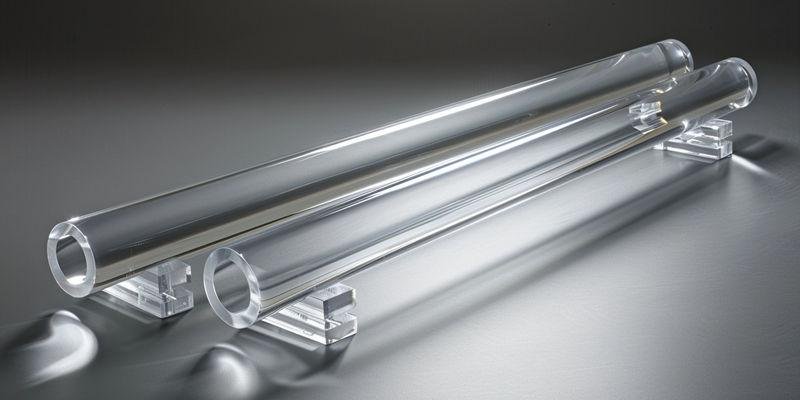
Application-specific requirements drive quartz vs glass tube application selection. Engineers and scientists often prioritize factors like temperature tolerance, purity, optical transmission, and chemical resistance when choosing materials for their applications. The table below highlights the most critical performance criteria:
Performance Requirement | Description |
|---|---|
Thermal Stability | Quartz tubes can withstand temperatures up to 1,050°C and have a melting point of about 1,710°C. |
UV Transparency | They exhibit excellent UV transmission, essential for applications like UV sterilization. |
Chemical Resistance | Quartz is chemically inert and highly resistant to most acids, bases, and solvents. |
Contamination Limits | High purity levels are crucial for semiconductor manufacturing to minimize contamination. |
Key Takeaways
Quartz tubes withstand temperatures up to 1200°C, making them ideal for high-temperature applications.
Glass tubes can leach sodium and boron, increasing contamination risks in semiconductor processes.
Quartz tubes maintain ultra-high purity, leading to improved yield rates of 12-18% in semiconductor manufacturing.
For UV applications, quartz transmits over 90% of UV light, while glass blocks nearly all UV, making quartz essential for accurate measurements.
Selecting the right tube material based on temperature and purity ensures reliable performance and reduces maintenance costs.
How Do Semiconductor Fabrication Temperature and Purity Requirements Drive Quartz Versus Glass Selection?
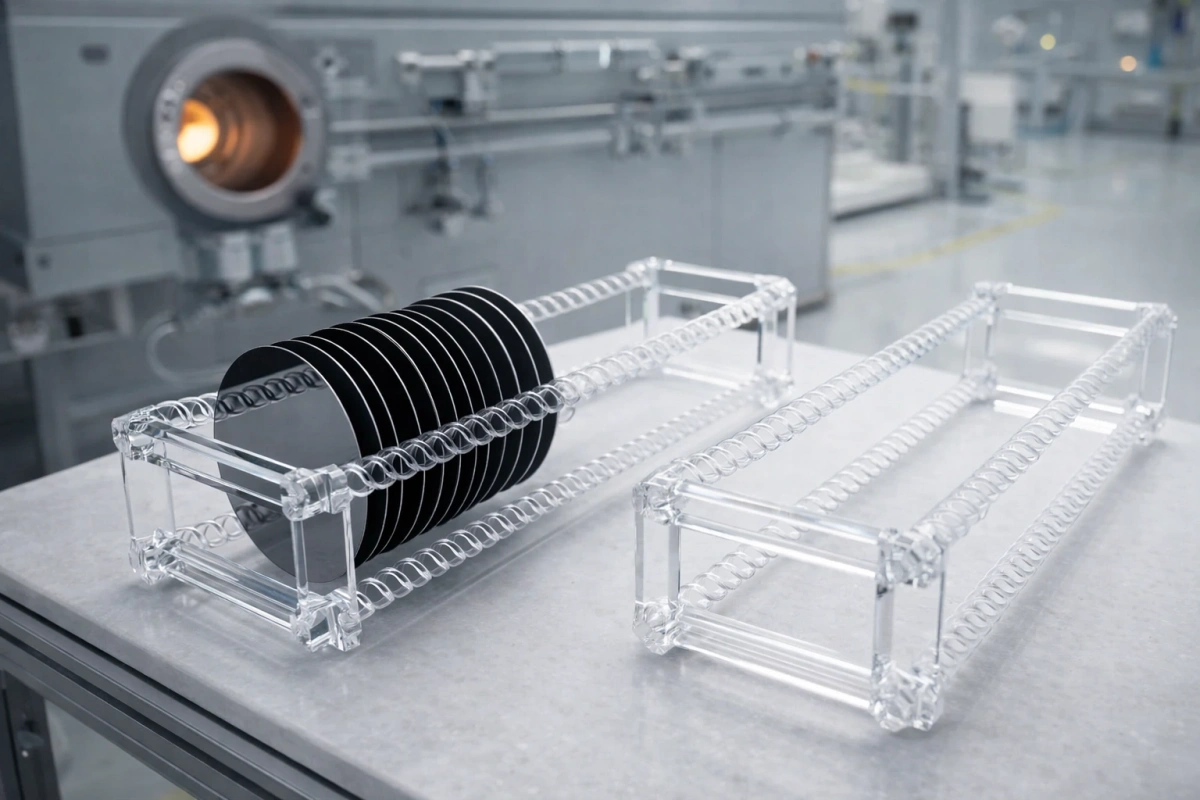
Semiconductor fabrication places strict demands on material performance. Engineers must consider both temperature and purity when selecting tubes for these applications. The choice between quartz and glass tubes directly impacts process reliability and product yield.
Borosilicate Glass Failing at 1050°C Versus Quartz Succeeding Through Pure Silica Composition
Borosilicate glass tubes cannot withstand the high temperatures required in semiconductor diffusion furnaces. Quartz tubes, made from fused silica or fused quartz, maintain structural integrity at temperatures up to 1100°C for long-term use and can tolerate short-term spikes to 1200°C. This difference in thermal stability results from the pure silica composition of quartz, which resists deformation and maintains dimensional accuracy.
The coefficient of thermal expansion further separates these materials. Fused silica exhibits a much lower expansion rate than borosilicate or soda-lime glass, reducing the risk of cracking or warping during rapid heating and cooling cycles. The following table highlights these differences:
Glass Type | Coefficient of Thermal Expansion (10⁻⁶ /K) |
|---|---|
Fused Silica | 0.55 |
Borosilicate | 3.25 |
Soda-Lime Glass | 9.0 |
Quartz tubes enable high-temperature applications in semiconductor processing, while glass tubes often fail due to their lower temperature limits. This performance gap makes quartz the preferred choice for critical processes.
Sodium Contamination from Glass Creating 100-1,000× Higher Defect Rates
Glass tubes introduce significant contamination risks in semiconductor environments. Sodium and boron, present in borosilicate and soda-lime glass, can leach into the process atmosphere and deposit on wafers. This contamination leads to higher defect rates, which directly reduces device yield.
Time-of-flight secondary ion mass spectrometry (TOF-SIMS) analysis shows that glass tubes release 100 to 1,000 times more sodium than quartz tubes. Even trace amounts of sodium can cause electrical failures in microelectronic devices. The following key points summarize the impact:
Glass tubes release sodium and boron, increasing contamination.
Quartz tubes maintain ultra-high purity, minimizing defect rates.
Yield improvements of 12–18% have been observed when switching to quartz.
For quartz vs glass tube application selection, purity and contamination control remain decisive factors. Semiconductor manufacturers consistently choose quartz tubes to protect product quality.
Semiconductor Cleanroom Requirements Mandating Quartz Over Glass
Cleanroom standards in semiconductor fabrication require materials that do not introduce particles or chemical impurities. Quartz tubes meet these requirements due to their high purity and chemical resistance. Glass tubes, by contrast, often fail to meet the strict contamination and cleanliness standards.
The maximum operating temperature for quartz tubes in cleanroom applications typically ranges from 1100°C to 1200°C, while glass tubes rarely exceed 300°C even under exceptional conditions. The table below compares these limits:
Material | Maximum Operating Temperature |
|---|---|
Quartz Tubes | 1100–1200°C |
Glass Tubes |
Semiconductor cleanrooms mandate quartz tubes for high-temperature and high-purity processes. This requirement ensures consistent device performance and reduces the risk of costly failures.
Why Do Laboratory UV-Visible Applications Require Quartz Over Glass Based on Compositional Transparency?
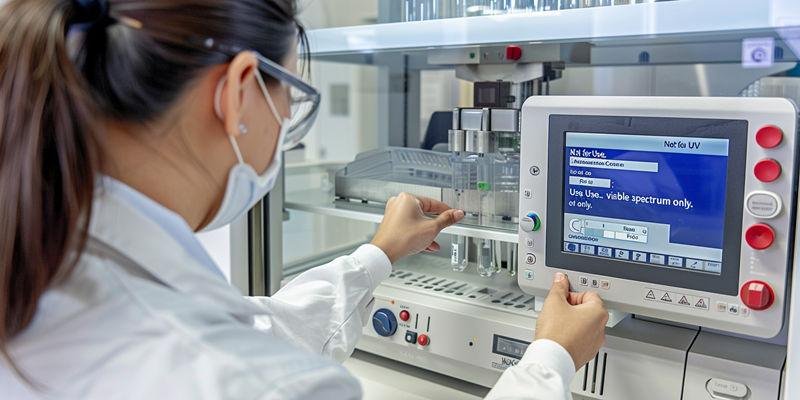
Laboratory UV-visible applications demand precise optical transmission and minimal background interference. The choice between quartz tubes and glass tubes directly affects measurement accuracy and sensitivity. Understanding the impact of material composition on UV transparency and purity helps scientists select the right tubes for their analytical needs.
Iron Content in Glass Blocking UV Versus Ultra-Pure Quartz Enabling Transmission
Iron content in glass tubes blocks ultraviolet light, especially below 320 nm. As iron levels rise from 10 to 200 ppm, UV absorption increases, causing significant measurement errors in trace analysis. Fused silica and fused quartz tubes, with iron content below 5 ppm, allow high UV transmission and accurate results.
Quartz tubes transmit over 90% of light from 200 nm to 2500 nm, while ordinary glass tubes block most UV radiation below 320 nm. This difference in optical transmission ensures that quartz tubes support sensitive applications such as DNA and protein quantification at 260 nm and 280 nm. Laboratories rely on quartz tubes for reliable UV-visible spectroscopy because glass tubes cannot provide the required transparency.
Material | Wavelength Range | UV Transparency |
|---|---|---|
Optical Glass | ~340 nm to 2,500 nm | Poor below 340 nm |
UV-Grade Quartz | ~190 nm to 2,500 nm | Excellent below 320 nm |
Boron Background Interference from Glass Versus Sub-ppb Detection with Quartz
Boron in glass tubes creates background interference that limits detection of weak signals in laboratory spectroscopy. Pyrex glass tubes often introduce high background levels, which obscure signals from boron-containing compounds. Quartz tubes, with extremely low boron content, enable sub-ppb detection and improve analytical sensitivity.
This difference in purity allows scientists to achieve lower detection limits and more accurate results in trace analysis. Quartz tubes minimize chemical interference, making them essential for applications that require high sensitivity and low background noise. Laboratories performing ICP-MS or trace metal analysis benefit from the superior purity of quartz tubes.
Quartz tubes enable sub-ppb detection for trace analysis.
Glass tubes introduce boron background, reducing sensitivity.
High purity in quartz tubes supports demanding laboratory applications.
Wavelength-Dependent Material Selection for Analytical Instrumentation
Material selection for analytical instrumentation depends on the required wavelength range and chemical resistance. Quartz tubes withstand solvents and reagents that would damage glass tubes, and they maintain over 90% UV transmission even at high thermal loads. Fused silica transmits light down to 190 nm, making it ideal for DNA and RNA quantification.
Quartz vs glass tube application selection becomes critical when UV measurements below 320 nm are necessary. For visible-only applications, glass tubes offer cost advantages, but they cannot match the optical or chemical performance of quartz tubes. Analytical labs choose quartz tubes for applications that demand high purity, broad wavelength coverage, and reliable optical transmission.
Tube Type | UV Transmission Below 320 nm | Chemical Resistance | Suitable Applications |
|---|---|---|---|
Quartz Tubes | Excellent | High | UV-Vis, trace analysis |
Glass Tubes | Poor | Moderate | Visible-only, general lab |
How Do Industrial Furnace Temperature Stability Requirements Compare Quartz Versus Glass Performance?
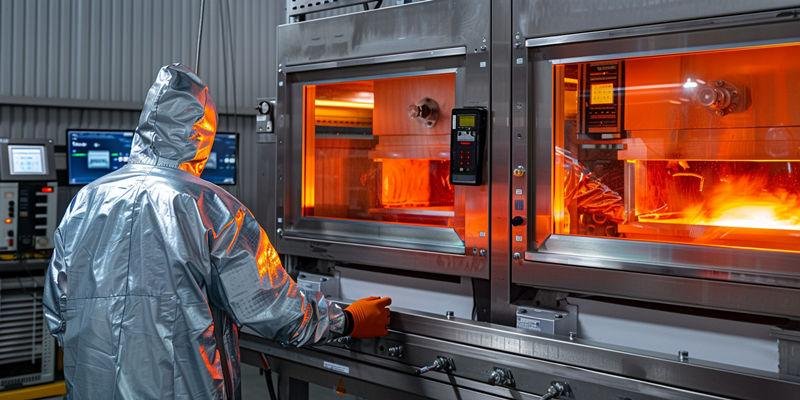
Industrial furnaces operate under extreme conditions that challenge the durability of materials. Engineers must select tubes that maintain structural integrity and resist deformation at high temperatures. The choice between quartz tubes and glass tubes depends on the application's temperature range, atmosphere, and service life expectations.
Viscous Flow in Glass Above 700°C Versus Dimensional Stability in Quartz at 1200°C
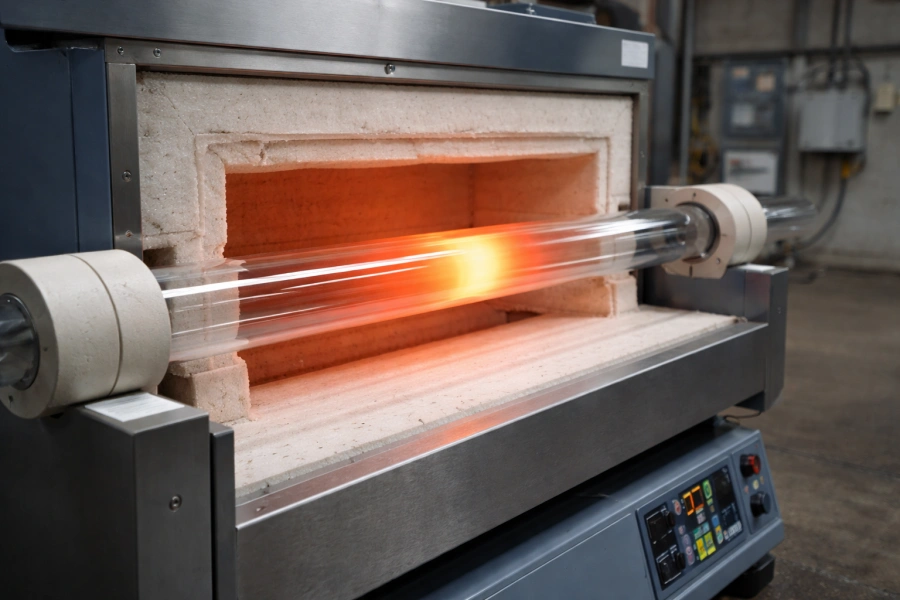
Glass tubes begin to soften and lose shape when exposed to temperatures above 700°C. This viscous flow leads to sagging and dimensional changes, which can compromise furnace performance. Quartz tubes, including fused silica and fused quartz, maintain their form and stability up to 1200°C, making them ideal for demanding applications.
The difference in dimensional stability arises from the materials' composition and structure. Standard glass tubes have lower structural integrity at high temperatures, while quartz tubes resist deformation due to their pure silica network. The following table highlights the temperature thresholds and stability characteristics:
Material | Viscous Flow Temperature | Dimensional Stability |
|---|---|---|
Standard Glass | Begins to soften at lower temperatures | Lower structural integrity at high temperatures |
Quartz Glass | Viscous flow above 1665°C | Maintains integrity up to 1200°C and beyond |
Quartz vs glass tube application selection for industrial furnaces often favors quartz tubes because they deliver reliable performance and prevent costly failures.
Glass Transition Temperature Limiting Borosilicate Service Range
Borosilicate glass tubes have a glass transition temperature (Tg) around 525°C. Above this point, atomic movement increases, causing the tubes to deform and lose mechanical strength. This limitation restricts borosilicate glass tubes to applications below 650°C, especially in oxidizing or inert atmospheres.
Engineers choose quartz tubes for processes that require higher thermal stability and purity. Fused quartz withstands rapid temperature changes and maintains its shape, even in high-stress environments. The following points summarize the impact of glass transition temperature:
Borosilicate glass tubes deform above 525°C.
Quartz tubes remain stable up to 1200°C.
Applications above 700°C require quartz tubes for safety and reliability.
Selecting the right tubes ensures consistent furnace operation and reduces maintenance costs.
Service Life Advantage: 18-36 Months for Quartz Versus 3-8 Months for Glass
Service life is a critical factor in industrial furnace applications. Quartz tubes typically last 18 to 36 months in continuous operation at high temperatures, while glass tubes often require replacement after only 3 to 8 months. This difference results from quartz's superior thermal and chemical resistance.
Longer service life reduces downtime and replacement expenses. Quartz tubes maintain purity and resist chemical attack, which extends their operational lifespan. The table below compares the maximum temperature and thermal stability of each material:
Material | Maximum Temperature | Thermal Stability Characteristics |
|---|---|---|
Quartz Tubes | Up to 1200°C (2192°F) | Excellent thermal stability, withstands rapid temperature changes without cracking. |
Glass Tubes | Up to 500°C (932°F) | Lower thermal resistance, prone to cracking under rapid temperature changes. |
Engineers often select quartz tubes for critical furnace applications to maximize reliability and minimize total cost of ownership.
How Do Chemical Processing Acid Resistance Requirements Determine Quartz Versus Glass Material Choice?
Chemical processing environments often expose tubes to aggressive acids and harsh reagents. Engineers must evaluate chemical resistance, service life, and contamination risks when choosing between quartz tubes and glass tubes. The right material selection ensures process reliability and protects product purity in specialized applications.
Service Life in Concentrated Acids: 10,000-15,000 Hours for Quartz Versus 800-1,500 for Glass
Quartz tubes deliver exceptional chemical resistance in concentrated acids, supporting continuous operation for 10,000 to 15,000 hours. Glass tubes, by comparison, typically last only 800 to 1,500 hours before significant degradation occurs. This difference in service life results from the unique structure of fused silica, which resists acid attack far better than standard glass.
Field data from chemical processing plants show that quartz tubes maintain structural integrity and dimensional stability even in 98% sulfuric acid, while glass tubes suffer from surface etching and rapid thinning. The extended lifespan of quartz reduces replacement frequency and minimizes costly downtime. For facilities running high-acid processes, this durability translates into significant operational savings.
Key Takeaways:
Quartz tubes last up to 15× longer in concentrated acids.
Glass tubes require frequent replacement due to chemical attack.
Longer service life reduces maintenance and downtime costs.
Alkali Leaching from Glass Creating Contamination Versus Pure Quartz Maintaining Purity
Glass tubes contain alkali metals that leach into process streams during acid exposure. This leaching introduces unwanted contamination, which can compromise product quality in specialized applications. Pure quartz tubes, made from fused silica, maintain chemical purity and prevent alkali release.
Studies reveal that glass tubes can increase sodium and potassium levels in acids by 5–20 ppm after only 500 hours of use. In contrast, quartz tubes keep contamination below 0.1 ppm, even after thousands of hours. This difference is critical for industries where purity standards are strict, such as pharmaceuticals and electronics.
Material | Alkali Leaching (ppm after 500h) | Maintains Purity? |
|---|---|---|
Glass Tubes | 5–20 | No |
Quartz Tubes | <0.1 | Yes |
This data-driven comparison highlights why quartz vs glass tube application selection matters for chemical processing.
Acid Processing Application Thresholds: >50% Concentration Requiring Quartz
Acid concentration directly influences material choice for tubes in chemical processing. When acids exceed 50% concentration, only quartz tubes provide the necessary chemical resistance and purity. Glass tubes fail rapidly under these conditions, leading to contamination and equipment failure.
Engineers set clear thresholds for material selection based on acid strength and process requirements. For applications involving dilute acids or neutral solutions, glass tubes may offer a cost-effective option. However, for high-concentration acids, quartz tubes remain the industry standard.
Quartz tubes withstand acids above 50% concentration.
Glass tubes are suitable for mild or dilute acids only.
Selecting the right material prevents contamination and extends equipment life.
How Do Optical System UV and Infrared Requirements Dictate Quartz Versus Glass Tube Selection?
Optical systems often require tubes that deliver precise transmission of ultraviolet and infrared light. Engineers must evaluate temperature, purity, and cycling demands to select the right material for these specialized applications. Quartz tubes and glass tubes offer different thermal properties and optical performance, making material choice critical for high-tech applications.
UV Sterilization Requiring Quartz: 85-92% Transmission Versus <5% for Glass
UV sterilization systems rely on tubes that allow ultraviolet light to pass through efficiently. Quartz tubes transmit 85–92% of UV light, while glass tubes block almost all UV, with less than 5% transmission. This difference results from the high-purity silica composition in quartz, which lacks the impurities found in glass.
Engineers choose quartz tubes for demanding environments where UV sterilization is essential. The high performance materials ensure that UV energy reaches its target, supporting effective disinfection in medical, laboratory, and water treatment applications. Data shows that quartz tubes maintain more than 90% UV transmittance, while glass tubes cannot penetrate UV wavelengths, making them unsuitable for these applications.
Quartz tubes transmit 85–92% of UV light.
Glass tubes block nearly all UV, with less than 5% transmission.
High-purity silica enables reliable sterilization in specialized applications.
Infrared Heating Applications: Low-OH Quartz Enabling 85-90% Versus High-OH Blocking 60-80%
Infrared heating systems require tubes that can withstand high temperatures and transmit infrared energy efficiently. Low-OH quartz tubes enable 85–90% infrared transmission, while high-OH glass tubes block 60–80% of infrared light. The purity and structure of fused silica allow quartz tubes to resist thermal shock and maintain stable performance.
Manufacturers design low-OH quartz tubes for applications that demand consistent infrared heating, such as semiconductor processing and industrial furnaces. These tubes provide superior thermal properties and chemical resistance, supporting long service life in harsh conditions. In contrast, glass tubes lose efficiency due to higher hydroxyl content and lower purity, which limits their use in high-performance infrared systems.
Material | Infrared Transmission | Thermal Shock Resistance | Service Life |
|---|---|---|---|
Low-OH Quartz | 85–90% | Excellent | Long |
High-OH Glass | 60–80% | Moderate | Short |
Engineers select quartz tubes for infrared heating in demanding environments, ensuring reliable operation and reduced maintenance.
Laser Beam Quality: Quartz Index Uniformity ±0.0001 Versus Glass ±0.0005-0.002
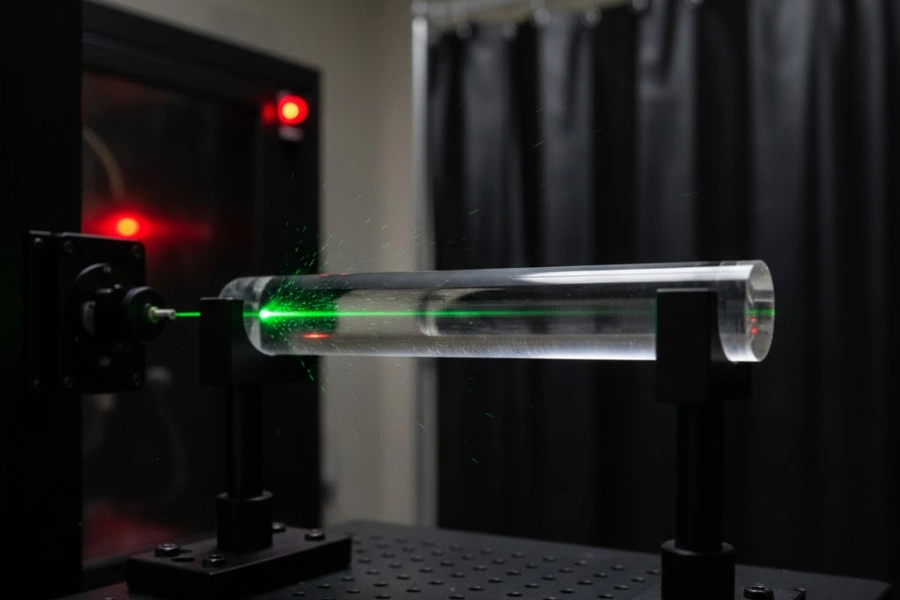
Laser systems require tubes with precise optical properties to maintain beam quality. Quartz tubes offer index uniformity of ±0.0001, while glass tubes vary from ±0.0005 to 0.002. This uniformity in quartz tubes results from their high purity and consistent structure, which minimizes distortion and supports accurate laser transmission.
High-tech applications such as medical lasers and scientific instrumentation depend on quartz tubes to deliver stable and focused beams. The superior purity and thermal stability of fused silica prevent optical aberrations, ensuring consistent performance over time. Glass tubes, with greater index variation, can cause beam spreading and reduce system accuracy.
Property | Quartz Tubes | Glass Tubes |
|---|---|---|
Index Uniformity | ±0.0001 | ±0.0005–0.002 |
Purity | High-purity silica | Lower purity |
Beam Quality | Excellent | Variable |
Engineers rely on quartz tubes for specialized applications that demand precise laser beam control and high performance materials.
Tip: For optimal results in optical systems, engineers should use a decision matrix that considers temperature, purity, optical transmission, and cycling requirements. Consulting with manufacturers for application engineering support helps match the right tube material to each system’s needs.
Selecting quartz or glass tubes depends on temperature, purity, and chemical resistance needs. Engineers use decision frameworks to match tube properties to each application. The table below highlights important differences:
Tube Type | Key Properties | Application Considerations |
|---|---|---|
Quartz | High thermal resistance, low thermal expansion | Suitable for high-temperature applications |
Glass | Lower thermal resistance, more chemical reactivity | Ideal for less demanding environments |
Quartz tubes offer superior resistance to thermal shock and chemical corrosion. Glass tubes provide cost savings for moderate requirements. Careful material selection prevents failures and helps optimize both performance and budget.
FAQ
What is the main factor when choosing between quartz and glass tubes?
Engineers look at temperature, purity, and optical needs first. Quartz handles higher temperatures and offers better purity. Glass works for less demanding uses.
How does chemical resistance differ between quartz and glass tubes?
Quartz resists most acids and bases, lasting up to 15,000 hours in harsh chemicals. Glass tubes often degrade after 800 to 1,500 hours. This difference affects long-term reliability.
Why do laboratories prefer quartz tubes for UV applications?
Quartz transmits over 90% of UV light below 320 nm. Glass blocks most UV, making it unsuitable for sensitive measurements. This property supports accurate results in spectroscopy.
When does glass become a cost-effective alternative to quartz?
Glass tubes cost 60–70% less than quartz. They suit applications below 600°C or where purity is not critical. Facilities often choose glass for general lab or moderate-temperature uses.
What is the best way to approach quartz vs glass tube application selection?
Engineers should match tube properties to process needs. They consider temperature, purity, and optical requirements. This approach ensures the right material supports performance and budget goals.