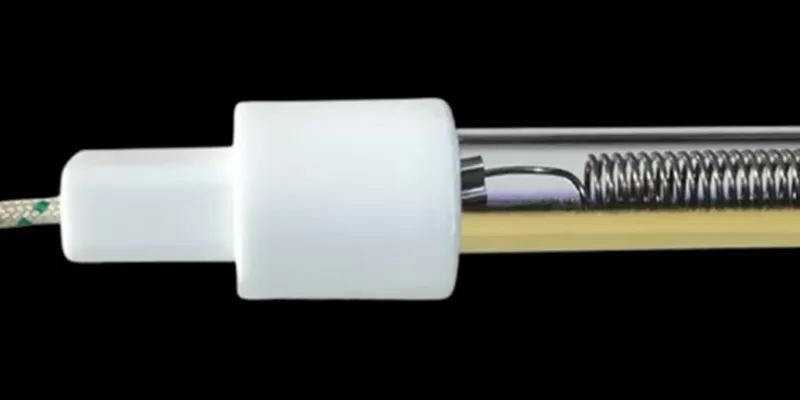
Quartz tubes heating elements deliver optimal efficiency by emitting infrared wavelengths that align with the absorption peaks of target materials. Matching the emission to each material’s heat absorption factor leads to faster heating times, improved energy efficiency, and better control.
Engineers can achieve up to 25% energy savings by optimizing wavelength performance.
Uniform heating minimizes overheating risks and supports consistent results in applications like paint drying or glass tempering.
Key Takeaways
Quartz tubes emit infrared energy efficiently, achieving over 95% transmission, which leads to faster heating and energy savings.
Engineers can save up to 25% on energy costs by matching the quartz tube's wavelength to the absorption needs of materials.
Using low-OH quartz improves heating performance for water-based applications, enhancing energy efficiency and reducing drying times.
Selecting the right coil temperature is crucial for maximizing the efficiency and lifespan of quartz heating elements.
Quality standards like ASTM E903 ensure quartz tubes deliver consistent performance, helping engineers achieve reliable heating results.
What Infrared Wavelength Range Do Quartz Tube Heating Elements Emit?
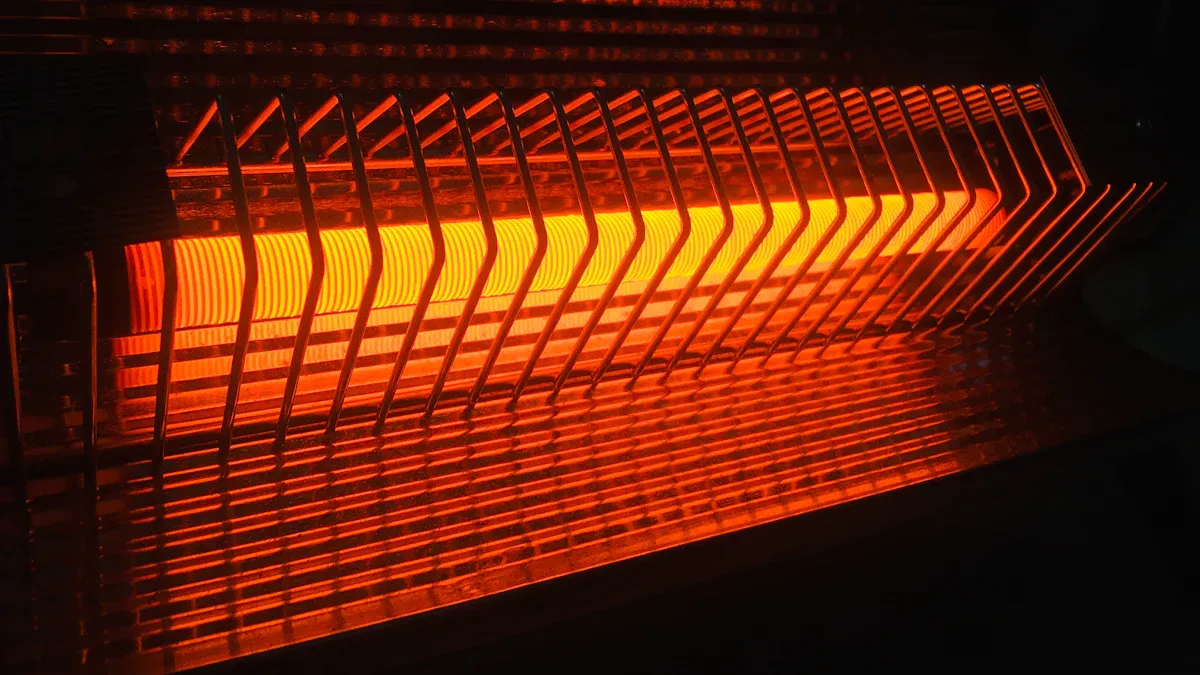
Quartz tubes heating elements produce infrared energy that targets specific material absorption bands. The wavelength range they emit depends on the coil temperature and the quartz tube’s transmission properties. Understanding this relationship helps engineers maximize heating efficiency for different industrial processes.
Wien's Law: Calculating Peak Wavelength from Tube Operating Temperature
Wien’s Law allows engineers to predict the peak emission wavelength of a heating element based on its operating temperature. When the coil inside quartz tubes heating elements heats up, it emits infrared radiation with a peak wavelength that shifts as the temperature changes. This relationship helps engineers select the right coil temperature for each application.
The table below shows how peak wavelength changes with temperature:
Peak Wavelength (μm) | Wave Type | |
|---|---|---|
Up to 1,500 | 1.6 | Medium Wave Infrared |
Up to 2,600 | 1.0 | Short Wave Infrared |
By using Wien’s Law, engineers can match the emission spectrum of quartz tubes heating elements to the absorption bands of target materials. This approach ensures that most of the emitted energy is absorbed, leading to faster heating and improved efficiency.
Quartz Tube Transmission Characteristics Across IR Spectrum (ASTM E903)
Quartz tubes heating elements rely on the high infrared transmission of quartz glass to deliver energy efficiently. ASTM E903 testing shows that high-purity quartz tubes transmit more than 95% of infrared energy in the 0.25 to 4.5 micron range. This high transmission rate means that nearly all the energy generated by the coil reaches the material being processed.
Ceramic tubes, by comparison, absorb a significant portion of infrared energy, which reduces overall system efficiency. Quartz’s amorphous structure and wide electronic bandgap allow infrared radiation to pass through with minimal loss. This property makes quartz tubes heating elements ideal for applications that require precise and efficient heating.
Key points for engineers:
Quartz tubes transmit >95% IR energy (0.25–4.5 μm)
Ceramic tubes absorb 40–60% of IR, lowering efficiency
High transmission supports faster, more uniform heating
Material Absorption Bands and Wavelength Matching Requirements
Different materials absorb infrared energy at specific wavelengths. Water, polymers, and plastics have strong absorption bands in the medium-wave to long-wave infrared range. Quartz tubes heating elements can be tuned to emit at these wavelengths by adjusting the coil temperature, which maximizes energy absorption and heating speed.
The emission spectrum of quartz tubes heating elements includes a short-wave band below 3 microns, which is not present in ceramic emitters. This feature allows quartz tubes to heat materials like water and certain polymers more efficiently. Matching the emission wavelength to the material’s absorption band can improve absorption efficiency to 85–92%, as shown by ASTM E903 and TOQUARTZ field data.
Material | Absorption Band (μm) | Optimal Emission (μm) |
|---|---|---|
Water | 2.7–3.2 | 2.7–3.2 |
Polymers/Plastics | 3.4–4.5 | 3.4–4.0 |
How Does Quartz Glass Transmission Enable Superior Heating Element Performance?

Quartz glass stands out as a material for heating elements because it transmits infrared energy with remarkable efficiency. This property allows more heat to reach the target material, improving both speed and uniformity of heating. Engineers often choose quartz tubes heating elements for applications where precise temperature control and energy savings matter most.
Quartz vs. Ceramic IR Transparency Comparison Data
Quartz glass transmits infrared energy much better than ceramic materials. Most of the infrared energy generated by the heating coil passes through quartz, while ceramics absorb a large portion and reduce system efficiency. This difference means that quartz tubes heating elements can deliver more usable heat to the process zone.
A comparison of infrared transparency shows clear advantages for quartz:
Material | IR Transmission (%) | Efficiency Impact |
|---|---|---|
Quartz | >95 | Maximum energy delivered |
Ceramic | 45–60 | Significant energy loss |
Key Takeaways:
Quartz glass achieves over 95% IR transparency.
Ceramic alternatives absorb much more IR, lowering efficiency.
Quartz heaters provide higher efficiency and more uniform heating.
OH Content Impact on 2.7-2.8 Micron Transmission in Heating Tubes
The amount of hydroxyl (OH) groups in quartz glass affects how well it transmits infrared energy at certain wavelengths. Low-OH quartz maintains high transmission at 2.7–2.8 microns, which is important for heating water-based materials. High-OH quartz absorbs more energy at these wavelengths, reducing heating performance.
Engineers select low-OH quartz for applications that require efficient heating at these critical wavelengths. This choice ensures that most of the infrared energy reaches the material, speeding up processes like drying and curing. Field data shows that low-OH quartz tubes heating elements can improve process speed by up to 22% and lower energy use by nearly 28%.
Summary of OH Content Impact:
Low-OH quartz: 85–92% transmission at 2.7–2.8 microns
High-OH quartz: 50–65% transmission at the same wavelengths
Low-OH quartz supports faster, more efficient heating
Amorphous Structure Advantages for Infrared Energy Transfer
Quartz glass has an amorphous structure, which means it lacks the grain boundaries found in ceramics. This structure allows infrared energy to pass through with little scattering or absorption. As a result, quartz delivers more consistent and uniform heating across the entire surface.
The high electronic bandgap of quartz also prevents unwanted interactions with infrared photons, further boosting its transparency. Field tests show that quartz heaters maintain better temperature uniformity and thermal insulation than ceramic heaters. This uniformity leads to improved product quality and reduced energy waste.
Property | Quartz | Ceramic |
|---|---|---|
Structure | Amorphous | Crystalline |
IR Scattering | Minimal | Significant |
Temperature Uniformity | High | Lower |
Which Coil Temperature Ranges Optimize Quartz Tube Heating Element Applications?
Selecting the right coil temperature range is essential for maximizing the efficiency and lifespan of quartz tubes heating elements. Different applications, such as coating, drying, and thermoforming, require specific temperature settings to achieve optimal results. Understanding the relationship between coil material, temperature, and power density helps engineers design systems that deliver consistent performance.
Nichrome Coil Temperature Ranges for Medium-Wave Applications
Nichrome coils serve as the standard for medium-wave infrared heating in industrial processes. These coils operate best within a temperature range of 1200°C to 1400°C, which suits applications like coating, drying, and thermoforming. Engineers often choose nichrome because it provides stable performance and a long service life.
The type of nichrome wire determines the maximum safe operating temperature. For example, Nichrome 60 can reach up to 1150°C, while Nichrome 80 can handle up to 1180°C. These temperatures allow for efficient energy transfer and reliable operation over thousands of hours.
Nichrome Type | Max Operating Temp (°C) | Max Operating Temp (°F) |
|---|---|---|
Nichrome 60 | 1150 | 2100 |
Nichrome 80 | 1180 | 2150 |
Key points for engineers:
Medium-wave applications use nichrome coils at 1200–1400°C.
These coils support coating, drying, and thermoforming.
Long service life and stable output make nichrome a preferred choice.
Tungsten Filament Configurations for Short-Wave High-Intensity Heating
Tungsten filaments enable short-wave, high-intensity heating for demanding industrial tasks. These filaments operate at much higher temperatures than nichrome, often exceeding 2000°C. This capability makes tungsten ideal for applications like metal preheating and glass forming, where rapid energy delivery is critical.
Short-wave heating elements emit energy at shorter wavelengths, which increases the intensity and penetration of the heat. Although tungsten filaments provide high efficiency, they typically have a shorter service life compared to medium-wave elements. Engineers must balance the need for intensity with maintenance schedules.
Type of Heating Element | Efficiency | Service Life |
|---|---|---|
Short-wave (Tungsten) | Up to 96% | Not specified |
Medium-wave (Nichrome) | ~60% | Up to 25,000 hours |
Summary of tungsten filament benefits:
Delivers high-intensity, short-wave infrared energy.
Suitable for rapid heating in metal and glass industries.
Offers high efficiency but requires more frequent replacement.
Power Density Scaling with Coil Operating Temperature
The power density of a heating element increases rapidly as the coil temperature rises. According to the Stefan-Boltzmann law, the radiant power output is proportional to the fourth power of the absolute temperature. This means even a small increase in temperature results in a significant boost in energy output.
As temperature increases, the emitted wavelength decreases, which shifts the heating element’s performance toward higher energy and greater penetration. Engineers use this principle to fine-tune heating systems for specific materials and process requirements. Proper temperature selection ensures both efficiency and longevity of the heating element.
Temperature (°C) | Power Density | Wavelength Output |
|---|---|---|
900 | Moderate | Medium-wave (2.5–4.0 μm) |
1400 | High | Shorter-wave (1.0–2.5 μm) |
In summary:
Power density rises sharply with temperature.
Higher temperatures shift output to shorter wavelengths.
Engineers must balance power, wavelength, and service life.
What Quality Standards Validate Quartz Tube Wavelength Performance for Heating Elements?
Quality standards play a crucial role in ensuring that quartz tubes heating elements deliver consistent and efficient performance. These standards help engineers verify that each tube meets strict requirements for infrared transmission, material purity, and optical uniformity. By following recognized testing methods, manufacturers can guarantee reliable heating results for industrial applications.
ASTM E903 Spectral Transmission Testing Requirements
ASTM E903 sets the benchmark for measuring how much infrared energy passes through quartz tubes. This test covers the 0.25 to 10 micron range, which includes the most important wavelengths for industrial heating. Engineers use the results to confirm that each tube transmits more than 95% of infrared energy at the target wavelengths.
Manufacturers conduct ASTM E903 tests on every production batch. They record the transmission curve and check for any dips or irregularities that could affect heating efficiency. Consistent results across batches indicate high-quality material and reliable performance.
Test | Wavelength Range (μm) | Required Transmission (%) |
|---|---|---|
ASTM E903 | 0.25–10 | >95 at 2.5–4.0 |
Key Points:
ASTM E903 ensures high IR transmission.
Batch testing confirms uniform quality.
Reliable data supports process optimization.
FTIR OH Content Analysis for Wavelength-Critical Applications
Fourier Transform Infrared (FTIR) spectroscopy measures the hydroxyl (OH) content in quartz tubes. High OH levels can absorb energy at 2.7–2.8 microns, which reduces efficiency for water-based processes. Engineers rely on FTIR data to select tubes with low OH content for critical applications.
Manufacturers analyze each batch using FTIR and report the OH concentration in parts per million (ppm). Low-OH quartz, with less than 30 ppm, maintains high transmission at key wavelengths. This ensures that heating elements perform well in drying, curing, and moisture-sensitive tasks.
Summary for engineers:
FTIR detects OH content that affects IR transmission.
Low-OH quartz supports efficient heating at 2.7–2.8 μm.
Batch certification provides confidence in material selection.
ISO 12123 Optical Homogeneity Standards for Heating Element Tubes
ISO 12123 defines the optical homogeneity and uniformity requirements for quartz tubes. This standard limits bubble content, transmission variation, and other defects that could cause uneven heating. Engineers use ISO 12123 to ensure that every tube delivers consistent performance across its length.
Manufacturers inspect tubes for bubbles smaller than 0.03 mm³ per 100 cm³ and require transmission uniformity within ±2% across the batch. These strict limits help prevent hot spots and maintain precise temperature control in industrial processes.
Standard | Bubble Content | Transmission Uniformity |
|---|---|---|
ISO 12123 | <0.03 mm³/100 cm³ | ±2% |
Meeting ISO 12123 gives engineers confidence that quartz tubes heating elements will provide stable, repeatable results in demanding environments.
How Should Engineers Specify Quartz Tube Material Grades for Wavelength-Optimized Heating Elements?
Engineers must choose the right quartz tube material grade to maximize heating efficiency. The selection depends on the target wavelength and the transmission needs of each application. Careful specification ensures that quartz tubes heating elements deliver consistent performance and energy savings.
Low-OH vs. Standard Quartz Tube Material Selection Criteria
Engineers compare low-OH quartz tubing with standard grades to match the demands of wavelength-optimized heating. Low-OH quartz contains less than 10 ppm hydroxyl, which reduces devitrification and supports stable performance under wide thermal gradients. Standard quartz tubing has higher hydroxyl levels, which can limit thermal resistance and increase the risk of devitrification.
Low-OH quartz also maintains lower aluminum levels, around 8 ppm for specific grades, which helps prevent unwanted reactions during heating. This material withstands rapid temperature changes, making it ideal for processes that require precise control. Standard quartz tubing may not perform as well in these demanding environments.
Property | Low-OH Quartz Tubing | Standard Quartz Tubing |
|---|---|---|
Hydroxyl Content | Less than 10 ppm | Higher levels |
Aluminum Levels | 8 ppm (specific grades) | Varies |
Thermal Gradient | Wide resistance | Limited resistance |
Devitrification Rate | Retarded | Higher risk |
Engineers should select low-OH quartz for applications needing high transmission at critical wavelengths and stable performance under thermal stress.
Wavelength-Specific Transmission Requirements in Procurement Specs
Engineers must specify transmission at the target wavelength in procurement documents. This approach ensures that the quartz tube will deliver the required energy for each process. For example, water-based coating applications need transmission above 95% at 2.7–2.8 microns, while plastics processing may require high transmission at 3.4–4.0 microns.
Manufacturers provide batch-specific transmission data, which helps engineers verify that the tubes meet the necessary standards. By focusing on wavelength-specific requirements, engineers avoid issues caused by generic purity specifications. This method leads to more predictable heating results and better process control.
Key points for procurement:
Specify transmission at the target wavelength (e.g., >95% at 2.7–2.8 μm).
Request batch-specific spectral data from suppliers.
Avoid relying only on general purity levels.
System Efficiency Calculations Including Quartz Tube Optical Losses
Engineers calculate system efficiency by considering quartz tube transmission, material absorption, and geometric view factors. The formula multiplies the transmission percentage by the absorption coefficient and the view factor. This calculation predicts total energy delivery and helps optimize heating element design.
For example, a quartz tube with 95% transmission and a material absorption coefficient of 0.85, combined with a view factor of 0.75, yields a system efficiency of about 60%. Engineers use these calculations to compare different tube grades and configurations. Accurate efficiency predictions support better energy management and process reliability.
Parameter | Value |
|---|---|
Transmission (%) | 95 |
Absorption Coefficient | 0.85 |
View Factor | 0.75 |
System Efficiency (%) | 60 |
Calculating system efficiency helps engineers select the best quartz tube material and design for each application.
Matching the wavelength output of quartz tubes heating elements to the absorption bands of target materials leads to maximum efficiency. This approach delivers practical benefits:
Benefit | Description |
|---|---|
Energy Efficiency | Direct, targeted heat with minimal energy wasted, leading to lower operational costs. |
Fast Response Time | Rapid heat-up and cool-down cycles enable precise temperature control and quick adaptation. |
Consistent Performance | Stable infrared output ensures reliable results in demanding applications like food processing. |
Engineers should prioritize wavelength-specific transmission and quality standards. They can expect lower energy use, stable temperature control, and reliable performance in industrial settings.
FAQ
Why does matching the infrared wavelength to the material matter?
Materials absorb heat best at certain wavelengths. When engineers match the quartz tube’s emission to these absorption bands, the process uses less energy and heats faster. This approach improves efficiency and reduces operational costs.
Why choose low-OH quartz tubes for water-based applications?
Low-OH quartz transmits more infrared energy at 2.7–2.8 microns. Water absorbs heat strongly at these wavelengths. Using low-OH quartz speeds up drying and curing, saving energy and time.
Why do quartz tubes last longer than ceramic alternatives?
Quartz tubes resist thermal shock and maintain high infrared transmission over time. Their amorphous structure prevents cracks and devitrification. This durability leads to longer service life and fewer replacements.
Why do engineers specify transmission at a target wavelength?
Specifying transmission at the target wavelength ensures the quartz tube delivers the required energy for the process. This method avoids inefficiency caused by generic purity specs and supports consistent, predictable heating results.
Why is ASTM E903 testing important for quartz tubes?
ASTM E903 testing verifies that quartz tubes transmit over 95% of infrared energy at key wavelengths. This standard ensures reliable performance, supports process optimization, and helps engineers select the best material for their application.