1. /
  2. 블로그
  3. /
  4. What Causes Quartz Tube...

높은 작동 온도에서 쿼츠 튜브 변형의 원인은 무엇인가요?

마지막 업데이트: 10/16/2025
목차
높은 작동 온도에서 쿼츠 튜브 변형의 원인은 무엇인가요?

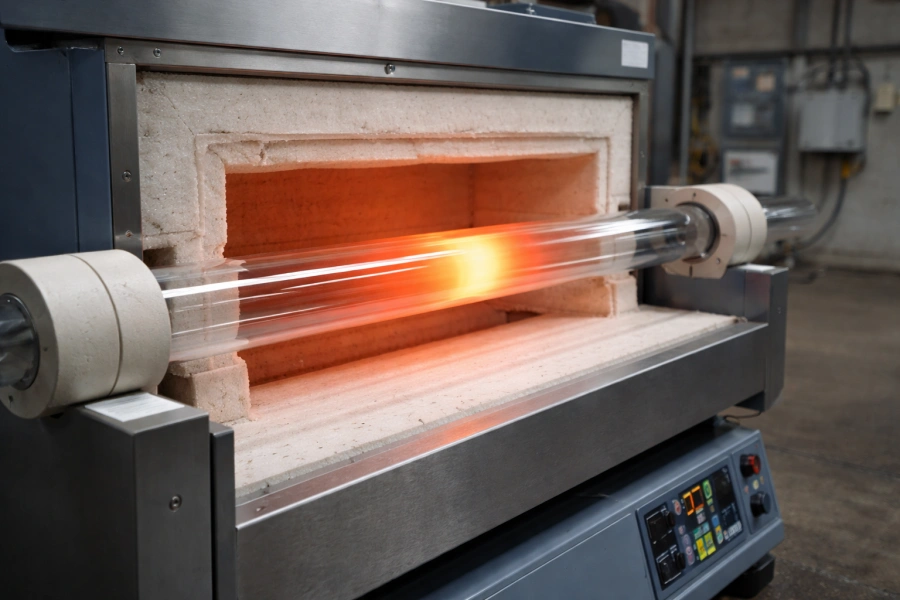
Quartz tube deformation high temperature results from a combination of physical and chemical factors. When exposed to high temperatures, quartz glass approaches its softening point and its viscosity drops, making it vulnerable to dimensional changes.

  • The melting point of quartz glass exceeds 1650°C.

  • The softening point ranges from 1630°C to 1670°C.

  • Quartz tube materials provide high temperature resistance and maintain exceptional dimensional stability.
    However, as viscosity decreases, even strong materials like quartz can deform under stress.

주요 내용

  • Quartz tubes begin to deform when temperatures exceed 1200°C due to a significant drop in viscosity.

  • Maintaining dimensional tolerances is crucial; deformation beyond ±0.1 mm can lead to operational failures.

  • Thicker walls and shorter spans in tube design greatly reduce sagging and extend service life.

  • Hydroxyl content in quartz affects its strength; lower OH levels lead to better performance at high temperatures.

  • Regular monitoring of quartz tubes helps prevent unexpected failures and costly repairs.

When Does Measurable Deformation Begin in Fused Quartz Tubes?

When Does Measurable Deformation Begin in Fused Quartz Tubes?

Quartz tube deformation high temperature begins when the material’s viscosity drops below a critical threshold. Engineers monitor this change because it signals the start of measurable sag or creep. Industrial applications rely on strict tolerance limits to maintain safe and reliable operation.

Defining Measurable Deformation: Tolerance Limits for Industrial Applications

Measurable deformation in quartz tubes refers to any dimensional change that exceeds the allowed tolerance for a specific application. Semiconductor and lighting industries set these limits to prevent tube failure and maintain product quality. Most manufacturers use precision instruments to track changes as small as 0.01 mm.

Field data shows that quartz tubes must stay within ±0.1 mm of their original diameter to meet industry standards. If deformation exceeds 0.2 mm, the tube may no longer fit its intended fixture or maintain proper sealing. Engineers use these standards to decide when a tube needs replacement or additional support.

팁: Regular monitoring helps prevent unexpected downtime and costly repairs.
Table: Industrial Tolerance Limits for Quartz Tubes

허용 오차 유형

가치

치수 허용 오차

±0.1 mm

애플리케이션

Less than 0.2 mm clearance

Viscosity Thresholds: 10^10 poise as the Critical Boundary

Viscosity acts as the main barrier against quartz tube deformation high temperature. When viscosity drops to around 10^10 poise, quartz tubes begin to show measurable sag under their own weight. This threshold marks the point where the material shifts from elastic to viscoelastic behavior.

At high temperatures above 1200°C, the viscosity of fused quartz decreases rapidly. Tubes exposed to these conditions for long periods experience time-dependent strain, which accumulates and leads to permanent deformation. ASTM and ISO standards confirm that tubes with viscosity below 10^10 poise cannot maintain their shape under typical industrial loads.

  • 핵심 포인트:

    • Viscosity of 10^10 poise signals the start of measurable deformation.

    • Quartz tubes above 1200°C show increased sag rates.

    • Maintaining viscosity above this threshold extends tube service life.

Temperature-Dependent Deformation Rates: Field Performance Data

Temperature directly affects the rate of quartz tube deformation high temperature. Field performance data reveals that tubes operating at 1200°C sag at a rate of 0.08 mm per 1,000 hours, while those at 1250°C can deform up to 1.2 mm in the same period. This exponential increase highlights the importance of temperature control.

Engineers use ASTM C1525 and ISO 7884 standards to measure deformation rates and predict service intervals. Tubes with thicker walls or vertical orientation resist sag better, but even these designs struggle when temperatures approach the softening point. Regular inspection and data tracking help identify tubes at risk of exceeding tolerance limits.

온도(°C)

점도(포이즈)

Sag Rate (mm/1,000 hr)

1200

1.0 × 10^10

0.08

1220

3.2 × 10^9

0.25

1250

8.5 × 10^8

1.2

Why Does Viscosity Decrease Cause Plastic Deformation Under Constant Load?

Viscosity controls how quartz glass responds to stress at high temperatures. When viscosity drops, the material can no longer resist slow, permanent shape changes under constant force. This section explains the science behind this process and why it matters for quartz tube deformation high temperature.

Viscoelastic Behavior: Elastic vs. Viscous Response Components

Fused quartz displays both elastic and viscous behavior, especially at elevated temperatures. In the elastic phase, the material returns to its original shape after stress is removed, but as temperature rises and viscosity falls, the viscous response becomes dominant. This shift allows the tube to slowly deform over time, even if the applied load remains constant.

Creep and stress relaxation are two key features of viscoelastic materials like fused quartz. Creep describes how the tube stretches or sags gradually under a steady load, while stress relaxation means the force inside the material decreases if the shape is held fixed. Research shows that at high temperatures, mesoscopic relaxation mechanisms such as shear banding contribute to this time-dependent strain. These mechanisms operate at scales larger than individual atoms, causing the material to flow slowly and accumulate permanent deformation.

Engineers must understand this viscoelastic behavior to predict service life and prevent failure.
핵심 포인트:

  • Elastic response dominates at low temperatures and high viscosity.

  • Viscous flow increases as temperature rises and viscosity drops.

  • Creep and stress relaxation lead to permanent shape changes over time.

Molecular Mechanism: Si-O Bond Breaking and Reformation Under Stress

At the molecular level, plastic deformation in fused quartz happens when silicon-oxygen (Si-O) bonds break and reform under stress. High temperatures give atoms enough energy to move, making it easier for these bonds to rearrange. This process allows the glass network to shift slowly, leading to permanent changes in shape.

Thermal energy at elevated temperatures approaches the bond dissociation energy of Si-O bonds, which is about 4.7 electron volts. When stress is applied, some bonds break and then reform in slightly different positions, causing the tube to stretch or sag. The rate of this bond rearrangement increases as temperature rises, which explains why deformation accelerates near the softening point. Studies show that at 1200°C, the average lifetime of a broken Si-O bond is between 10^-6 and 10^-8 seconds, allowing for significant molecular movement over hours or days.

This molecular mechanism explains why quartz tubes can maintain their shape at low temperatures but deform under constant load when heated.

프로세스

튜브에 미치는 영향

Si-O bond breaking

Enables atomic movement

Bond reformation

Causes permanent strain

Higher temperature

Faster deformation

Arrhenius Relationship: Quantifying Viscosity-Temperature Dependence

The viscosity of fused quartz changes with temperature in a predictable way, following the Arrhenius relationship. This means that as temperature increases, viscosity drops exponentially, making the material more likely to deform under stress. Scientists use this relationship to calculate how quickly a quartz tube will sag or creep at different temperatures.

The Arrhenius equation for viscosity is log(viscosity) = A + B/T, where A and B are constants and T is temperature in Kelvin. For high-purity fused quartz, the activation energy (B) is about 72,000 K. Data shows that viscosity falls from 10^14.5 poise at 1120°C to 10^10 poise at 1200°C, and then to 10^7.6 poise at 1270°C. Each 20°C rise near 1200°C can reduce viscosity by a factor of 2.5 to 3.2, which leads to much faster deformation rates.

Understanding this relationship helps engineers set safe operating temperatures and predict service intervals.
Summary Table:

온도 범위

Viscosity Behavior

Above melting point (Tm)

Arrhenius-type behavior

Below critical temp (Tc)

Arrhenius-type behavior

Between Tm and Tc

Super-Arrhenius-type behavior

Why Do Tube Geometry and Orientation Affect Deformation Rates?

Tube geometry and installation orientation play a major role in how quartz tubes deform at high temperatures. The way a tube is shaped and positioned changes the amount and type of stress it experiences. Understanding these factors helps engineers design tubes that last longer and resist sagging.

Bending Stress Distribution in Horizontal Tubes: Beam Theory Application

Horizontal tubes face bending stress because gravity pulls down on the unsupported span. This stress causes the tube to sag over time, especially when the material softens at high temperatures. Beam theory explains that the longer the span and the thinner the wall, the greater the bending stress.

Engineers use the formula σ = (3FL²)/(2πDt²) to calculate the maximum bending stress in a horizontal tube, where F is the tube’s weight, L is the unsupported length, D is the diameter, and t is the wall thickness. Field data shows that a 50 mm diameter tube with a 1,000 mm span and 3 mm wall thickness at 1200°C experiences about 150 Pa of bending stress. This stress, combined with lower viscosity at high temperatures, leads to measurable sag rates. Reducing the unsupported span or increasing the tube’s diameter can lower the stress and slow deformation.

주요 요점:

  • Longer spans and thinner walls increase bending stress.

  • Bending stress causes sagging in horizontal tubes.

  • Shorter spans and larger diameters help reduce deformation.

Wall Thickness Cubic Relationship to Deflection Resistance

Wall thickness has a powerful effect on a tube’s ability to resist bending and sag. The resistance to deflection increases with the cube of the wall thickness, meaning even small increases in thickness can make a big difference. For example, doubling the wall thickness from 2 mm to 4 mm reduces sag by a factor of eight.

This cubic relationship comes from the tube’s moment of inertia, which determines how much it bends under load. Field studies confirm that tubes with thicker walls show much lower sag rates at the same temperature and span. For instance, a 2 mm wall tube may sag 1.5 mm per 1,000 hours at 1220°C, while a 4 mm wall tube under the same conditions sags only 0.19 mm. Engineers often specify thicker walls for high-temperature or long-span applications to extend tube life.

매개변수

권장 값

튜브 수명에 미치는 영향

L/OD 비율

≤ 50

구부러짐과 처짐 감소

튜브 길이

가능한 한 짧게

휨 및 파손 최소화

튜브 직경

더 큰 선호

강성 및 강도 향상

Comparative Analysis: Horizontal vs. Vertical Orientation Performance

Orientation changes how gravity affects the tube. In horizontal installations, gravity acts across the span, causing bending and sag. In vertical installations, gravity pulls along the tube’s length, so the main stress is hoop stress from internal or external pressure, not bending.

Field data shows that horizontal tubes deform 5 to 15 times faster than vertical tubes at the same temperature and geometry. For example, a 50 mm diameter, 3 mm wall tube at 1200°C sags 0.12 mm per 1,000 hours when horizontal but less than 0.02 mm when vertical. This difference means vertical orientation is preferred for high-temperature applications when possible.

  • 요약 포인트:

    • Horizontal tubes experience much higher sag rates due to bending.

    • Vertical tubes resist deformation better under the same conditions.

    • Choosing vertical orientation can extend tube service life by several times.

Why Does Hydroxyl Content Accelerate High-Temperature Deformation?

Hydroxyl content plays a critical role in the deformation of quartz tubes during service at high temperatures. The presence of OH groups changes the internal structure of the glass, making it more susceptible to sag and creep. Understanding how hydroxyl content interacts with temperature and manufacturing methods helps engineers select the right quartz tube for demanding applications.

Si-OH vs. Si-O-Si Bond Energy Differences and Thermal Activation

Hydroxyl groups weaken the quartz network by replacing strong Si-O-Si bonds with weaker Si-OH bonds. This substitution lowers the energy required for bond movement, which increases the rate of deformation of quartz tubes. At high temperatures, the hydrolysis of Si-O bonds leads to hydrolytic weakening, making the material more prone to sag.

The Si-OH bond has a lower dissociation energy than the Si-O-Si bond. When exposed to heat, these weaker bonds break and reform more easily, allowing the glass structure to shift under stress. As the rate of devitrification rises with increased hydroxyl content, viscosity drops and the quartz tube becomes more vulnerable to permanent shape changes. Hydroxyl groups act as network terminators, disrupting the continuous glass network and accelerating deformation of quartz tubes.

핵심 포인트:

  • Si-OH bonds require less energy to break than Si-O-Si bonds.

  • Hydroxyl content increases the rate of devitrification and lowers viscosity.

  • Hydrolytic weakening makes quartz tubes more susceptible to deformation at high temperatures.

Manufacturing Method Impact: Electric Fusion vs. Flame Fusion OH Content

The method used to manufacture a quartz tube determines its hydroxyl content. Electric fusion produces quartz tubes with low OH levels, while flame fusion introduces more hydroxyl groups into the glass. This difference in manufacturing leads to significant variations in deformation resistance.

Electric fusion takes place in a dry, controlled environment, which limits water incorporation and keeps OH content below 30 ppm. Flame fusion uses a hydrogen-oxygen flame, which adds water vapor and raises OH content to 150-200 ppm. Quartz tubes made by flame fusion show higher rates of deformation of quartz tubes because the increased hydroxyl content lowers viscosity and accelerates sagging. Field performance data confirms that low-OH quartz tubes maintain their shape longer under identical thermal loads.

제조 방법

OH 함량(ppm)

변형 저항

전기 융합

<30

높음

불꽃 융합

150-200

Lower

Quantifying OH Effect: Viscosity Measurements Across Temperature Range

Researchers have measured the effect of hydroxyl content on viscosity across different temperatures. Results show that as OH content rises, viscosity decreases, and the deformation of quartz tubes becomes more pronounced. However, in some studies, inhomogeneity in the distribution of OH groups can affect the accuracy of viscosity measurements.

At temperatures above 1500°C, the presence of water in the glass network leads to a marked reduction in viscosity. This makes the quartz tube more likely to deform during prolonged exposure to heat. Although some data sets show no direct correlation between OH content and viscosity due to inhomogeneity, the overall trend remains clear: higher hydroxyl content increases the risk of deformation.

Observation

Finding

Viscosity Measurements

No clear trends or direct correlations to OH groups content were observed.

OH Groups Distribution

Two different trends in OH groups distribution were found in the studied tubes.

Inhomogeneity

The tubes exhibited inhomogeneity affecting viscosity measurements.

Why Do Impurities Lower Effective Softening Temperature and Increase Sag?

Why Do Impurities Lower Effective Softening Temperature and Increase Sag?

Impurities in quartz tube materials play a major role in reducing the effective softening temperature and increasing sag rates. These impurities disrupt the internal structure of the glass, making it more vulnerable to deformation of quartz tubes at high temperatures. Understanding how different impurities act helps engineers select better materials and extend the service life of quartz tube products.

Network Modifier Theory: How Impurities Disrupt Si-O-Si Bonding

Network modifier theory explains that impurities act as disruptors within the silica network. When impurities enter the structure, they break or weaken the strong Si-O-Si bonds that give quartz tube its strength. This disruption lowers the energy needed for the material to deform, especially at elevated temperatures.

Dissolution occurs preferentially and originates from high-energy sites on surfaces (structural defects and impurities), favoring the formation of etch pits. Impurities, when present, are thought to disrupt/weaken intermolecular bonds, destabilizing a solid, either crystalline (quartz) or amorphous (silica). Such weakening ensures that a smaller driving force is sufficient to overcome the free energy barrier; thereby making both quartz and silica more susceptible to dissolution.

As a result, the deformation of quartz tubes accelerates when impurity levels rise. The glass becomes more prone to sagging and permanent shape changes, especially during long-term high-temperature use.

핵심 포인트:

  • Impurities break or weaken Si-O-Si bonds.

  • Lower bond strength means easier deformation.

  • Higher impurity content leads to faster sag in quartz tube applications.

Aluminum and Titanium Impurity Effects on Viscosity

Aluminum and titanium impurities have a direct impact on the viscosity of quartz tube. Even small amounts can change how the material flows and resists deformation of quartz tubes. These elements alter the structure by interacting with oxygen atoms and creating sites that trap vacancies or stabilize hydroxyl groups.

  • Aluminum impurities increase the viscosity of fused quartz due to their impact on hydroxyl group stability and oxygen vacancy trapping.

  • The presence of aluminum leads to a higher flow activation energy, resulting in slower reorientation of structural domains, which increases viscosity.

  • Even low concentrations of aluminum can significantly alter the viscosity, indicating that structural changes occur with minimal doping.

Field studies show that quartz tube samples with higher aluminum or titanium content often display different deformation rates compared to high-purity materials. This effect can either slow or accelerate sag, depending on the balance of impurities and the operating temperature.

불순물

Effect on Viscosity

Impact on Deformation

알루미늄

Increases viscosity

May slow deformation

티타늄

Alters structure

Can change sag rate

Surface Sodium Contamination: Localized Viscosity Reduction Mechanism

Surface sodium contamination creates weak spots in the quartz tube, leading to localized reductions in viscosity. Sodium ions disrupt the silica network at the surface, making it easier for the glass to flow and deform under stress. This effect becomes more pronounced at high temperatures, where even small amounts of sodium can trigger rapid sagging.

The allowable stress for quartz tubes depends on both temperature and pressure. Quartz tubes can withstand temperatures up to 1100°C for long periods, but exceeding 1200°C increases the risk of deformation of quartz tubes. Proper installation and careful handling help prevent sodium contamination and maintain the structural integrity of the tube.

조건

Long-term Use

Short-term Use

Maximum Temperature for Deformation

대기

1100°C

1200°C

Exceeding 1200°C can cause deformation

진공

N/A

N/A

1000°C

요약 표:
This table highlights the importance of controlling surface contamination and operating conditions to reduce sag risk in quartz tube applications.

Quartz tube deformation high temperature results from several interacting factors. Temperature above 1200°C, reduced viscosity, tube geometry, hydroxyl content, and impurities all play a role. These factors can compromise the structural integrity and functionality of the quartz tube.

  • Exceeding 1200°C may cause deformation and shorten tube life.

  • Quartz tube performance depends on controlling viscosity, hydroxyl content, and impurity levels.

  • Understanding these limitations helps maintain tube integrity during high temperatures.

그리고 viscosity and hydroxyl content influence bubble evolution and cristobalite formation, which are essential for quartz tube stability. Impurities can accelerate devitrification and increase sag risk. For long-term performance, engineers should follow technical standards:

사용 사례

최대 온도

기간

장기 사용

1100°C

Extended periods

단기 사용

1200°C

Brief exposure

진공 상태

1000°C

진공 상태

Alternative Material

Corundum Tubes

1200°C 이상

Applying these strategies and consulting standards ensures reliable operation and extends service life.

자주 묻는 질문

Why does quartz tube deformation increase so quickly above 1200°C?

Quartz tubes deform faster above 1200°C because viscosity drops sharply. Lower viscosity allows gravity and stress to cause permanent shape changes. Field data shows sag rates can triple with just a 20°C increase above this threshold.

Why do engineers prefer low-OH quartz tubes for high-temperature use?

Low-OH quartz tubes resist deformation better at high temperatures. Fewer hydroxyl groups mean stronger Si-O-Si bonds. This results in higher viscosity and longer service life for the tube.

Why does tube orientation matter for deformation rates?

Horizontal tubes experience more bending stress from gravity. This stress causes faster sagging compared to vertical tubes. Vertical orientation reduces deformation and extends tube lifespan.

Why do impurities like aluminum and sodium affect quartz tube performance?

Impurities disrupt the silica network and lower viscosity. Aluminum and sodium create weak spots, making the tube more likely to deform under heat. High-purity quartz tubes show much better resistance to sag.

Why should operators monitor tube dimensions during service?

Regular monitoring helps detect early signs of deformation. Early detection allows for timely replacement or support, preventing equipment failure and costly downtime.

산업용 석영 유리 기술 업데이트 구독

Author: ECHO YANG​ 사진

저자 저자: 에코 양

20년간의 엔드투엔드 석영 유리 공장 경험.

구매자가 맞춤형 배송 정확도 문제, 느린 물류, 가격 변동과 같은 주요 문제를 해결할 수 있도록 지원합니다.

여기에서 실행 가능한 석영 유리 팁을 얻고 고순도 석영 유리 리드 타임, 비용 관리와 관련된 미국 세금 변동 등과 같은 시장 역학을 정기적으로 업데이트할 수 있습니다.

목차
ko_KR한국어
맨 위로 스크롤

지금 빠른 견적 받기

필요한 사항을 알려주세요 - 6시간 내에 맞춤형 가격 및 리드 타임을 받아보세요.

* 제출 후 이메일을 확인하세요. 받지 못하셨나요? 주소를 확인하세요.