1. /
  2. 블로그
  3. /
  4. 쿼츠란 무엇인가요?

쿼츠 버너란 무엇이며 어떤 기능을 하나요?

마지막 업데이트: 02/25/2026
목차

Difficulty arises when high-temperature quartz fabrication demands precision without contamination. Conventional flame tools introduce mismatch, instability, or impurities. Consequently, material compatibility becomes critical.

A quartz burner is a high-temperature flame tool fabricated from high-purity fused silica and engineered specifically for quartz processing operations. It enables localized softening, fusion, polishing, and reshaping of quartz components while maintaining chemical purity and thermal compatibility.

In industrial glassworking environments, accurate thermal control determines whether quartz components achieve structural integrity or develop stress-induced flaws. Therefore, understanding the tool, its material foundation, and its operational mechanics establishes the basis for reliable fabrication outcomes.


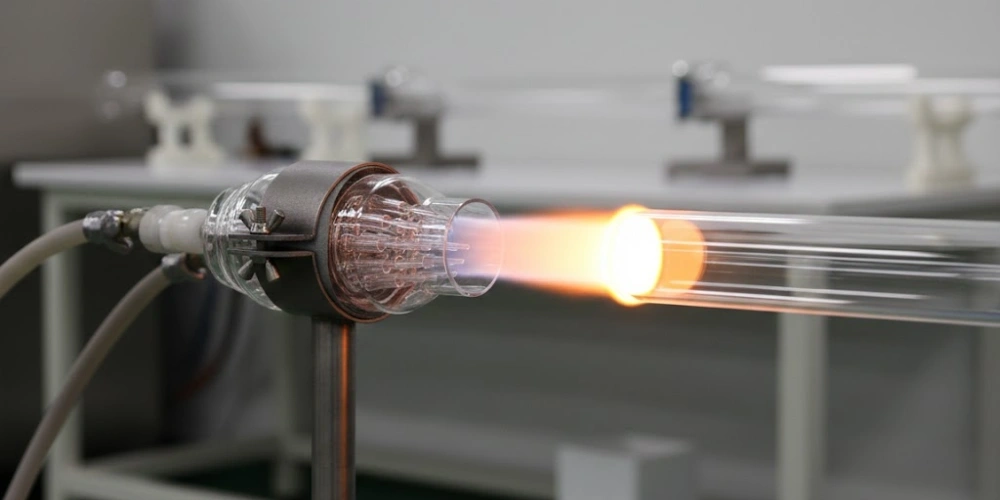
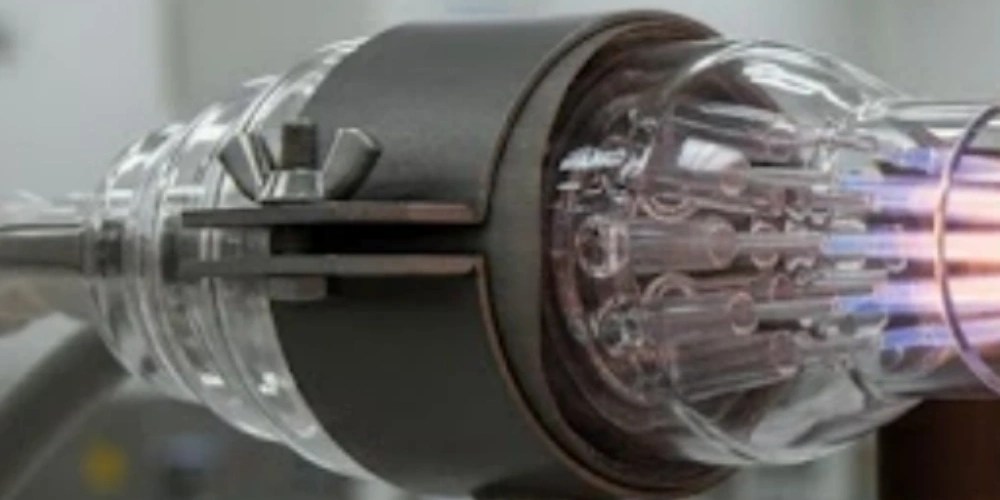
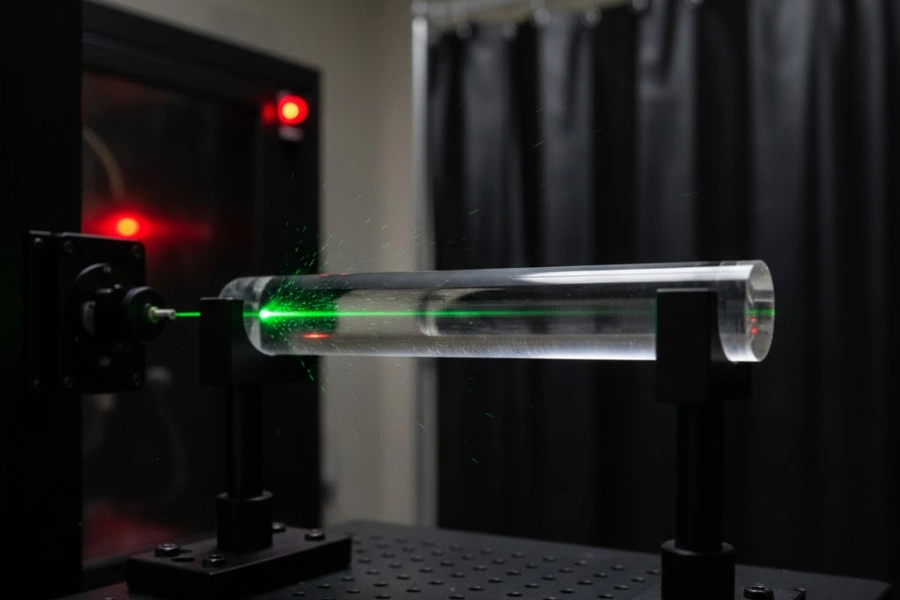
Quartz burner sealing quartz tube in optical assembly

Before exploring material science and flame mechanics, foundational clarity regarding the tool itself establishes semantic precision for both engineering readers and search algorithms targeting the term quartz burner.

A Quartz Burner at Its Core

At the most fundamental level, a quartz burner is defined by its material identity and functional purpose rather than by superficial appearance. Moreover, its classification as a precision industrial flame instrument distinguishes it from laboratory burners or general heating devices. Establishing this definition anchors the technical narrative that follows.

The Formal Definition of a Quartz Burner

A quartz burner is a high-temperature flame processing tool manufactured primarily from high-purity fused silica (SiO₂ ≥ 99.99%), designed for localized heating and forming of quartz components.

Structurally, the body and nozzle are fabricated from fused silica to maintain thermal compatibility with the workpiece. Operationally, it generates controlled flame temperatures typically ranging from 2,000°C to 2,800°C, depending on gas composition. Functionally, it supports fusion welding, flame polishing, reshaping, and sealing of quartz tubes, rods, and vessels without introducing metallic contamination.

Industrial documentation consistently classifies such equipment within precision thermal fabrication tools, emphasizing its role in quartz-specific processing rather than general combustion tasks.

How a Quartz Burner Differs from Conventional Flame Tools

Material compatibility defines the primary distinction between a quartz burner and conventional metal or ceramic flame nozzles.

Metal burners commonly operate below 1,500°C continuous tolerance, and thermal expansion coefficients of stainless steel (approximately 17 × 10⁻⁶ /°C) exceed quartz by more than 30 times. Ceramic nozzles offer higher temperature resistance, yet typical alumina expansion coefficients (~8 × 10⁻⁶ /°C) still create mismatch relative to fused silica (~0.55 × 10⁻⁶ /°C). Such disparities can introduce thermal stress and microfractures during precision quartz welding.

Operational environments requiring impurity control further reinforce differentiation. Metallic nozzles may release trace ions at elevated temperatures, whereas fused silica maintains chemical inertness up to 1,200°C in oxidizing atmospheres, preserving purity standards essential for optical and semiconductor-grade quartz processing.

The Industrial Category Quartz Burners Belong To

Within industrial taxonomy, quartz burners belong to the category of precision flame-based thermal forming tools used in engineered quartz fabrication chains.

Unlike laboratory Bunsen burners that serve educational or analytical heating roles, industrial quartz flame tools operate in fabrication facilities producing optical tubes, vacuum vessels, lamp envelopes, and semiconductor components. Production settings often require dimensional tolerances below ±0.2mm, and flame stability must remain within temperature fluctuations of less than ±3% during sustained operation.

Experience in high-purity quartz workshops demonstrates that even minor instability in flame geometry can alter weld symmetry or wall thickness distribution. Therefore, classification within precision industrial tooling underscores its role in controlled manufacturing rather than generalized heating.

Core Characteristics of a Quartz Burner

매개변수 Typical Value or Range
SiO₂ 순도(%) ≥ 99.99
Maximum Flame Temperature (°C) 2,000–2,800
Thermal Expansion Coefficient (×10⁻⁶ /°C) ~0.55
Continuous Structural Tolerance (°C) > 1,200
Dimensional Control Capability (mm) ±0.2

Material performance ultimately determines whether flame stability, dimensional control, and contamination resistance can be sustained during quartz processing. Consequently, attention shifts from tool identity to the intrinsic properties of the silica body itself.

High-Purity Quartz as the Foundational Material

Every performance attribute associated with a quartz burner originates in the thermophysical and chemical behavior of high-purity fused silica. Furthermore, mechanical stability and flame precision remain inseparable from material composition and structural homogeneity. A rigorous understanding of fused silica therefore provides the scientific basis for evaluating durability, heat tolerance, and operational purity.

The Composition and Purity Standards of Fused Silica

High-purity fused silica consists predominantly of silicon dioxide, typically SiO₂ ≥ 99.99%, with metallic impurities measured in parts per million or lower.

Industrial production methods include electric fusion of natural quartz sand at temperatures exceeding 1,700°C, as well as chemical vapor deposition routes capable of achieving impurity levels below 10 ppm total metallic content. The amorphous structure eliminates crystalline grain boundaries, reducing internal scattering sites and enhancing homogeneity. Density typically ranges between 2.19–2.21 g/cm³, while hydroxyl content may vary from 1 ppm to 1,000 ppm depending on manufacturing route.

In fabrication settings where trace contamination affects optical transmission or semiconductor yield, even 0.01% impurity variation can alter performance outcomes, reinforcing the necessity of controlled purity grades.

Thermal Properties That Make Quartz Irreplaceable

Thermal endurance defines the suitability of fused silica for high-intensity flame environments.

The softening point of fused silica is approximately 1,665°C, while the annealing point lies near 1,140°C, and the strain point around 1,070°C. More critically, the linear thermal expansion coefficient averages 0.55 × 10⁻⁶ /°C (20–300°C), among the lowest of all industrial glass materials. Thermal shock resistance allows temperature differentials exceeding 1,000°C without catastrophic fracture when heating and cooling gradients are properly managed.

Operational observations in quartz forming lines reveal that components heated from room temperature to above 1,200°C within seconds maintain structural integrity when expansion mismatch is minimized. Such behavior explains why fused silica remains unmatched for flame-contact tooling.

Chemical Inertness and Contamination-Free Processing

Chemical stability plays an equally decisive role in high-purity flame processing.

Fused silica demonstrates resistance to most acids except hydrofluoric acid and hot concentrated phosphoric acid. In oxidizing atmospheres below 1,200°C, reaction rates remain negligible, and metallic ion release approaches analytical detection limits. Under neutral combustion gases such as hydrogen–oxygen mixtures, no measurable contamination is transferred to adjacent quartz workpieces.

Industrial fabrication environments handling optical fibers and vacuum components report impurity thresholds below 1 part per billion for critical applications. In such contexts, inert silica tooling prevents ion migration that would otherwise compromise transmission efficiency or dielectric performance.

Optical Transparency and Its Operational Significance

Transparency across ultraviolet to infrared wavelengths enhances operational control during flame work.

Fused silica exhibits transmission exceeding 90% between 200 nm and 2,000 nm for high-grade material with minimal hydroxyl absorption bands. Visual monitoring of the flame–workpiece interface becomes possible through the translucent nozzle body, allowing precise alignment and temperature assessment. Unlike opaque metal burners, optical transparency permits real-time observation of localized viscous flow regions.

During fine welding of quartz tubes with wall thicknesses below 1.5mm, direct visual feedback supports consistent seam formation and reduces geometric distortion. Optical clarity therefore contributes not merely to aesthetics but to measurable process accuracy.

Material Properties Governing Quartz Burner Performance

속성 Typical Value or Range
SiO₂ 순도(%) ≥ 99.99
밀도(g/cm³) 2.19–2.21
연화점(°C) ~1,665
Thermal Expansion (×10⁻⁶ /°C) ~0.55
Thermal Shock Resistance (°C Differential) > 1,000
UV–IR Transmission (%) > 90 (200–2,000 nm)

Material science thus reveals why fused silica serves not merely as a structural medium but as the enabling platform for high-temperature precision flame processing.


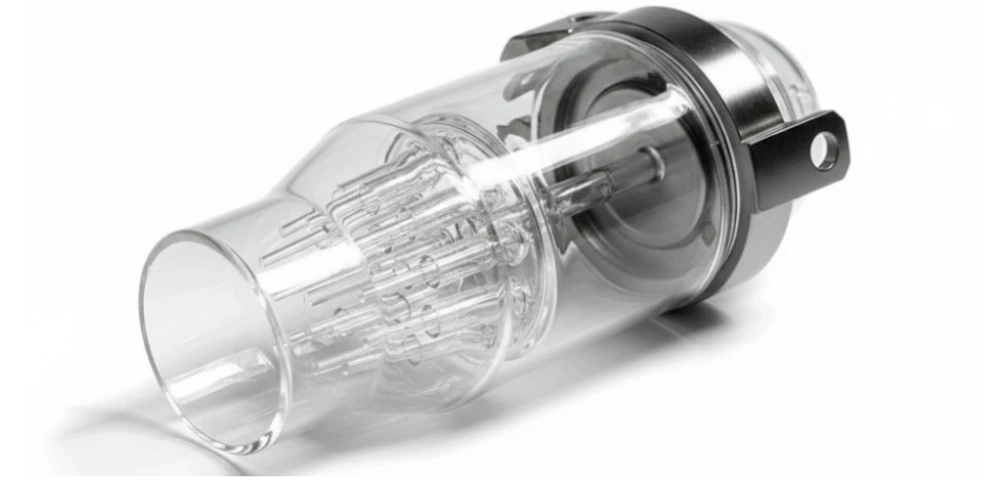
quartz burner product configuration

With the material basis clarified through thermophysical and chemical analysis, structural configuration now becomes the determining factor in how that material performs under combustion-driven heat loads.

Structural Anatomy of a Quartz Burner

Mechanical geometry governs how thermal energy is shaped, directed, and stabilized during operation. Although fused silica provides intrinsic resistance to heat and contamination, functional performance depends equally on internal channel design, nozzle geometry, and dimensional proportions. Structural analysis therefore bridges material capability and combustion behavior.

The Quartz Nozzle — Precision at the Flame Exit

The nozzle constitutes the terminal control point of flame formation, directly influencing temperature distribution and heat flux density.

Single-orifice nozzles commonly feature diameters between 0.8 mm and 2.5 mm, generating concentrated point flames suitable for localized fusion. Multi-orifice designs may incorporate 3–12 micro-apertures, each below 1.2 mm, producing linear or planar flame distributions. Wall thickness at the exit region typically ranges from 1.5 mm to 3.0 mm, balancing thermal endurance with weight control.

In fabrication environments handling quartz tubes of 10–60 mm outer diameter, variations in nozzle diameter as small as 0.2mm can alter flame symmetry and affect weld uniformity. Precision at the flame exit therefore directly correlates with dimensional control during quartz forming.

Gas Supply Channels and Mixing Chamber Design

Internal gas routing determines combustion efficiency and flame temperature stability.

Hydrogen–oxygen systems generally operate at pressures between 0.05–0.3 MPa, while natural gas–oxygen combinations may require 0.1–0.4 MPa to maintain flame consistency. Pre-mixed chamber designs enhance combustion uniformity and can achieve flame temperatures approaching 2,800°C, whereas external mixing configurations allow safer control for lower-intensity applications around 2,000°C. Channel diameters within the burner body typically measure 2–6 mm, ensuring sufficient volumetric flow without inducing turbulence1.

Manufacturing experience indicates that even slight asymmetry in channel alignment—on the order of 0.1 mm eccentricity—may create uneven flame cones. Consequently, internal passage precision contributes measurably to thermal repeatability during industrial cycles.

Nozzle Geometry Variants and Their Processing Targets

Geometric diversity allows adaptation to specific fabrication tasks.

Circular single-hole designs concentrate thermal energy for spot welding or tip-off sealing. Linear multi-hole nozzles distribute heat across lengths up to 50 mm, enabling uniform polishing of cylindrical surfaces. Annular or ring-shaped configurations generate circumferential heating zones for tube expansion or diameter correction processes.

Processing records show that flame length can vary from 10 mm to 80 mm depending on aperture arrangement and gas flow rate. Alignment angle relative to the workpiece, often maintained between 30° and 60°, further influences heat distribution patterns. Structural geometry therefore defines application specificity within quartz flame processing systems.

Structural Parameters of a Quartz Burner

Structural Parameter Typical Range or Value
Nozzle Diameter (mm) 0.8–2.5
Multi-Orifice Count 3–12
Wall Thickness at Tip (mm) 1.5–3.0
Gas Channel Diameter (mm) 2-6
Operating Gas Pressure (MPa) 0.05–0.4
Flame Length (mm) 10–80

Structural anatomy transforms material capability into controlled flame behavior, establishing the mechanical framework through which high-temperature quartz processing becomes technically feasible.


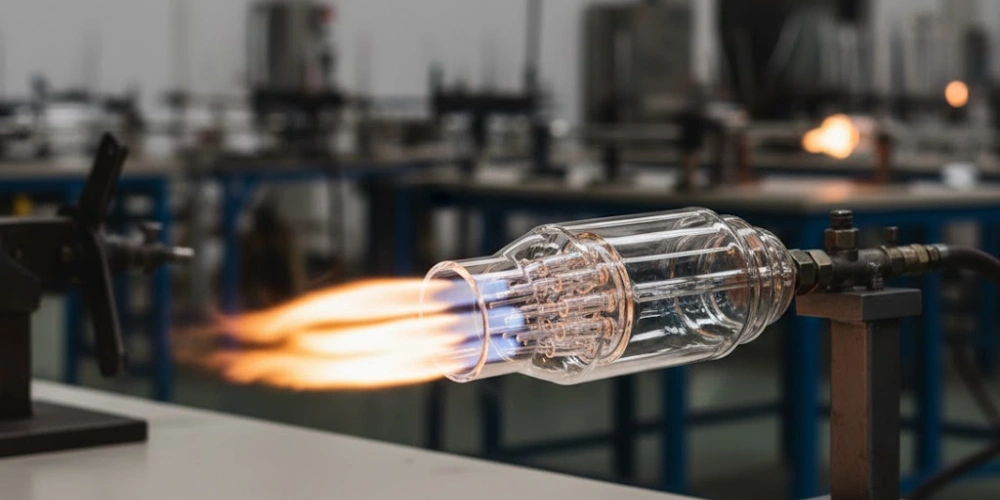
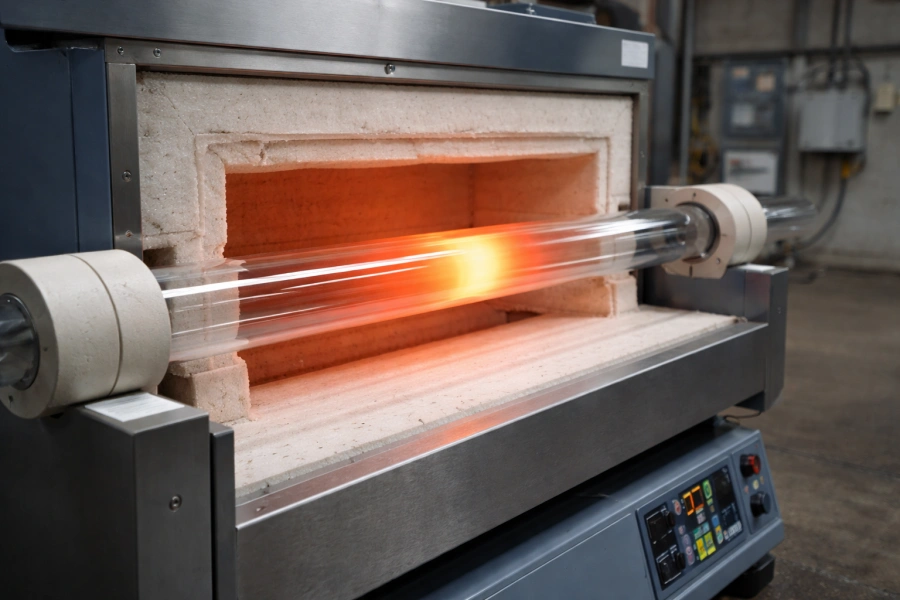
Quartz burner operating in industrial quartz fabrication workshop

Once structural geometry defines how gases are directed and stabilized, attention turns toward the thermodynamic sequence that converts controlled combustion into localized viscous deformation of silica.

The Working Principle Behind Quartz Burner Operation

Operational effectiveness arises from the interaction between combustion chemistry, heat transfer dynamics, and the temperature-dependent behavior of amorphous silica. In addition, flame structure and proximity to the workpiece govern how energy is delivered with spatial precision. Examining the combustion process and subsequent material response clarifies how controlled heat transforms rigid quartz into a formable state.

Combustion Gases and the Temperature Range They Produce

Flame temperature is determined primarily by fuel–oxidizer composition and stoichiometric balance.

Hydrogen–oxygen mixtures can generate theoretical adiabatic flame temperatures up to 2,800°C, while methane–oxygen systems typically reach approximately 2,000–2,200°C under optimal mixing conditions. Air-fuel systems, by contrast, often remain below 1,900°C, limiting their suitability for high-purity quartz fusion. Gas flow stability within ±2% variation maintains flame symmetry and prevents oscillation during sustained operation.

Industrial flame calibration procedures frequently confirm that deviations of more than 50°C in peak temperature can affect fusion consistency in quartz sections below 2 mm thickness. Selection of gas combination therefore determines whether energy output sufficiently exceeds the 1,665°C softening threshold of fused silica while maintaining safety margins.

The Softening Mechanism of Quartz Under Localized Heat

Unlike crystalline metals that exhibit a discrete melting point, amorphous silica transitions gradually into a viscous flow state.

When local temperature surpasses approximately 1,600°C, viscosity2 decreases from roughly 10¹³ Pa·s at the annealing range to below 10⁷ Pa·s near the softening region. Within this interval, quartz becomes deformable without fully liquefying, enabling controlled welding or reshaping. Surrounding regions remain below strain temperature (~1,070°C), preserving dimensional stability due to the low expansion coefficient of 0.55 × 10⁻⁶ /°C.

Fabrication records indicate that heating durations of 3–10 seconds are often sufficient to initiate fusion in thin-walled tubing. Gradual cooling through the annealing zone reduces residual stress accumulation and minimizes microcrack formation.

Heat Transfer Modes in Quartz Flame Processing

Energy transfer during flame operation involves a combination of convection and thermal radiation.

Convective heat transfer dominates at close nozzle distances of 5–20 mm, where high-velocity combustion gases directly contact the workpiece surface. Radiative transfer becomes increasingly significant at elevated flame temperatures above 2,200°C, contributing to deeper thermal penetration. Adjusting flame angle between 30° and 60° influences surface heat flux distribution and can modify effective heating area by more than 15%.

In precision tube welding operations, maintaining consistent standoff distance within ±1 mm has been observed to stabilize weld bead geometry. Controlled manipulation of these heat transfer parameters supports repeatable dimensional accuracy in quartz fabrication.

Thermodynamic Parameters in Quartz Burner Operation

Operational Parameter Typical Range or Value
Hydrogen–Oxygen Flame Temperature (°C) Up to 2,800
Methane–Oxygen Flame Temperature (°C) 2,000–2,200
Quartz Softening Temperature (°C) ~1,665
Viscosity at Softening (Pa·s) ~10⁷
Recommended Nozzle Distance (mm) 5-20
Typical Heating Duration (s) 3–10

Through coordinated combustion control, viscosity reduction, and managed heat transfer, the operational principle converts chemical energy into precisely confined thermal deformation of fused silica.


With thermodynamic mechanisms clarified, functional relevance emerges through real fabrication scenarios where controlled flame interaction reshapes, joins, and refines quartz components under measurable thermal constraints.

Primary Applications of Quartz Burners in Fabrication

Industrial quartz processing relies on repeatable heat delivery capable of exceeding softening thresholds without inducing structural defects. Moreover, dimensional accuracy and chemical purity must be preserved throughout each operation cycle. Application-level examination therefore illustrates how quartz burners translate combustion physics into controlled fabrication outcomes.

Fusion Welding of Quartz Tubes and Rods

Fusion welding represents one of the most fundamental uses in quartz component manufacturing.

In practice, two quartz sections are aligned with axial tolerance typically below ±0.15 mm, and heated until interface temperatures exceed 1,650°C, allowing viscous flow bonding. Uniform rotation speeds between 30–90 rpm help distribute heat symmetrically during tube welding. Controlled cooling through the annealing range near 1,140°C reduces internal stress gradients that may otherwise exceed safe tensile limits of approximately 50 MPa.

Production records from high-purity glass workshops demonstrate that weld seam integrity improves significantly when flame temperature stability remains within ±2%, reinforcing the necessity of precision combustion control.

Flame Polishing for Optical and Surface Quality

Flame polishing enhances surface smoothness without mechanical abrasion.

Rapid thermal exposure at temperatures above 1,700°C causes surface asperities below 10 µm height to reflow through viscous leveling. Flame sweep speeds commonly range from 5–20 mm/s, preventing excessive bulk heating while maintaining surface softening. Resulting surface roughness (Ra) values can decrease from 0.8 µm to below 0.1 µm, achieving optical-grade finishes suitable for transparent quartz assemblies.

Manufacturing environments producing laboratory or optical vessels report measurable increases in light transmission—often exceeding 3–5% improvement—after controlled flame polishing operations.

Localized Thermal Reshaping of Quartz Components

Targeted reshaping enables geometric modification without compromising entire structures.

Bending operations typically involve localized heating zones approximately 10–25 mm in length, with temperature gradients confined to avoid global deformation. Expansion or constriction processes rely on internal or external support tools while maintaining surface temperatures above 1,650°C only at designated regions. Controlled rotation at speeds near 20–60 rpm supports uniform wall distribution during reshaping.

Field fabrication logs indicate that maintaining heating duration within 5–15 seconds per segment reduces ovalization risk and preserves concentricity within ±0.3mm, depending on tube diameter.

Sealing and Tip-Off Operations in Quartz Vessels

Sealing procedures finalize vacuum or containment systems in quartz vessels.

End segments are heated until softening permits collapse and closure, often within temperature bands of 1,700–1,900°C. Uniform circumferential heating is required to prevent asymmetric contraction that could introduce microcracks. In high-vacuum components, sealing integrity may be tested to leakage rates below 10⁻⁹ mbar·L/s, demanding precise thermal management during closure.

Operational data from lamp and vacuum tube fabrication lines show that flame uniformity deviations greater than 3% can produce uneven wall thinning, emphasizing the need for stable geometry and consistent heat flux.

Application Parameters in Quartz Fabrication

Application Process 온도 범위(°C) Typical Duration (s) Dimensional Control (mm)
Fusion Welding 1,650–1,800 3–10 ±0.15
플레임 폴리싱 1,700–1,900 Continuous sweep Ra < 0.1 µm
Thermal Reshaping >1,650 (localized) 5–15 per segment ±0.3
Sealing / Tip-Off 1,700–1,900 4–12 Leak rate < 10⁻⁹ mbar·L/s

Application-specific deployment demonstrates how quartz burners convert controlled combustion into repeatable fabrication processes, preserving structural integrity while enabling precision thermal transformation.


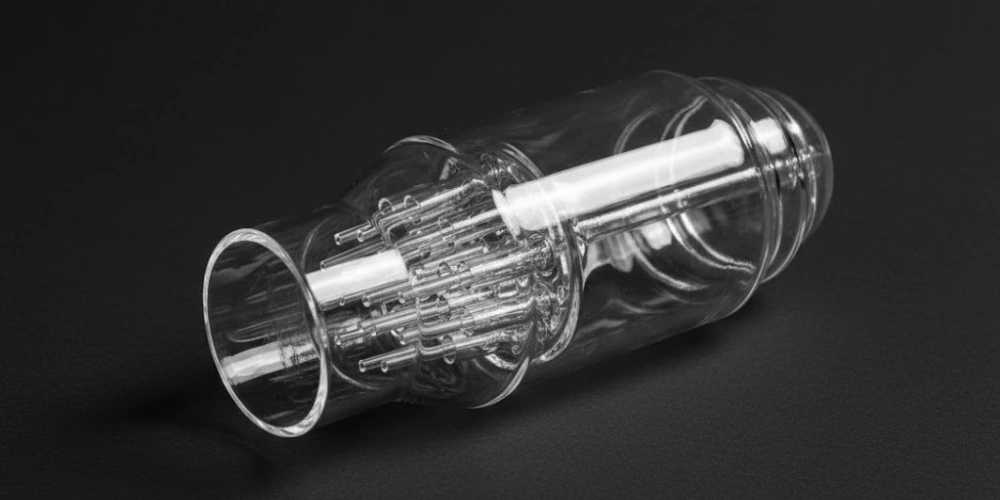
Quartz burner specification detailing multi nozzle glass design

Where fabrication applications demonstrate practical capability, performance evaluation consolidates material science, structural precision, and combustion stability into measurable operational advantages.

Performance Advantages Intrinsic to a Quartz Burner

Intrinsic performance emerges from the synergy between low thermal expansion, chemical inertness, and geometric stability under sustained heat exposure. Furthermore, durability during cyclic industrial use determines long-term reliability beyond isolated fabrication events. Quantified analysis therefore clarifies why quartz-based flame tools maintain operational consistency where alternative materials degrade.

Thermal Shock Resistance Under Cyclic Heating Conditions

Repeated heating and cooling cycles impose rapid thermal gradients3 that can induce stress fractures in conventional materials.

Fused silica exhibits a thermal expansion coefficient of approximately 0.55 × 10⁻⁶ /°C, significantly lower than alumina (~8 × 10⁻⁶ /°C) or stainless steel (~17 × 10⁻⁶ /°C). As a result, temperature differentials exceeding 1,000°C can be tolerated when heating and cooling are controlled within operational parameters. Strain point values near 1,070°C allow safe passage through cooling zones without structural distortion when managed properly.

Industrial cycle testing has shown that flame tools fabricated from high-purity silica withstand more than 500 rapid heating cycles from ambient temperature to above 1,200°C without crack initiation, provided cooling transitions remain gradual through the annealing range.

Dimensional Stability at Sustained High Temperatures

Dimensional consistency ensures repeatable flame geometry and predictable heat delivery.

At continuous operating temperatures above 1,000°C, fused silica maintains structural rigidity with negligible creep compared to many ceramic materials. Viscosity at 1,200°C remains above 10¹¹ Pa·s, preventing deformation of nozzle apertures during extended operation. Consequently, flame exit diameter variation typically remains within ±0.05 mm across prolonged heating intervals.

Observations in production workshops confirm that stable nozzle geometry contributes directly to weld symmetry and polishing uniformity, particularly during operations exceeding 30 minutes of sustained heating.

Resistance to Corrosive Atmospheres During Operation

Operational environments may contain reactive gases or byproducts that degrade alternative materials.

Fused silica demonstrates strong resistance to oxidizing atmospheres and acidic vapors such as hydrogen chloride under temperatures below 1,200°C. Reaction rates in such environments remain minimal, and surface mass loss is typically below 0.01% over extended exposure periods when hydrofluoric acid is absent. Unlike metallic nozzles, silica structures do not release contaminating ions under high-temperature combustion.

Facilities handling chlorine-containing processes report that silica-based flame components retain structural integrity over months of continuous operation, reducing maintenance frequency and contamination risk.

Performance Metrics Associated with Quartz Burner Reliability

성능 매개변수 Typical Value or Range
Thermal Expansion (×10⁻⁶ /°C) ~0.55
Thermal Shock Tolerance (°C Differential) > 1,000
스트레인 포인트(°C) ~1,070
Viscosity at 1,200°C (Pa·s) > 10¹¹
Nozzle Dimensional Stability (mm) ±0.05
Surface Mass Loss in Oxidizing Atmosphere (%) < 0.01

Intrinsic properties therefore translate into measurable endurance, dimensional precision, and environmental resistance during sustained industrial flame operations.


As performance characteristics become measurable, technical evaluation naturally progresses toward specification frameworks that engineers reference during equipment assessment and integration planning.

Technical Parameters That Characterize Quartz Burner Specifications

Engineering comparison of quartz flame tools relies on quantifiable parameters rather than descriptive claims. Moreover, dimensional and thermal ratings provide the reference language required for system compatibility analysis. Specification clarity therefore supports informed evaluation in precision fabrication environments.

  • Nozzle Aperture Diameter
    Aperture diameter commonly ranges from 0.8 mm to 3.0 mm, directly influencing flame concentration and heat flux density. Smaller diameters generate localized point flames suitable for fine welding, whereas larger diameters distribute energy across broader areas. Variations exceeding 0.1 mm can measurably affect flame geometry and surface heating patterns. Consequently, aperture tolerance becomes a primary selection factor.

  • SiO₂ 순도 수준
    High-grade fused silica typically maintains ≥99.99% SiO₂ content, with metallic impurities measured below 10 ppm in precision grades. Elevated purity reduces contamination risk during optical or semiconductor component processing. Even incremental impurity shifts of 0.01% may alter thermal stability or optical clarity under extreme temperatures. Purity certification therefore serves as a foundational specification parameter.

  • Maximum Continuous Operating Temperature
    Continuous structural tolerance generally exceeds 1,200°C, while exposure to flame temperatures may reach 2,800°C at the combustion interface. Sustained heating above strain temperature (~1,070°C) requires controlled cooling transitions. Engineering documentation frequently specifies operational safety margins of 10–15% below theoretical limits to prevent long-term degradation. Thermal rating thus guides system compatibility.

  • Wall Thickness and Structural Dimensions
    Nozzle wall thickness commonly varies between 1.5 mm and 3.5 mm, balancing durability and thermal response time. Thicker sections increase structural rigidity but may slightly delay heat dissipation. Dimensional precision often falls within ±0.2mm, supporting repeatable integration with gas supply assemblies. Mechanical proportion therefore contributes directly to durability and alignment stability.

  • Compatible Gas Types and Pressure Range
    Hydrogen–oxygen and methane–oxygen systems dominate industrial applications, operating within pressure ranges of 0.05–0.4 MPa. Flow uniformity within ±2% enhances flame symmetry and temperature consistency. Pressure compatibility ensures stable combustion without internal turbulence. Gas system alignment therefore completes the specification profile.

Together, these parameters establish a measurable framework through which quartz burner designs can be compared, validated, and aligned with precision fabrication requirements.


Quartz burner welding high purity quartz components

As specification metrics define structural and thermal capacity, sustained operational performance depends equally on environmental discipline and controlled process conditions.

Operating Conditions for Sustained Quartz Burner Performance

Stable flame geometry and structural longevity are closely tied to external operating variables. Moreover, environmental temperature, gas delivery stability, and thermal cycling discipline influence whether intrinsic material advantages translate into extended service life. Operational conditions therefore shape real-world durability in high-temperature quartz fabrication environments.

  • Gas Pressure Stability
    Hydrogen–oxygen systems typically operate within 0.05–0.30 MPa, while methane–oxygen combinations may extend toward 0.40 MPa depending on flame intensity requirements. Pressure fluctuations greater than ±3% can disturb flame symmetry and alter localized temperature distribution. Sustained deviations may introduce uneven heating zones that affect weld geometry. Maintaining regulated pressure therefore supports consistent combustion behavior.

  • Ambient Environmental Temperature
    Workshops operating between 18°C and 28°C provide stable baseline conditions for predictable thermal gradients. Sudden ambient variations exceeding ±10°C can influence cooling rates after high-temperature exposure. Controlled environmental stability reduces residual stress accumulation during repeated heating cycles. Thermal equilibrium within the workspace thus enhances dimensional consistency.

  • Controlled Cooling Intervals
    After exposure to temperatures above 1,600°C, gradual cooling through the annealing zone near 1,140°C minimizes internal stress. Rapid quenching across temperature differentials exceeding 800–1,000°C increases fracture probability. Cooling durations of 2–5 minutes for thin-walled components often maintain structural integrity during repetitive operations. Managed thermal descent therefore protects long-term structural stability.

  • Nozzle-to-Workpiece Distance Control
    Optimal standoff distances typically range from 5–20 mm, depending on flame temperature and component thickness. Variations beyond ±1 mm can significantly alter convective heat flux distribution. Precise alignment prevents overheating of adjacent regions and reduces distortion risk. Spatial control therefore complements combustion stability in precision processing.

  • Duty Cycle and Operational Duration
    Continuous flame exposure exceeding 30–45 minutes may require intermittent cooling intervals to maintain nozzle integrity. Extended high-intensity operation above 2,500°C increases thermal load concentration at the exit aperture. Scheduled rest periods reduce cumulative stress within the silica body. Structured duty cycles therefore contribute to extended service life.

Sustained quartz burner performance ultimately results from coordinated control of combustion parameters, environmental stability, and disciplined thermal management, preserving precision across repeated industrial cycles.


결론

A quartz burner integrates high-purity fused silica, precision structural geometry, and controlled combustion dynamics into a specialized tool for high-temperature quartz fabrication. Material properties such as low thermal expansion and chemical inertness underpin durability, while structural precision shapes flame behavior. Through calibrated operating conditions and defined specification parameters, consistent welding, polishing, reshaping, and sealing operations become technically achievable in demanding industrial environments.


자주 묻는 질문

What temperature does a quartz burner typically reach?

Hydrogen–oxygen systems can achieve flame temperatures up to 2,800°C, while methane–oxygen combinations typically operate between 2,000–2,200°C. Actual working temperature depends on gas mixture ratio and pressure stability.

Why must fused silica be used instead of metal nozzles?

Fused silica has a thermal expansion coefficient of approximately 0.55 × 10⁻⁶ /°C, far lower than metals. This minimizes thermal mismatch and prevents contamination during high-purity quartz processing.

How is thermal shock avoided during operation?

Controlled heating and gradual cooling through the annealing range near 1,140°C reduce internal stress. Avoiding rapid temperature differentials above 800–1,000°C further protects structural integrity.

What determines nozzle diameter selection?

Application type governs aperture size. Diameters between 0.8–3.0 mm are common, with smaller openings producing concentrated flames for fine welding and larger apertures enabling broader heat distribution.


참조:


  1. This phenomenon affects gas flow stability and flame uniformity in high-temperature processing systems. 

  2. This parameter quantifies resistance to flow and explains how silica transitions into a deformable state under high heat. 

  3. This term defines temperature variation across a material, influencing stress distribution. 

산업용 석영 유리 기술 업데이트 구독

Author: ECHO YANG​ 사진

저자 저자: 에코 양

20년간의 석영 유리 제조 경험을 바탕으로,
저는 OEM 구매자와 엔지니어가 소싱 리스크를 줄일 수 있도록 지원합니다.

여기에서 쿼츠 선택, 리드 타임 관리, 비용 관리, 공급 위험 감소에 대한 실용적인 인사이트를 확인할 수 있습니다.

모든 인사이트는 공장 측의 관점에서 제공됩니다.

목차
맨 위로 스크롤

지금 빠른 견적 받기

필요한 사항을 알려주세요 - 6시간 내에 맞춤형 가격 및 리드 타임을 받아보세요.

* 제출 후 이메일을 확인하세요. 받지 못하셨나요? 주소를 확인하세요.