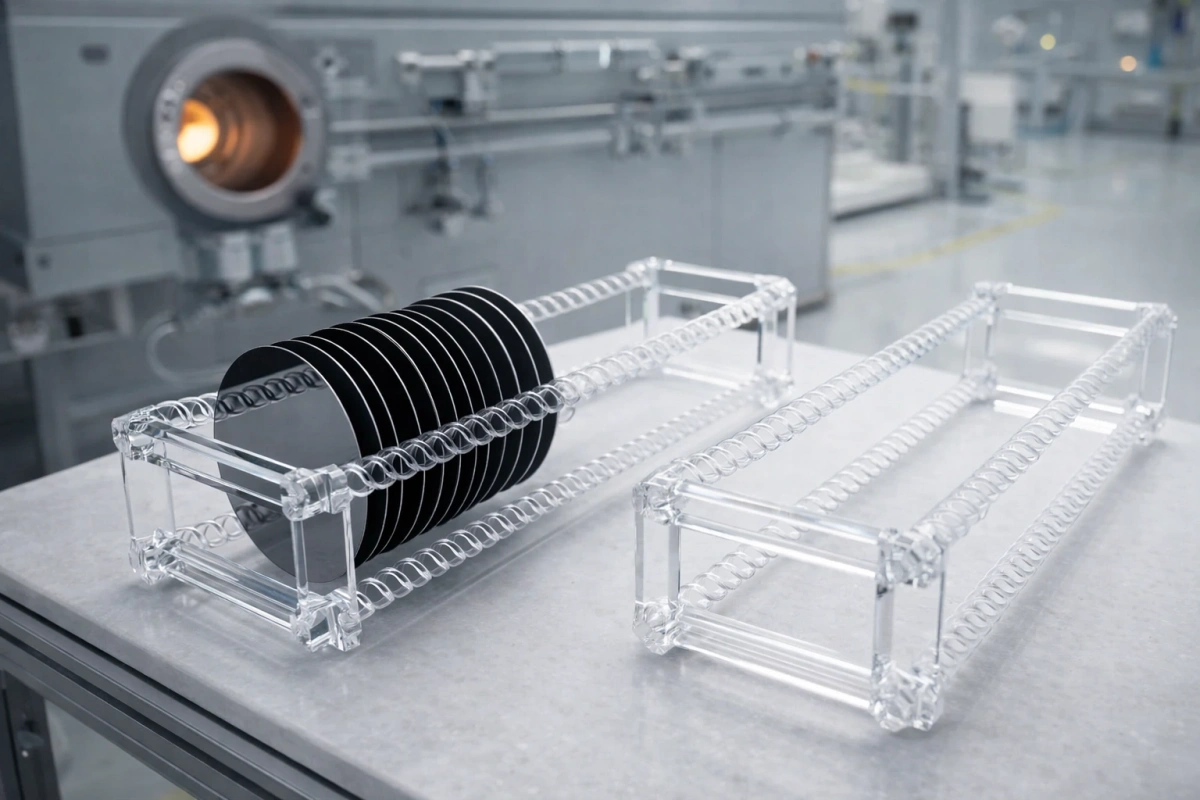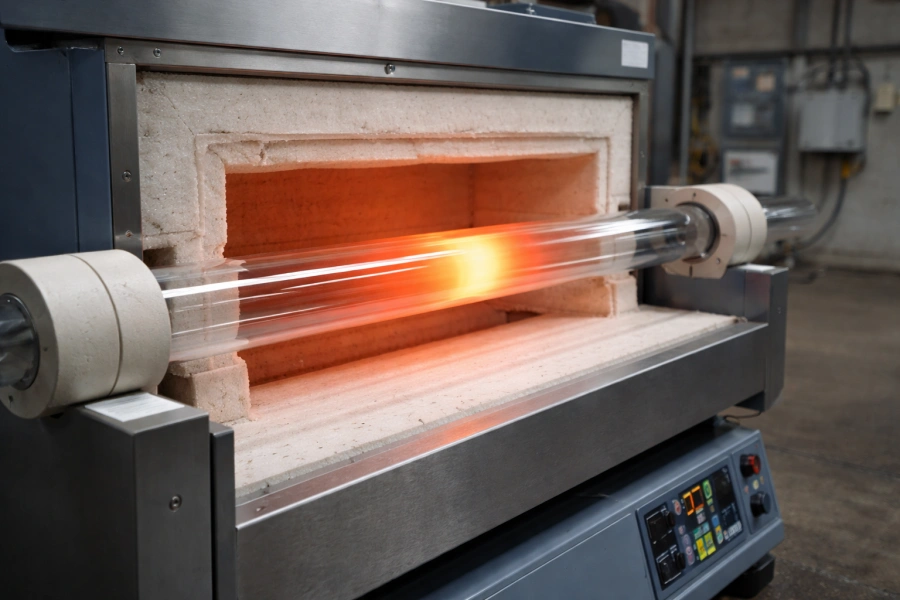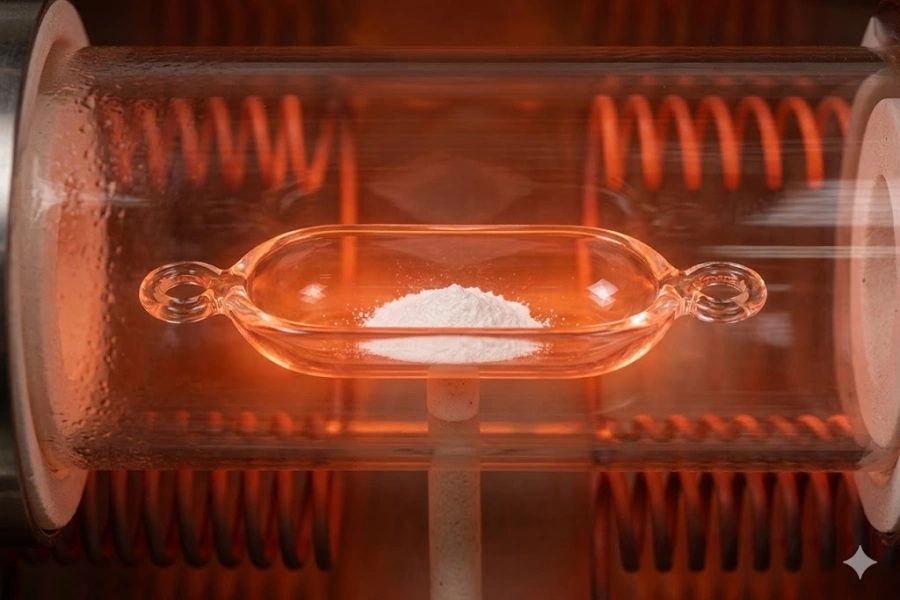
Les barres de quartz se dégradent silencieusement - et la température en est presque toujours la cause. Connaître les limites thermiques précises permet d'éviter une dégradation irréversible du matériau avant qu'elle ne commence.
Cet article couvre toute la gamme de fonctionnement thermique des barres de quartz fondu, y compris le seuil de service continu de 1100°C et le plafond à court terme de 1650°C, les mécanismes de dévitrification et de rupture par contrainte thermique déclenchés par une chaleur excessive, et les précautions de manipulation nécessaires pour préserver l'intégrité structurelle dans les environnements industriels et de laboratoire.
Les limites thermiques des barres de quartz ne sont pas des chiffres arbitraires tirés des fiches techniques des fabricants. Elles sont ancrées dans la structure atomique du dioxyde de silicium amorphe et dans les limites thermodynamiques au-delà desquelles cette structure commence à se réorganiser de manière irréversible. Chaque valeur de température abordée dans cet article a une signification physique spécifique, et la confusion de ces valeurs dans des applications réelles conduit systématiquement à une défaillance prématurée du matériau.
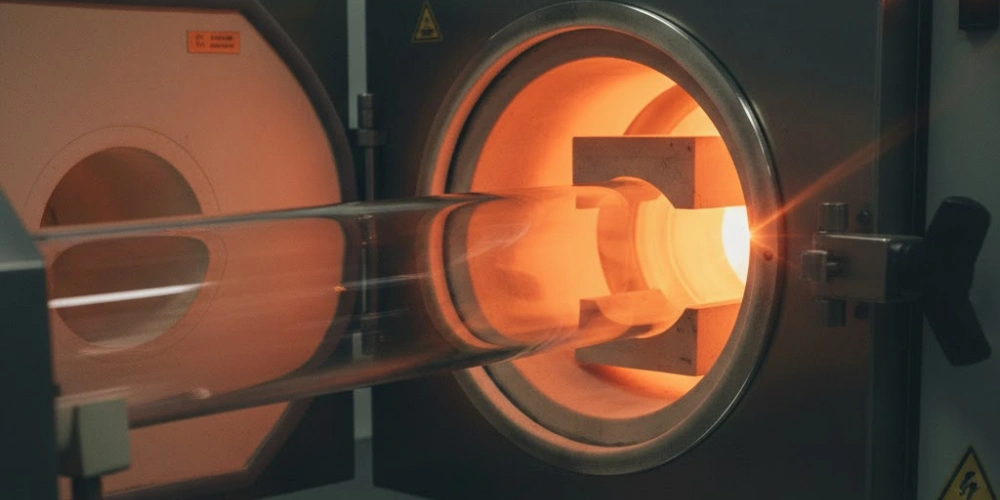
Les barres de quartz atteignent une température maximale à court terme de 1650°C
Parmi les paramètres les plus fréquemment mal appliqués dans la sélection des matériaux à haute température, les limites thermiques du quartz fondu exigent une interprétation précise - et non une approximation. Deux limites de température distinctes régissent la sécurité opérationnelle, et chacune s'applique dans des conditions fondamentalement différentes.
Le seuil d'utilisation continue de 1100°C et sa justification physique
Barres de quartz fondu sont conçus pour fonctionner en continu à des températures allant jusqu'à environ 1100°C. Ce plafond n'est pas défini par le début de la fusion, mais par le seuil cinétique à partir duquel la relaxation structurelle et la dévitrification de la surface commencent à s'accumuler à un rythme qui compromet les performances à long terme. À des températures soutenues supérieures à cette valeur, le réseau de silice amorphe acquiert suffisamment d'énergie thermique pour que le réarrangement atomique se produise de manière mesurable sur des échelles de temps pertinentes pour le service industriel - généralement des heures ou des jours.
Les données expérimentales issues des études de vieillissement thermique indiquent que les échantillons maintenus à 1050°C pendant 200 heures ne présentent pas de cristallisation de surface significative, alors que les échantillons maintenus à 1050°C pendant 200 heures ne présentent pas de cristallisation de surface significative. maintenus à 1150°C pendant des durées équivalentes présentent une nucléation mesurable de la cristobalite sur les surfaces libres. La transition n'est pas abrupte ; il s'agit d'un processus dépendant de la vitesse et régi par la cinétique d'Arrhenius, ce qui explique précisément pourquoi 1100°C est considéré comme un plafond opérationnel conservateur plutôt que comme une limite physique stricte.
Le seuil de 1100°C coïncide également avec une zone de la courbe viscosité-température de la silice fondue où la viscosité tombe en dessous d'environ 10¹⁰-⁵ Pa-s - une valeur à laquelle le fluage sous charge mécanique devient non négligeable sur des périodes de service prolongées.
Le plafond à court terme de 1650°C et les forces qui le sous-tendent
À environ 1650°C, le quartz fondu s'approche de son point de ramollissement.définie comme la température à laquelle la viscosité tombe à environ 10⁷-⁶ Pa-s. En dessous de ce seuil de viscosité, le matériau ne peut plus supporter son propre poids sous une charge gravitationnelle standard sans se déformer de manière mesurable. L'exposition à court terme dans la plage de 1600°C à 1650°C n'est autorisée que lorsque la contrainte mécanique est absente ou négligeable et que la durée de l'exposition est mesurée en minutes plutôt qu'en heures.
Le point de ramollissement de la silice fondue de haute pureté se situe généralement entre 1665°C et 1683°C, en fonction de la teneur en hydroxyle et des niveaux d'impuretés à l'état de traces. Les matériaux à forte teneur en OH (plus de 1000 ppm) se ramollissent à des températures légèrement inférieures. en raison de l'effet de modification du réseau des groupes silanols sur la structure tétraédrique SiO₂. Cette distinction devient critique lorsqu'il s'agit de spécifier des tiges pour des applications optiques dans l'ultraviolet sous vide ou à haute température, où le choix du grade détermine directement le plafond thermique.
L'exposition thermique à ces valeurs extrêmes doit être considérée comme un état transitoire. Chaque excursion vers le plafond de 1650°C accélère la dégradation cumulative de la qualité de la surface et de la stabilité dimensionnelle, même si aucune exposition unique ne produit de dommages visuellement apparents.
Pourquoi les limites de température continue et de température maximale remplissent-elles des fonctions totalement différentes ?
La limite d'utilisation continue de 1100°C et le plafond à court terme de 1650°C concernent deux modes de défaillance totalement distinctsLa limite continue régit la dégradation en fonction du temps - cinétique de dévitrification, fluage visqueux et accumulation de fatigue. La limite continue régit la dégradation en fonction du temps - cinétique de dévitrification, fluage visqueux et accumulation de fatigue. Le plafond à court terme marque la limite d'un compromis structurel aigu - ramollissement, affaissement et perte de contrôle dimensionnel.
En pratique, un barreau de quartz fonctionnant à 1080°C en continu pendant 500 heures accumule plus de dommages fonctionnels qu'un barreau exposé à 1600°C pendant 30 secondesLes ingénieurs qui choisissent le quartz fondu pour des processus cycliques à haute température doivent évaluer les deux paramètres indépendamment et concevoir des profils thermiques qui respectent chaque limite séparément. Les ingénieurs qui choisissent le quartz fondu pour des processus cycliques à haute température doivent évaluer les deux paramètres indépendamment et concevoir des profils thermiques qui respectent chaque limite selon ses propres termes.
Limites de température du barreau de quartz en un coup d'œil
| Paramètres | Valeur | Condition |
|---|---|---|
| Température de service continu (°C) | 1100 | Fonctionnement durable, de quelques heures à quelques mois |
| Température maximale à court terme (°C) | 1650 | Exposition transitoire, minutes |
| Point de ramollissement (°C) | 1665-1683 | En fonction de l'année d'études |
| Point de fonctionnement - viscosité 10³ Pa-s (°C) | ~2000 | Opérations de formage du verre uniquement |
| Point de recuit - viscosité 10¹³ Pa-s (°C) | ~1140 | Soulagement du stress |
| Point de déformation - viscosité 10¹⁴-⁵ Pa-s (°C) | ~1070 | Contrainte permanente fixée en dessous de ce seuil |
Propriétés thermiques qui confèrent au barreau de quartz sa résistance à la chaleur
Enracinées dans la physique du dioxyde de silicium amorphe, les performances thermiques du quartz fondu dépassent celles de la plupart des céramiques et verres réfractaires, d'une manière qu'il est difficile de reproduire avec d'autres matériaux. Ces propriétés ne sont pas indépendantes - elles interagissent pour produire un système de matériaux capable de survivre à des conditions thermiques qui fractureraient de manière catastrophique le verre borosilicaté ou déformeraient la plupart des céramiques à base d'oxyde.
Structure SiO₂ amorphe et son rôle dans la stabilité thermique
Le quartz fondu est un solide non cristallin composé entièrement de quartz en coin. SiO₄ tétraèdres1 disposés dans un réseau aléatoire continu. Cette architecture désordonnée est dépourvue de la périodicité à longue portée du quartz cristallin, et ce caractère aléatoire de la structure est directement responsable de sa stabilité thermique. En l'absence de joints de grains, de plans de clivage ou de sites de défauts périodiques, le quartz fondu n'a pas de voies préférentielles pour l'initiation de fissures ou la décomposition thermique à des températures modérées.
L'énergie de la liaison Si-O est d'environ 444 kJ/mol, soit l'une des plus élevées de tous les systèmes céramiques d'oxyde. Cette force de liaison empêche la dissociation thermique du réseau en dessous de 1700°C.ce qui confère au quartz fondu une fenêtre de stabilité qui englobe la grande majorité des processus industriels à haute température. En outre, l'absence de cations mobiles - contrairement aux verres sodocalciques ou borosilicatés - élimine la conductivité ionique et la dégradation due aux alcalins à des températures élevées.
Cette intégrité structurelle persiste jusqu'à la température d'apparition de la dévitrification, au-delà de laquelle le réseau amorphe commence à se réorganiser en cristobalite cristalline - une transition de phase qui modifie fondamentalement le comportement mécanique et optique.
Dilatation thermique ultra-faible et résistance aux chocs thermiques
Le coefficient de dilatation thermique (CTE) du quartz fondu est d'environ 0,55 × 10-⁶/°C.Le quartz fondu résiste aux chocs thermiques avec un coefficient de dilatation (CTE) exceptionnellement bas, comparé à 3,3 × 10-⁶/°C pour le verre borosilicaté et à 8-12 × 10-⁶/°C pour la plupart des céramiques techniques. Ce CET exceptionnellement bas est la principale raison pour laquelle le quartz fondu résiste aux chocs thermiques avec un facteur de mérite - défini comme la résistance à la traction divisée par le produit du module d'élasticité, du CET et de la conductivité thermique - bien supérieur à celui de la plupart des matériaux concurrents.
Lorsqu'un bâton de quartz est plongé de la température ambiante dans un four à 1000°C, la dilatation différentielle entre sa surface extérieure et son cœur reste si faible que la contrainte thermique induite reste bien en deçà du seuil de rupture à la traction du matériau, qui est d'environ 50-65 MPa. La même excursion thermique appliquée à un barreau d'alumine standard, dont le CDT est proche de 8 × 10-⁶/°C, génère des contraintes plusieurs fois supérieures et provoque souvent une rupture immédiate.
Cette résistance aux chocs thermiques n'implique cependant pas une immunité à la fatigue. Des cycles thermiques répétés, même dans des limites de température sûres, accumulent progressivement des microfissures de surface qui réduisent la ténacité effective à la rupture au fil du temps.
Point de ramollissement et point de fusion - deux seuils que les ingénieurs doivent distinguer
Le quartz fondu n'a pas de véritable point de fusion cristallographique au sens classique du terme.Le point de fusion est la température à laquelle le matériau se fond, car il s'agit d'un solide amorphe et non d'une phase cristalline. Ce qui est communément appelé "point de fusion" dans la littérature commerciale - environ 1710°C - correspond à la température à laquelle la viscosité devient suffisamment faible pour que le matériau puisse s'écouler sous son propre poids sans contrainte. Le point de ramollissement, à environ 1665°C, représente le seuil le plus pertinent sur le plan opérationnel pour les applications porteuses.
En dessous du point de ramollissement, Le quartz fondu se comporte comme un solide viscoélastique dont la vitesse de fluage augmente exponentiellement avec la température. Entre 1100°C et 1300°C, le fluage est suffisamment lent pour être négligeable pour des durées de service courtes, mais il devient significatif sur des périodes dépassant plusieurs centaines d'heures. Au-dessus de 1300°C, les taux de fluage s'accélèrent fortement et une déformation permanente devient visible en quelques heures sous une charge mécanique même modeste.
Comprendre cette distinction permet d'éviter l'erreur courante qui consiste à supposer que toute température inférieure au "point de fusion" de 1710°C est sûre pour une utilisation structurelle - une idée fausse qui a causé des défaillances prématurées dans des applications de tubes à diffusion de semi-conducteurs dans le monde entier.
Propriétés thermiques du quartz fondu par rapport à certains matériaux haute température
| Propriété | Quartz fondu | Verre borosilicaté | Alumine (99%) | Silice fondue (qualité UV) |
|---|---|---|---|---|
| CTE (10-⁶/°C) | 0.55 | 3.3 | 8.1 | 0.55 |
| Point de ramollissement (°C) | 1665 | 820 | N/A (cristallin) | 1670 |
| Température d'utilisation continue (°C) | 1100 | 500 | 1700 | 1100 |
| Conductivité thermique (W/m-K) | 1.38 | 1.14 | 30 | 1.38 |
| Résistance à la traction (MPa) | 50-65 | 40-60 | 150-200 | 50-65 |
| Résistance aux chocs thermiques | Excellent | Modéré | Médiocre-Modéré | Excellent |
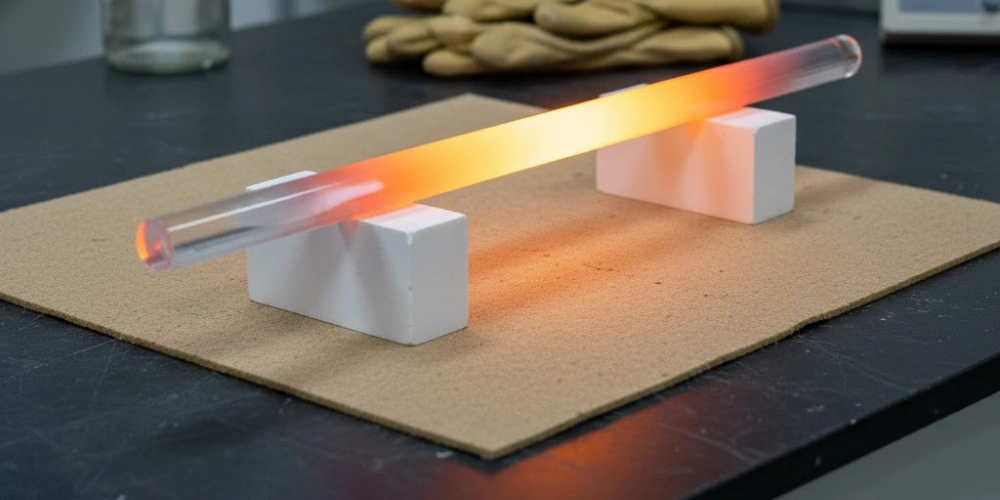
Dévitrification de bâtonnets de quartz déclenchée par une chaleur excessive
Conséquence directe de toute excursion thermique soutenue au-delà du plafond de service de 1100°C, la dévitrification représente le mode de défaillance le plus insidieux et le plus lourd de conséquences rencontré dans les applications de quartz à haute température. Contrairement à la fracture, qui est immédiate et visuellement évidente, la dévitrification est une transformation progressive qui compromet l'intégrité du matériau avant qu'aucun signe visible n'apparaisse à l'opérateur.
Définition structurelle de la dévitrification au niveau atomique
La dévitrification est la conversion thermiquement activée du dioxyde de silicium amorphe en cristobalite cristalline (β-SiO₂).un polymorphe à haute température qui se nucléarise préférentiellement sur les surfaces libres et les sites d'impuretés au sein du réseau de quartz fondu. Au niveau atomique, ce processus implique le réarrangement coopératif des tétraèdres SiO₄ de leur configuration aléatoire en réseau vers l'arrangement cubique ordonné à faces centrées caractéristique de la β-cristobalite.
La transformation est classée comme un processus de nucléation et de croissance régi par la cinétique classique de l'état solide. Les taux de nucléation atteignent leur maximum entre 1200°C et 1250°C environ.tandis que les taux de croissance cristalline atteignent leur maximum vers 1450°C. Cette dépendance à l'égard de la température signifie qu'une exposition entre 1100°C et 1300°C est particulièrement dangereuse pour la nucléation - même sans croissance rapide, une fois que les noyaux se forment, les cycles de chauffage ultérieurs leur permettent de croître en domaines cristallins visibles.
La dévitrification est irréversible dans des conditions de fonctionnement normales. Une fois que des domaines de cristobalite se forment dans le réseau de quartz fondu, aucun traitement thermique pratique en dessous du point de ramollissement ne peut restaurer la structure amorphe d'origine.
Température et durée d'exposition nécessaires pour initier la cristallisation
L'apparition d'une cristallisation de surface détectable sur des barres de quartz fondu de haute pureté nécessite l'action combinée de la température et du temps. À 1150°C, la formation mesurable de cristobalite sur des surfaces propres et non contaminées nécessite généralement des durées d'exposition supérieures à 100 heures. À 1200°C, le même degré de cristallisation peut se produire en 20 à 40 heures. À 1300°C, la dévitrification de la surface devient visible à l'œil nu en 5 à 10 heures d'exposition continue.
Ces chiffres s'appliquent à des surfaces exemptes de contamination métallique et de groupes hydroxyles. La présence de métaux alcalins, même à l'état de traces - aussi peu que 1 ppm de sodium - réduit le temps d'induction de la cristallisation d'un ordre de grandeur. à une température donnée, car les ions alcalins agissent comme des modificateurs de réseau qui abaissent la barrière d'énergie d'activation pour la réorientation des tétraèdres de SiO₄.
La nature cumulative de l'exposition thermique doit également être reconnue. Une tige de quartz soumise à 50 cycles de chauffage, chacun atteignant 1180°C pendant 4 heures, accumule les mêmes dommages de dévitrification qu'une exposition unique de 200 heures - un fait qui est souvent négligé dans les équipements de processus cycliques.
La contamination de surface comme catalyseur de la dévitrification accélérée
La contamination est la variable la plus contrôlable dans la cinétique de dévitrification des barres de quartz. Les empreintes digitales sont l'une des sources les plus courantes et les plus dommageables de contamination des surfaces. La transpiration humaine dépose des ions de sodium, de potassium et de chlorure sur la surface de la silice à des concentrations suffisantes pour catalyser la nucléation de la cristobalite à des températures aussi basses que 900°C. Ce seuil est d'environ 200°C inférieur à la température de début de dévitrification d'une surface propre. Ce seuil est inférieur d'environ 200°C à la température de début de dévitrification pour une surface propre.
La contamination métallique due au contact avec les outils - les outils de manutention en acier inoxydable, par exemple - dépose du fer, du chrome et du nickel sur la surface. Il a été démontré que la contamination par le fer à des concentrations de seulement 5 ppm réduisait la température de début de dévitrification de 80°C à 120°C dans des études contrôlées en laboratoire. Cela explique pourquoi les composants en quartz des fours de diffusion de semi-conducteurs, qui doivent être manipulés selon des protocoles de salle blanche spécifiques, présentent des durées de vie nettement plus courtes lorsque des outils métalliques standard sont utilisés par inadvertance.
Les résidus organiques provenant des lubrifiants d'usinage ou des dépôts atmosphériques d'hydrocarbures se décomposent pendant le chauffage initial, laissant des résidus carbonés et métalliques qui servent de sites de nucléation hétérogènes pour la croissance de la cristobalite.
Symptômes visuels et dimensionnels d'un barreau de quartz dévitrifié
La première indication visuelle de dévitrification est une légère décoloration laiteuse ou trouble à la surface de la tige de quartzCette opacité est due à la diffusion de la lumière transmise aux limites des cristaux de cristobalite, qui ont un indice de réfraction d'environ 1,49 - légèrement supérieur à celui de la silice amorphe environnante (1,46). Cette opacité résulte de la diffusion de la lumière transmise aux limites des cristaux de cristobalite, qui ont un indice de réfraction d'environ 1,49 - légèrement supérieur à celui de la silice amorphe environnante, qui est de 1,46. La différence d'indice de réfraction crée une diffusion visible même lorsque la couche cristalline ne fait que quelques micromètres d'épaisseur.
Au fur et à mesure que la dévitrification progresse, la surface prend une forme caractéristique. blanc, mat, texture givrée qui se distingue facilement de l'aspect transparent et poli au feu d'origine. En coupe, la microscopie à lumière polarisée révèle les domaines cristallins comme des régions biréfringentes par rapport à la matrice amorphe optiquement isotrope. La profondeur de la couche dévitrifiée varie généralement de 10 μm dans les cas précoces à plusieurs centaines de micromètres dans les spécimens gravement dégradés.
Sur le plan dimensionnel, les spécimens dévitrifiés peuvent présenter une légère rugosité de surface détectable par profilométrie, avec des valeurs de rugosité moyenne (Ra) passant de valeurs typiques telles que fabriquées inférieures à 0,1 μm à 0,5-2,0 μm dans les cas de dévitrification modérée.
Dégradation de la résistance mécanique et de la transmission optique après dévitrification
La cristobalite subit une transformation de phase displacive de la forme β à la forme α à environ 220°C lors du refroidissement.accompagnée d'une contraction du volume d'environ 2,8%. Cette contraction génère des micro-contraintes de traction à la limite entre la couche superficielle dévitrifiée et le noyau amorphe sous-jacent. Ces contraintes agissent comme des initiateurs de fissures préexistantes, réduisant le module de rupture effectif du barreau de 30% à 60% selon la profondeur de la couche dévitrifiée.
Dans les applications optiques, les conséquences sont tout aussi graves. La transmission du quartz fondu dans le domaine de l'ultraviolet (200-300 nm) diminue de 15% à 40% par millimètre d'épaisseur de la couche superficielle dévitrifiée.La taille des domaines cristallins augmente avec la taille des domaines, ce qui rend les composants de qualité UV inadaptés aux applications optiques de précision après une cristallisation, même modérée. Pour les applications infrarouges, les pertes par diffusion dans la gamme des 3-5 μm augmentent proportionnellement à la taille des domaines cristallins.
D'un point de vue structurel, la combinaison des microcontraintes de surface et de la réduction de la résistance à la rupture signifie qu'un barreau de quartz dévitrifié est beaucoup plus susceptible de se rompre sous l'effet d'un cycle thermique - les conditions mêmes qui sont à l'origine de sa dégradation - créant ainsi un mécanisme de défaillance qui s'accélère de lui-même.
Conditions d'apparition de la dévitrification pour les bâtonnets de quartz fondu
| État de surface | Température d'apparition (°C) | Temps de cristallisation visible (h) | Catalyseur primaire |
|---|---|---|---|
| Propre, non contaminé | 1150-1200 | 80-150 | Énergie thermique seule |
| Contamination des empreintes digitales | 900-950 | 10-30 | Ions Na, K, Cl |
| Contact avec des outils en fer (5 ppm Fe) | 1030-1070 | 20-50 | Fe comme catalyseur de nucléation |
| Exposition aux métaux alcalins (1 ppm Na) | 950-1000 | 5-15 | Modification du réseau |
| Surface riche en OH (>500 ppm) | 1100-1130 | 50-100 | Mobilité du groupe silanol |
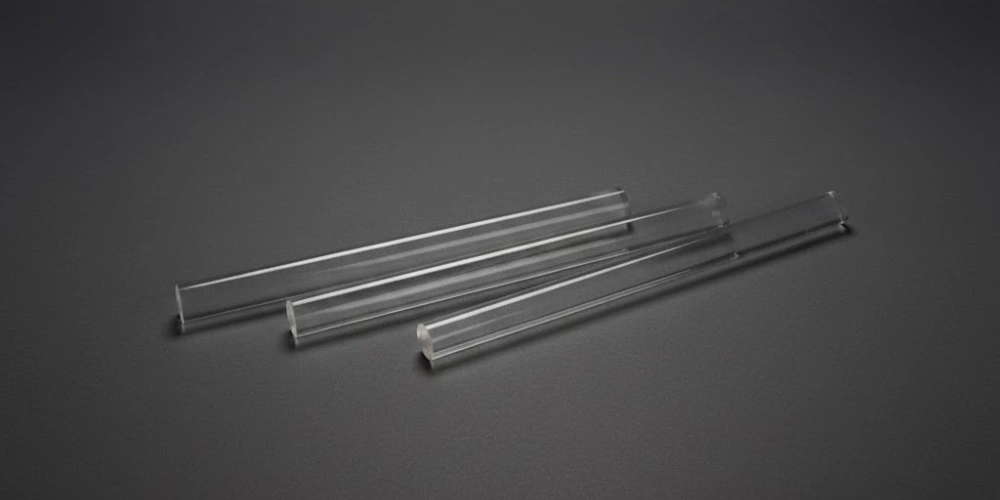
Contrainte thermique et comportement à la rupture dans le service de barres de quartz
Parallèlement à la voie de dégradation chimique représentée par la dévitrification, la rupture mécanique par contrainte thermique constitue un mode tout aussi important - et souvent plus brutal - de destruction des barreaux de quartz. Contrairement à la dévitrification, la rupture thermique peut se produire dès le premier cycle de chauffage si les gradients de température ou les variables géométriques dépassent des seuils critiques.
Formation d'un gradient thermique le long d'un barreau de quartz sous l'effet d'un chauffage localisé
Lorsque la chaleur est appliquée à une section d'un bâton de quartz alors que les régions adjacentes restent à des températures plus basses, un gradient thermique s'établit qui génère des tensions de dilatation différentielles dans tout le matériau. Pour une tige d'un diamètre de 10 mm et d'une conductivité thermique de 1,38 W/m-K, un taux de chauffage localisé de 20°C/min appliqué sur une zone de 50 mm produit des différentiels de température radiaux de 15°C à 25°C entre la surface de la tige et son axe central. Bien que le faible CDT du quartz fondu atténue les contraintes qui en résultent, des gradients soutenus supérieurs à 50°C sur de courtes distances axiales peuvent générer des contraintes de traction approchant le seuil de rupture du matériau.
Les analyses par éléments finis des assemblages de tubes de diffusion ont démontré que des gradients de température supérieurs à 3°C/mm le long de la direction axiale d'une tige de quartz génèrent des concentrations de contraintes au niveau des discontinuités géométriques - les faces d'extrémité, les transitions de diamètre et les points de contact avec le support - qui peuvent dépasser 40 MPa, approchant ainsi la limite inférieure des valeurs de résistance à la traction rapportées. Ce comportement est particulièrement prononcé dans les tiges dont l'épaisseur de paroi est inférieure à 3 mm, où l'accumulation de chaleur à la surface par rapport au cœur est plus rapide.
Le problème du gradient thermique est aggravé dans les configurations de fours à zones multiples, où les limites entre les zones chauffées et non chauffées imposent des transitions de température axiale brutales sur toute tige traversant plusieurs zones.
Cyclage rapide en température et son effet sur la propagation des fissures
Des cycles thermiques répétés - même dans des limites de température qui, individuellement, ne causeraient aucun dommage détectable - étendent progressivement les microfissures de surface préexistantes par un mécanisme de fatigue analogue à une charge mécanique cyclique. Chaque cycle de chauffage et de refroidissement génère une impulsion de contrainte aux extrémités des fissures, et le facteur d'intensité de contrainte à ces extrémités s'accumule de manière incrémentielle avec chaque cycle. Pour les fissures superficielles d'une profondeur initiale de 10 μm - typiques des surfaces de quartz polies au feu telles que reçues - la modélisation de la mécanique de la rupture indique que 1000 cycles thermiques entre 25°C et 900°C peuvent étendre la profondeur des fissures à 25-40 μm.réduisant la résistance résiduelle de 20-35%.
La phase de refroidissement de chaque cycle est généralement plus dommageable que la phase de chauffage, car la surface extérieure se refroidit et se contracte plus rapidement que l'intérieur, ce qui met la surface en tension alors que le noyau reste en compression. Des taux de refroidissement supérieurs à 5°C/min pour des tiges d'un diamètre supérieur à 15 mm produisent systématiquement des contraintes de traction superficielle supérieures à 20 MPa. dans les premiers millimètres de profondeur, un seuil suffisant pour propager des fissures préexistantes dans les spécimens présentant des dommages de fatigue accumulés.
Dans les applications de fours à semi-conducteurs, où les tubes de diffusion et les tiges de support en quartz peuvent subir de 500 à 2000 cycles thermiques au cours de leur durée de vie, ce mécanisme de fatigue est la principale cause de rupture soudaine - qui se produit souvent sans aucun avertissement visuel préalable.
Variables géométriques - Diamètre et épaisseur de la paroi comme facteurs de tolérance au stress
La géométrie d'une tige de quartz exerce une influence directe et quantifiable sur sa résistance aux contraintes thermiques. Pour les barres solides, la résistance à la contrainte est inversement proportionnelle au diamètre : une barre de 5 mm de diamètre peut tolérer des gradients thermiques environ 3 fois supérieurs à ceux d'une barre de 25 mm de diamètre avant d'atteindre des niveaux de contrainte équivalents, car la différence de température absolue entre le cœur et la surface diminue avec la surface de la section transversale. Les données des fabricants montrent systématiquement que les tiges d'un diamètre inférieur à 8 mm peuvent être chauffées à des vitesses allant jusqu'à 15°C/min sans générer de concentrations de contraintes supérieures à 15 MPatandis que les barres de plus de 20 mm de diamètre nécessitent des vitesses de chauffage inférieures à 5°C/min pour des niveaux de contrainte équivalents.
Pour les tubes creux en quartz utilisés comme éléments structurels en forme de tige, l'épaisseur de la paroi détermine à la fois le gradient thermique à travers la paroi et le moment d'inertie disponible pour résister à la flexion. Les parois d'une épaisseur inférieure à 2 mm chauffent et refroidissent si rapidement que les contraintes induites par le gradient sont minimes, mais elles n'offrent pratiquement aucune résistance aux charges mécaniques à des températures élevées où le fluage est actif. Des parois de 3 à 6 mm représentent la plage optimale. pour la plupart des applications structurelles à haute température, en équilibrant la gestion du gradient thermique et la capacité de charge mécanique.
Les transitions de diamètre conique ou étagé sur la longueur d'une tige créent des facteurs de concentration de contrainte de 1,5 à 2,5 fois la contrainte thermique nominale - une amplification géométrique qui doit être prise en compte dans toute application thermique de précision.
Paramètres de contrainte thermique pour les bâtonnets de quartz fondu en fonction de leur diamètre
| Diamètre de la tige (mm) | Vitesse de chauffe maximale sûre (°C/min) | Vitesse de refroidissement maximale de sécurité (°C/min) | Gradient thermique maximal estimé (°C/mm) | Niveau de risque de fracture |
|---|---|---|---|---|
| < 5 | 20 | 15 | 8 | Faible |
| 5-10 | 15 | 10 | 5 | Faible-modéré |
| 10-20 | 8 | 5 | 3 | Modéré |
| 20-40 | 4 | 3 | 1.5 | Haut |
| > 40 | 2 | 1.5 | 0.8 | Très élevé |
Le quartz fondu et la silice fondue présentent des plafonds thermiques différents
L'ambiguïté entre "quartz fondu" et "silice fondue" est l'une des sources les plus persistantes d'erreurs de spécification dans l'approvisionnement en matériaux haute température, et les conséquences de cette confusion sont directement visibles dans les données de performance thermique.
-
Quartz fondu est produit par la fusion de cristaux de quartz naturels (SiO₂ d'une pureté typique de 99,9-99,99%) dans des processus de fusion électrique ou à la flamme. Le matériau obtenu contient entre 150 et 400 ppm de groupes hydroxyles (OH) et des traces d'impuretés métalliques à des niveaux de 1 à 20 ppm. Sa température d'utilisation continue est d'environ 1050°C à 1100°Cet le début de la dévitrification se produit vers 1150°C en cas de chauffage prolongé.
-
Silice fondue (synthétique) est fabriqué à partir de tétrachlorure de silicium (SiCl₄) de haute pureté ou de précurseurs de silane par l'intermédiaire de hydrolyse à la flamme2 ou par dépôt de plasma, ce qui permet d'obtenir un matériau d'une pureté supérieure à 99,999% SiO₂. Selon le procédé de fabrication, la teneur en OH varie de moins de 1 ppm (Type III, IV) à plus de 1000 ppm (Type II). Les silices fondues de haute pureté et à faible teneur en OH résistent à la dévitrification jusqu'à environ 1200°C. et conservent une stabilité dimensionnelle supérieure à 1100°C. La température de service continu pour les qualités supérieures est donc supérieure d'environ 50°C à 100°C à celle du quartz fondu standard.
La distinction est particulièrement importante dans les applications de semi-conducteurs et de fibres optiques, où les températures de fonctionnement dépassent souvent le plafond de 1100°C et où le choix de la qualité du matériau détermine directement la durée de vie du composant. En spécifiant "barre de quartz" de manière générique sans préciser la qualité de matériau requise, on risque d'acheter du quartz fondu standard pour des applications qui nécessitent techniquement de la silice fondue synthétique.
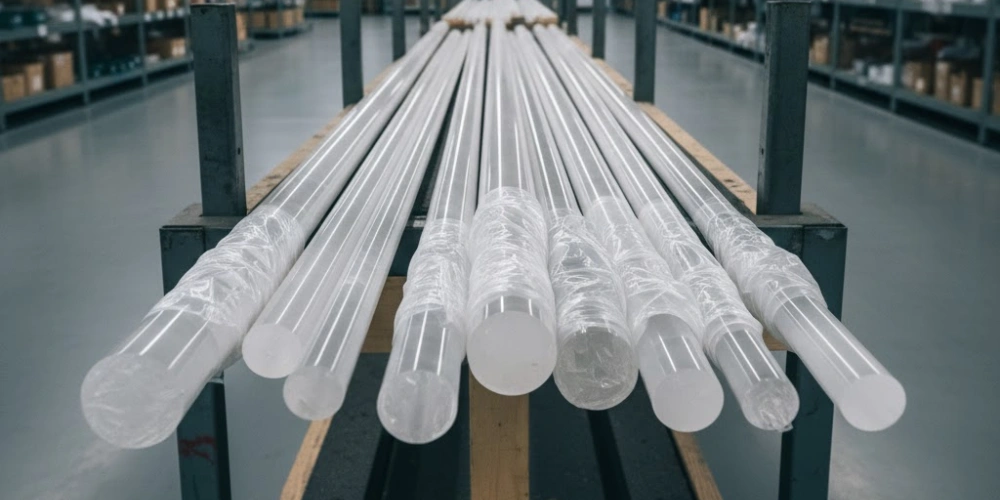
Les niveaux de pureté et leur influence sur les plafonds thermiques en quartz
Au-delà de la classification générale quartz fondu/silice fondue, le profil d'impureté spécifique d'un lot de matériaux donné modifie quantitativement les limites de la performance thermique de manière prévisible et mesurable.
-
Teneur en hydroxyle (OH) est la variable d'impureté unique la plus influente. Une teneur élevée en OH (supérieure à 800 ppm) abaisse le point de ramollissement d'environ 30°C à 50°C par rapport à un matériau sans OH, car les groupes silanols interrompent la continuité du réseau SiO₂ et réduisent la connectivité moyenne du réseau. Inversement, une très faible teneur en OH (inférieure à 10 ppm) peut améliorer la résistance à la déformation visqueuse à des températures supérieures à 1200°C, mais peut entraîner une susceptibilité au compactage induit par les rayonnements dans les applications UV.
-
Impuretés de métaux alcalins - principalement le sodium (Na), le potassium (K) et le lithium (Li) - agissent comme des modificateurs de réseau à des concentrations aussi faibles que 0,1 ppm, en créant des sites d'oxygène non pontants qui augmentent la mobilité ionique et accélèrent la cinétique de dévitrification. Chaque incrément de 1 ppm de sodium réduit la température effective de début de dévitrification d'environ 15°C à 25°C. Les matériaux destinés à être utilisés à haute température doivent avoir une teneur totale en alcali inférieure à 0,2 ppm.
-
Impuretés de métaux de transition - Le fer, le titane et le chrome absorbent le rayonnement infrarouge plus fortement que la matrice de silice environnante, créant des points chauds localisés pendant le chauffage radiatif. Des concentrations de fer supérieures à 3 ppm ont été mesurées pour augmenter les températures de surface locales de 40°C à 80°C au-dessus de la température globale dans des environnements de fours chauffés à l'infrarouge, ce qui abaisse effectivement le plafond thermique pratique sans aucun changement dans les spécifications nominales du matériau. Pour les applications à des températures supérieures à 900°C, la teneur totale en métaux de transition doit rester inférieure à 1 ppm.
Les certificats de pureté fournis avec chaque lot de matériaux doivent être évalués par rapport à ces références avant que les déclarations de performance thermique ne soient acceptées à leur valeur nominale.
Conditions atmosphériques altérant la performance thermique des bâtonnets de quartz
L'environnement gazeux qui entoure une tige de quartz pendant un service à haute température n'est pas thermiquement neutre - il interagit chimiquement et physiquement avec la surface de la silice d'une manière qui modifie à la fois la température de service effective et la cinétique de dégradation.
-
Environnements sous vide supprimer les réactions d'oxydation de la surface et éliminer l'apport de vapeur d'eau - un accélérateur connu de l'altération de la surface. hydroxylation3 et la dévitrification. Dans des conditions de vide supérieures à 10-³ Pa, le début de la cristallisation superficielle est décalé vers le haut d'environ 50°C à 80°C par rapport à l'atmosphère ambiante, ce qui prolonge la durée de vie effective à des températures proches du plafond d'utilisation continue. Cependant, un service sous vide supérieur à 1200°C favorise l'évaporation du SiO de la surface de la tige à une vitesse d'environ 0,1 μm/heure, ce qui entraîne une perte de masse progressive et une rugosité de la surface sur des périodes de service prolongées.
-
Atmosphères de gaz inerte (argon, hélium, azote) reproduisent largement l'effet du vide sur la suppression de la dévitrification tout en éliminant la perte de masse par évaporation. Les atmosphères d'azote inférieures à 1300°C sont généralement sûres ; au-dessus de 1300°C, une nitruration partielle de la surface de la silice a été signalée dans l'azote de haute pureté, formant des domaines de nitrure de silicium à l'état de traces qui altèrent les propriétés thermiques locales.
-
Atmosphères oxydantes (air, environnements enrichis en oxygène) favorisent l'oxydation superficielle de toute espèce de silicium réduit, mais ont généralement un impact minimal sur le quartz fondu stœchiométrique en dessous de 1200°C. Au-dessus de ce seuil, la pression partielle de l'oxygène influence l'équilibre entre le SiO₂ de surface et le SiO volatil, les pressions d'oxygène plus élevées supprimant l'évaporation.
-
Atmosphères humides et de vapeur sont parmi les environnements les plus agressifs pour les tiges de quartz. La vapeur d'eau hydroxyle la surface de la silice, augmentation de la concentration en OH à la surface et accélération de la dévitrification de 100°C à 150°C par rapport aux atmosphères sèches. Les environnements à vapeur supérieurs à 900°C doivent être totalement évités en cas de service de longue durée.
-
Atmosphères réductrices (hydrogène, gaz formateur) à des températures supérieures à 900°C peut réduire partiellement le SiO₂ de surface en SiO, créant une couche de surface substoichiométrique légèrement assombrie avec des propriétés optiques et mécaniques altérées. Des pressions partielles d'hydrogène supérieures à 10 kPa à 1000°C produisent une réduction mesurable de la surface dans les 50 heures d'exposition.
Plages de température des bâtonnets de quartz dans les principales applications industrielles
Dans les industries qui dépendent le plus des composants en quartz fondu, les exigences thermiques imposées aux tiges et aux tubes couvrent une large gamme - et chaque secteur fonctionne avec des profils de température caractéristiques, des fréquences de cycle et des conditions atmosphériques qui interagissent avec les limites thermiques du matériau de manière spécifique au secteur.
-
Fours de diffusion et d'oxydation de semi-conducteurs représentent l'application de routine la plus exigeante sur le plan thermique. Les cuves, les tubes et les tiges de support en quartz de ces systèmes fonctionnent en permanence entre 900°C et 1150°C, l'extrémité supérieure de cette plage se heurtant directement au plafond de dévitrification. Le nombre de cycles dans les fabriques à grand volume peut atteindre 2000 à 3000 cycles thermiques par an, ce qui fait de la fatigue thermique le principal mécanisme limitant la durée de vie plutôt qu'une surchauffe ponctuelle.
-
Lampes UV et systèmes d'irradiation germicide fonctionnent à des températures d'enveloppe comprises entre 600°C et 900°C - bien en deçà de la plage de service continu sûre - mais les exigences optiques de ces applications signifient que même la dévitrification sous-critique, causée par la contamination plutôt que par la surchauffe, rend les composants non fonctionnels avant qu'une défaillance mécanique ne se produise.
-
Fours tubulaires de laboratoire et cuves de réaction à haute température fonctionnent généralement entre 800°C et 1100°C. Dans le cadre de la recherche, les protocoles thermiques sont souvent irréguliers et les taux de chauffage sont souvent appliqués sans contrôle strict, ce qui fait que le choc thermique est un mode de défaillance plus courant que dans les environnements industriels avec des programmes de température automatisés.
-
Fabrication de préformes de fibres optiques utilise des tiges et des mandrins en silice fondue à des températures comprises entre 1400°C et 1800°C pendant les opérations d'effondrement et d'étirage. À ces températures, le matériau est délibérément utilisé au-dessus du plafond de service continu pour de courtes durées contrôlées, en s'appuyant sur l'absence de charge mécanique soutenue et sur l'effet protecteur des atmosphères de gaz inertes de haute pureté pour empêcher la dévitrification et la perte de masse par évaporation.
-
Éléments chauffants infrarouges et tubes radiants dans les fours industriels fonctionnent entre 700°C et 1050°C. Le principal problème thermique dans ces applications est la surchauffe localisée aux points de connexion électrique, où la résistance de contact génère des points chauds qui peuvent dépasser de 100°C à 200°C la température de fonctionnement globale.
Précautions de manipulation thermique essentielles pour les barres de quartz en fonctionnement
En comblant le fossé entre la compréhension des limites de température en théorie et leur application correcte en pratique, les précautions régissant la manipulation physique et la gestion thermique des tiges de quartz sont les leviers les plus directs disponibles pour prolonger la durée de vie. Les défaillances attribuables à des erreurs de manipulation représentent une part disproportionnée des remplacements prématurés de composants en quartz, tant dans l'industrie que dans les laboratoires.
Taux de chauffage et de refroidissement contrôlés pour éviter les chocs thermiques
Le contrôle de la vitesse de chauffage et de refroidissement est le moyen le plus immédiatement efficace de prévenir la fracture par choc thermique des barres de quartz. Pour les barres dont le diamètre est compris entre 10 et 20 mm, une vitesse de chauffe maximale de 5 à 8 °C par minute est recommandée pour la plage de température comprise entre la température ambiante et 600 °C, où les gradients thermiques entre la surface et le cœur sont les plus importants par rapport à la conductivité thermique du matériau. Au-dessus de 600°C, où le transfert de chaleur radiatif devient de plus en plus dominant et plus uniforme, des vitesses de chauffage allant jusqu'à 10°C/min sont généralement tolérables pour cette gamme de diamètres.
La phase de refroidissement exige un contrôle des taux égal ou supérieur à celui du chauffage. La trempe rapide à partir de la température de fonctionnement - même à partir de 800°C - génère des contraintes de traction sur la surface extérieure d'un barreau qui se contracte devant l'intérieur encore chaud. Pour les barres qui ont accumulé des microfissures de surface lors de cycles antérieurs, des vitesses de refroidissement supérieures à 8°C/min à partir de températures supérieures à 700°C ont été associées à des taux de rupture spontanée de 15% à 25% par cycle dans les registres documentés de maintenance des équipements de traitement.
Le préchauffage des barres de quartz avant leur insertion dans un four chaud - à au moins 300°C au-dessus de la température ambiante - réduit considérablement l'impulsion de choc thermique subie pendant les premières minutes de l'insertion, en particulier lorsque les températures de fonctionnement du four dépassent 900°C.
Contamination par contact avec les mains et son effet accélérateur sur la dévitrification de la surface
Le contact direct de la peau avec les surfaces des barres de quartz pendant leur manipulation est l'une des causes les plus évitables de dévitrification accélérée en laboratoire et dans les environnements de production. La transpiration humaine dépose du sodium à raison d'environ 0,1 à 1 μg/cm² par contact - une quantité suffisante pour catalyser la cristallisation de la surface à des températures de 150°C à 200°C inférieures au début de la dévitrification de la surface propre. Dans les environnements de semi-conducteurs en salle blanche, ce mécanisme de contamination a été quantifié pour réduire la durée de vie des composants en quartz de 40% à 60% lorsque les gants de salle blanche standard ne sont pas utilisés de manière cohérente.
La manipulation doit se faire exclusivement avec des gants en coton ou en nitrile non pelucheux.Le contact doit être limité, dans la mesure du possible, aux extrémités les plus froides des tiges. Après tout contact accidentel avec la peau, la surface affectée doit être nettoyée avec de l'alcool isopropylique (IPA) de qualité semi-conducteur et laissée à sécher complètement avant toute exposition thermique. Si cette étape de nettoyage n'est pas effectuée, les contaminants déposés se lient de manière covalente à la surface de la silice pendant le premier cycle de chauffage, après quoi il est pratiquement impossible de les enlever sans traitement abrasif.
Même la manipulation avec des gants introduit une contamination si les gants eux-mêmes ont été exposés à des outils métalliques, des lubrifiants ou des solvants organiques - ce qui renforce l'importance de disposer d'un équipement de manipulation propre et spécialisé pour les composants en quartz.
Placement des supports mécaniques à des températures de fonctionnement élevées
L'emplacement et la géométrie des structures de soutien mécanique des tiges de quartz à des températures élevées sont des facteurs déterminants de la distribution des contraintes et des modèles de déformation par fluage. À des températures supérieures à 900°C, la viscosité du quartz fondu est suffisamment faible pour qu'une tige orientée horizontalement de 10 mm de diamètre et de 500 mm de long, soutenue uniquement à ses extrémités, présente un affaissement mesurable à mi-portée dans les 200 heures - une déviation qui compromet de façon permanente l'adéquation dimensionnelle de la tige et concentre les contraintes aux points de contact du support.
Les intervalles de support ne doivent pas dépasser 200 mm pour les tiges d'un diamètre inférieur à 10 mm utilisées à des températures supérieures à 1000°C.Les points de contact doivent être répartis sur la plus grande surface possible afin de minimiser la concentration des contraintes. Les contacts ponctuels - tels que ceux créés par les supports céramiques en arête de couteau - génèrent des pressions de contact qui peuvent localement dépasser la limite d'élasticité en compression du matériau à haute température, enfonçant le support dans la surface de la tige et créant un site de concentration de contraintes qui initie une fissuration lors du refroidissement ultérieur.
Les matériaux de support doivent être chimiquement compatibles avec le quartz fondu - l'alumine de haute pureté ou les métaux du groupe du platine sont préférables. Les supports en carbure de silicium, malgré leurs avantages mécaniques, introduisent des traces de contamination au carbone et au silicium sur les surfaces de contact au-dessus de 1000°C.
Résumé des précautions à prendre lors de la manipulation thermique des barres de quartz
| Paramètre de manipulation | Pratique recommandée | Risque de non-conformité |
|---|---|---|
| Vitesse de chauffe (dia. 10-20 mm) | ≤ 8°C/min en dessous de 600°C | Fracture par choc thermique |
| Taux de refroidissement (dia. 10-20 mm) | ≤ 5°C/min à partir de > 700°C | Fissuration superficielle par traction |
| Type de gant | Coton propre ou nitrile | Accélération de la dévitrification |
| Nettoyage après contact | Essuyer avec de l'IPA avant de chauffer | Début de cristallisation catalytique |
| Portée maximale du support (dia. 1000°C) | ≤ 200 mm | Affaissement permanent par fluage |
| Matériel de soutien | Alumine ou platine de haute pureté | Contamination de la surface et fissuration |
| Préchauffage avant l'insertion du four | ≥ 300°C au-dessus de la température ambiante | Choc thermique à l'insertion |
Longévité des tiges de quartz soumises à une charge soutenue à haute température
Pour tout déploiement durable à haute température, la durée de vie dépend de la mesure dans laquelle les conditions opérationnelles se rapprochent des limites thermiques du matériau - et de la rigueur avec laquelle les conditions de manipulation et les conditions atmosphériques sont contrôlées.
-
Température de fonctionnement par rapport au plafond de 1100°C est la principale variable limitant la durée de vie. Un barreau de quartz fonctionnant à 950°C dans une atmosphère inerte propre et sèche peut raisonnablement atteindre une durée de vie de 18 à 36 mois en fonctionnement continu. Le même bâtonnet utilisé à 1080°C dans des conditions atmosphériques et de manipulation identiques peut subir une dégradation optique ou mécanique liée à la dévitrification dans un délai de 3 à 6 mois.
-
Nombre de cycles thermiques exerce une influence secondaire mais significative. Les barres soumises à 500 cycles thermiques ou plus entre la température ambiante et la température de fonctionnement accumulent suffisamment d'extension de fissures superficielles pour réduire la résistance effective à la rupture de 20% à 40%, même en l'absence d'un seul événement de surchauffe. Les applications à cycle élevé - telles que le traitement par four discontinu dans la fabrication de semi-conducteurs - doivent donc prévoir un remplacement préventif à des intervalles de cycle définis plutôt que d'attendre un dommage visible.
-
Gestion de l'atmosphère et de la contamination peut prolonger ou réduire la durée de vie d'un facteur de 2 à 4, indépendamment de la température. Les tiges maintenues dans des environnements de gaz inertes propres et secs avec des protocoles de manipulation stricts surpassent systématiquement les composants identiques utilisés dans l'air humide avec une manipulation incontrôlée par des marges substantielles dans des comparaisons industrielles côte à côte.
-
Géométrie et configuration de la charge déterminer si la déformation par fluage ou la concentration de contraintes au point de contact devient le principal mécanisme de fin de vie à des températures supérieures à 900°C. Les tiges d'un diamètre supérieur à 20 mm dans les configurations horizontales présentent généralement une non-conformité dimensionnelle induite par le fluage avant que la dévitrification de la surface ne devienne visuellement apparente, ce qui inverse la séquence du mode de défaillance observée dans les composants de plus petit diamètre.
L'inspection périodique - combinant l'évaluation visuelle des changements d'opacité de la surface et la mesure dimensionnelle de l'affaissement induit par le fluage - est la méthode la plus fiable pour prédire la durée de vie restante avant qu'une défaillance catastrophique ne se produise.
Conclusion
Les performances thermiques des tiges de quartz fondu sont limitées par deux seuils distincts : le plafond de 1100°C en service continu, régi par la cinétique de dévitrification et le fluage visqueux, et le maximum à court terme de 1650°C, défini par le point de ramollissement du matériau. Le dépassement de l'une ou l'autre de ces limites - même brièvement et de manière répétée - entraîne une dégradation progressive du matériau par cristallisation de la cristobalite, fissuration par fatigue thermique ou déformation par fluage. Le degré de pureté, l'environnement atmosphérique, la gestion de la contamination et la géométrie du support modifient tous ces limites de manière significative. Pour obtenir des performances fiables à long terme, il faut traiter chacune de ces variables comme un paramètre d'ingénierie de précision plutôt que comme une considération de fond.
FAQ
Quelle est la température maximale de fonctionnement continu d'un bâton de quartz fondu ?
La température maximale de fonctionnement continu d'une tige de quartz fondu standard est d'environ 1100°C. Au-delà de cette valeur, la cinétique de dévitrification et le fluage visqueux s'accumulent à des taux qui compromettent les performances structurelles et optiques sur des durées de service pratiques.
Quelle est la cause de la dévitrification des barres de quartz, et peut-on l'inverser ?
La dévitrification est causée par la cristallisation thermiquement activée du SiO₂ amorphe en cristobalite, accélérée par la contamination de la surface par des métaux alcalins, des empreintes digitales ou le contact d'outils métalliques. Une fois les domaines de cristobalite formés, la transformation est irréversible dans des conditions de fonctionnement normales - aucun traitement thermique pratique en dessous du point de ramollissement ne peut restaurer la structure amorphe d'origine.
L'atmosphère qui entoure un bâton de quartz affecte-t-elle ses limites thermiques ?
Les conditions atmosphériques influencent considérablement les performances thermiques effectives. Les environnements sous vide et sous gaz inerte suppriment la dévitrification de 50°C à 80°C par rapport à l'air ambiant, tandis que les atmosphères humides ou à vapeur accélèrent la cristallisation de 100°C à 150°C. Les atmosphères réductrices supérieures à 900°C peuvent réduire partiellement la surface de la silice, ce qui altère les propriétés optiques et mécaniques.
Comment les barres de quartz doivent-elles être manipulées pour éviter une dégradation thermique prématurée ?
Les barreaux de quartz doivent toujours être manipulés avec des gants propres en coton ou en nitrile afin d'éviter toute contamination par contact avec la peau, ce qui peut réduire la température d'apparition de la dévitrification de 150°C à 200°C. Les vitesses de chauffage et de refroidissement doivent être limitées à 5°C à 8°C par minute pour les barreaux de 10 mm à 20 mm de diamètre, et les supports mécaniques ne doivent pas être espacés de plus de 200 mm pour les barreaux de petit diamètre fonctionnant à plus de 1000°C.
Références :
-
Les tétraèdres SiO₄ sont les unités structurelles fondamentales de tous les matériaux à base de silice, et la connectivité de leur réseau détermine la stabilité thermique et mécanique du quartz fondu.↩
-
L'hydrolyse à la flamme est un procédé de synthèse en phase vapeur utilisé pour produire de la silice fondue synthétique de haute pureté, produisant un matériau dont les niveaux d'impuretés métalliques sont nettement inférieurs à ceux du quartz fondu d'origine naturelle.↩
-
L'hydroxylation est le processus chimique par lequel des groupes hydroxyles sont introduits à la surface de la silice par réaction avec la vapeur d'eau, ce qui accélère la dévitrification dans les atmosphères humides ou riches en vapeur d'eau.↩