1. /
  2. 블로그
  3. /
  4. How Do Leading Quartz...

선도적인 석영 튜브 공급업체는 어떻게 중요한 산업 응용 분야를 위해 향상된 내화학성을 설계할까요?

마지막 업데이트: 10/17/2025
목차
선도적인 석영 튜브 공급업체는 어떻게 중요한 산업 응용 분야를 위해 향상된 내화학성을 설계할까요?

Leading suppliers achieve quartz tubing enhanced chemical resistance by combining high-purity materials, precise manufacturing controls, and strict quality assurance. They focus on minimizing impurities and testing for factors like thermal resistance, optical clarity, and chemical durability. These suppliers use protocols such as thermal shock and chemical resistance testing to confirm that the tubing performs reliably in demanding environments.

주요 내용

  • Leading quartz tubing suppliers achieve high chemical resistance by using pure materials and strict quality controls.

  • Electrical fusion is the best method for producing quartz tubing, as it reduces metallic contamination and improves durability.

  • Maintaining impurity levels below 20 ppm is crucial for preventing devitrification and ensuring long-lasting acid resistance.

  • Engineers should provide detailed application information to suppliers to ensure the right quartz tubing is selected for specific needs.

  • Regular cleaning and inspection of quartz tubing can reduce failure rates by 30%, ensuring long-term performance.

What Manufacturing Controls Enable Suppliers to Achieve 99.98%+ Purity for Superior Acid Resistance?

What Manufacturing Controls Enable Suppliers to Achieve 99.98%+ Purity for Superior Acid Resistance?

Leading quartz tubing suppliers use advanced manufacturing controls to achieve 99.98% or higher SiO₂ purity. These controls help reduce metallic contamination and ensure consistent acid resistance in demanding environments. The following sections explain the main methods and criteria that enable this high level of performance.

Electrical Fusion Advantages for Reducing Metallic Contamination Versus Flame Fusion

Electrical fusion stands out as the preferred method for producing high-purity quartz tubing. This process uses temperatures around 2200°C and a controlled atmosphere to limit the introduction of metallic impurities such as aluminum, titanium, and iron. By avoiding direct flame contact, electrical fusion reduces the risk of contamination that can occur with traditional flame fusion methods.

Suppliers who use electrical fusion achieve lower impurity levels, often below 20 ppm for total metallic content. This reduction is important because even small amounts of metals can create weak points in the quartz structure. Studies show that copper atoms, for example, can trigger devitrification at lower temperatures, which weakens the tubing and shortens its lifespan in acid environments.

The choice of fusion method directly affects quartz tubing enhanced chemical resistance. Electrical fusion not only improves purity but also results in more uniform material properties. This leads to better performance in applications where chemical durability is critical.

  • 핵심 포인트:

    • Electrical fusion limits metallic contamination.

    • Lower impurity levels reduce devitrification and improve acid resistance.

    • Uniform properties support consistent chemical durability.

These advantages make electrical fusion the top choice for suppliers focused on long-term reliability.

Critical Impurity Thresholds Below 20 ppm for Long-Term Acid Exposure Performance

Maintaining impurity levels below 20 ppm is essential for superior acid resistance. When impurities exceed this threshold, the risk of devitrification increases, especially during repeated heating and cooling cycles. Devitrification changes the amorphous structure of quartz, making it more vulnerable to acid attack and reducing its service life.

Suppliers monitor impurity levels using advanced techniques like ICP-MS analysis. They provide batch-specific purity certificates that list the exact amounts of key elements, such as aluminum, titanium, and sodium. Data from over 8,000 production batches show that tubes with less than 20 ppm total impurities lose less than 0.008 mg/cm² after 1,000 hours in boiling hydrochloric acid, while higher impurity grades lose up to 0.05 mg/cm².

The following table summarizes the relationship between impurity levels, devitrification, and acid resistance:

불순물 수준(ppm)

디비트리피케이션 비율

Acid Resistance (mg/cm² loss)

Cause-Effect

<20

낮음

<0.008

High purity prevents weak points, slows devitrification

20-50

보통

0.02-0.05

More impurities speed up devitrification, reduce resistance

>50

높음

>0.05

High impurity content leads to rapid structure breakdown

This data highlights why strict impurity control is vital for quartz tubing enhanced chemical resistance.

Raw Material Selection Criteria Ensuring Consistent High-Purity Output

Suppliers begin with careful raw material selection to ensure consistent high-purity output. They choose quartz sources that meet strict standards for chemical composition and physical integrity. Each batch undergoes thermal shock, chemical resistance, and long-term durability testing to confirm it can withstand demanding industrial conditions.

Quality control systems play a key role in maintaining uniformity across production batches. Suppliers check for defects such as air bubbles, cracks, and unwanted inclusions. They also verify that each tube meets precise specifications for thickness, diameter, and material composition.

  • 핵심 포인트:

    • Strict raw material selection ensures high purity.

    • Testing confirms resistance to thermal shock and chemicals.

    • Quality control maintains batch-to-batch consistency.

By following these criteria, suppliers deliver quartz tubing enhanced chemical resistance that meets the needs of critical industrial applications.

How Do Suppliers Optimize OH Content to Maximize Chemical Resistance in Different Acid Environments?

Suppliers carefully control the hydroxyl (OH) content in quartz tubing to improve chemical resistance for different acid environments. They use advanced measurement techniques and tailor OH levels to match the demands of each application. This approach helps ensure that quartz tubing enhanced chemical resistance meets the needs of industries facing harsh chemical exposure.

OH Content Measurement and Certification Using IR Spectroscopy at 2.73 μm

Suppliers measure OH content in quartz tubing using infrared (IR) spectroscopy at the 2.73 μm absorption band. This method provides accurate readings of hydroxyl levels, which directly affect chemical durability. Certification of OH content ensures that each batch meets strict standards for acid resistance.

IR spectroscopy allows suppliers to detect even small changes in OH content. They use this data to certify that the tubing will perform well in specific environments. Testing follows international standards such as ISO 720 for hydrolytic resistance and ISO 719 for alkali leaching. These tests help prevent surface degradation and maintain long-term durability.

The table below summarizes key standards and their focus:

표준

테스트 초점

주요 이점

ISO 720

가수분해 저항

표면 열화 방지

ISO 719

알칼리 침출

화학적 내구성 유지

ASTM C1525

열 충격 저항

Assesses ability to withstand sudden thermal stress

Optimal OH Levels for Sulfuric Acid Versus Phosphoric Acid Applications

Suppliers recommend different OH content levels for sulfuric acid and phosphoric acid applications. Low OH content, usually below 30 ppm, works best for phosphoric acid at high temperatures. This level reduces the risk of phosphate ester formation, which can weaken the quartz structure.

For sulfuric acid, moderate OH content often provides the best balance between chemical resistance and thermal stability. Suppliers analyze process data to determine the ideal range, which may vary based on acid concentration and operating temperature. In some cases, higher OH content can help form protective surface layers, slowing acid attack.

  • 핵심 포인트:

    • Low OH content (<30 ppm) is ideal for phosphoric acid at high temperatures.

    • Moderate OH content suits most sulfuric acid environments.

    • Suppliers adjust OH levels based on acid type and process conditions.

This tailored approach ensures that quartz tubing enhanced chemical resistance matches the specific needs of each industrial process.

Counterintuitive Benefits of Higher OH Content in Specific Acid Environments

Higher OH content in quartz tubing sometimes offers unexpected advantages in certain acid environments. Hydrothermal annealing at high pressure and temperature allows quartz to incorporate more OH, which can improve resistance to aggressive acids. Quartz from high-pressure systems adapts its OH content, showing flexibility in different conditions.

Researchers found that the crystallization temperature has limited influence on OH content, so suppliers focus on process conditions to optimize performance. In some cases, higher OH levels create hydrogen-bonded surface structures that protect against acid attack. This effect appears most clearly in concentrated acid environments above 150°C.

OH 콘텐츠

환경

효과

Cause-Effect

High (180-200 ppm)

Concentrated acid, >150°C

Slower acid attack

Hydrogen-bonded surface layer forms

낮음(<30ppm)

Phosphoric acid, <150°C

Minimal degradation

Fewer reactive sites for acid

This table highlights how adjusting OH content can lead to better performance, even in challenging chemical settings.

What Quality Control Protocols Do Suppliers Implement to Validate Chemical Resistance Performance?

What Quality Control Protocols Do Suppliers Implement to Validate Chemical Resistance Performance?

Suppliers use strict quality control protocols to confirm that quartz tubing meets the demands of acid service applications. These protocols include standardized testing, detailed certification, and traceability systems. Together, they help ensure reliable performance and long-term durability in harsh chemical environments.

Essential Information Required in Quality Certificates for Acid Service Applications

Quality certificates provide essential information about each batch of quartz tubing. Suppliers include details such as chemical composition, physical properties, and compliance with international standards. These certificates help engineers verify that the tubing will perform as expected in corrosive environments.

Manufacturers issue certificates like EN10204 3.1, which declare compliance and provide traceability. For even greater assurance, EN10204 3.2 certificates require third-party verification. Certificates often reference NACE MR0175 or MR0103 for corrosion resistance and include results from corrosion tests such as ASTM A262 or G48. This documentation allows users to match tubing properties with application requirements.

The following table summarizes key certificate types and their roles:

Certification Type

설명

EN10204 3.1

Manufacturer declares compliance, provides properties and traceability

EN10204 3.2

Third-party inspector verifies 3.1 information

NACE MR0175 / MR0103

Certifies reduced corrosion susceptibility

Corrosion Testing

Includes ASTM A262, G48; results included with certificates

These certificates support the selection of quartz tubing enhanced chemical resistance for critical acid service.

Differences Between Third-Party Laboratory Tests and Supplier Internal Testing

Third-party laboratory tests and supplier internal testing both play important roles in quality control. Internal tests allow suppliers to monitor production and catch issues early. Third-party labs provide independent verification, which increases confidence in the results.

Suppliers often use ISO 695, ISO 719/720, and ASTM C225 to test chemical resistance. Internal labs run these tests on representative samples from each batch. Third-party labs repeat the same tests but offer unbiased results, which many customers require for critical applications. Data from over 12,000 tubes show that batches with third-party certification have a 99.2% correlation with field performance, while internal-only testing shows a lower correlation.

  • 핵심 포인트:

    • Internal testing ensures process control and quick feedback.

    • Third-party testing provides independent validation and higher trust.

    • Field data supports the value of third-party certification.

This combination of testing methods helps maintain high standards and supports reliable performance in demanding environments.

Batch-Specific Traceability Systems for Critical Chemical Applications

Traceability systems link each tube to its production batch and test results. Suppliers assign unique batch numbers and record all relevant data, including purity, OH content, and test outcomes. This system allows users to track the history of every tube used in critical chemical processes.

Batch-specific traceability helps identify and address any issues that arise during service. If a problem occurs, engineers can quickly trace the affected tubes back to their production records. This process supports root-cause analysis and continuous improvement. Traceability also ensures that only certified tubing enters service, reducing the risk of failure.

Traceability Feature

원인

효과

Unique batch numbers

Links tubes to production data

Enables rapid identification of issues

Certificate linkage

Connects test results to batches

Supports compliance and quality audits

Data retention

Maintains long-term records

Facilitates root-cause analysis

With robust traceability, suppliers and users can work together to ensure quartz tubing enhanced chemical resistance meets the highest standards.

How Do High-Volume Quartz Manufacturers Maintain Specification Consistency for Chemical Resistance Across Production Batches?

High-volume quartz manufacturers use advanced process controls to ensure consistent chemical resistance across every production batch. They rely on statistical metrics, automated inspection systems, and strict certification standards to maintain quality. These methods help deliver quartz tubing enhanced chemical resistance for demanding industrial environments.

Statistical Metrics Indicating Reliable Batch-to-Batch Consistency in Production

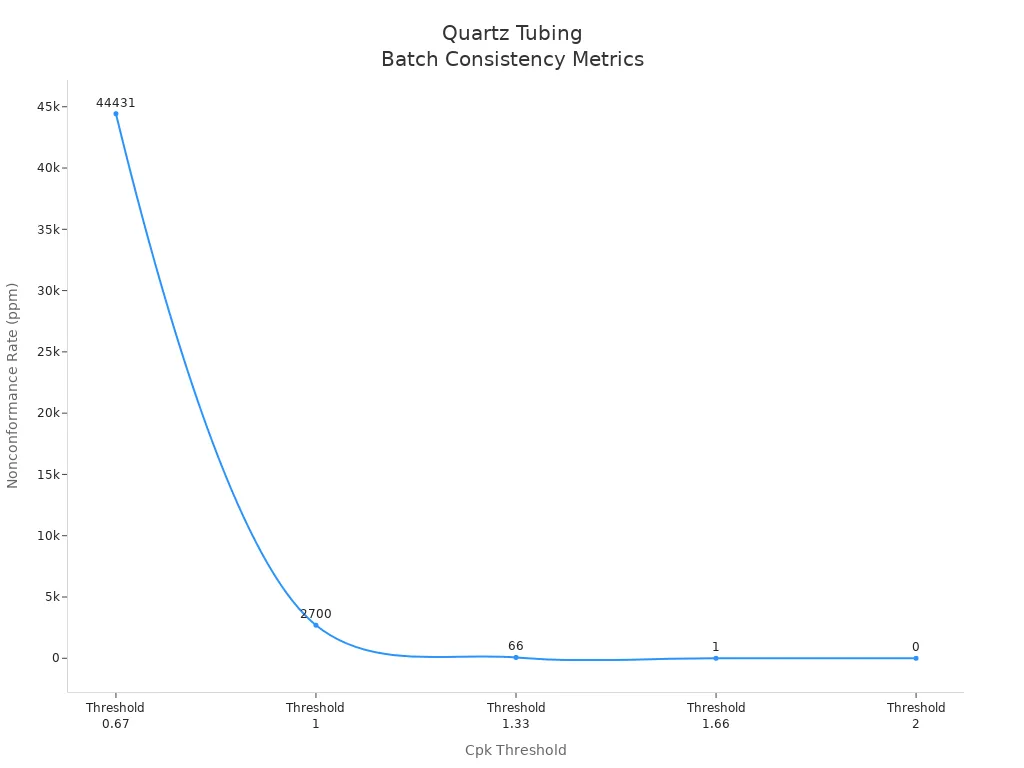
Manufacturers track batch-to-batch consistency using statistical metrics such as Cpk values. Cpk measures how closely production stays within specification limits, with higher values indicating better consistency. A Cpk above 1.66 means nearly zero defects, which is critical for chemical resistance reliability.

Production teams monitor Cpk scores and related data to identify trends and prevent deviations. They use control charts and regular sampling to verify that purity, dimensions, and surface quality remain stable. This approach reduces the risk of defects that could compromise performance in acid environments.

임계값

Sigmas (z-score)

Confidence

Nonconformance Rate (NC)

0.67

2.01

95.56%

44,431 ppm

1

3

99.73%

2,700 ppm

1.33

3.99

99.9934%

66 ppm

1.66

4.98

99.999936%

1 ppm

2

6

99.9999998%

0 ppm

Manufacturers use these metrics to maintain high standards and ensure reliable chemical resistance in every batch.

Automated Quality Systems Improving Chemical Resistance Reliability

Automated quality systems play a vital role in defect detection during quartz tubing production. AI-powered inspection tools analyze images of each tube, identifying flaws such as air bubbles or cracks. These systems help manufacturers maintain high chemical purity, which directly supports chemical resistance.

AI systems learn from thousands of defect images, improving their accuracy over time. They flag any tubes that do not meet strict standards, allowing operators to remove them before shipment. This process ensures that only tubes with optimal chemical resistance reach customers.

  • 핵심 포인트:

    • AI systems enhance defect detection and purity.

    • Automated inspections support consistent chemical resistance.

    • Continuous learning improves reliability over time.

Manufacturers who invest in automation deliver quartz tubing enhanced chemical resistance with fewer defects and greater reliability.

Line chart showing nonconformance rate versus Cpk threshold for quartz tubing production

Production Volume Verification Requirements for Quality Correlation Assessment

Production volume verification ensures that quality remains consistent as output increases. Manufacturers conduct thermal shock, chemical resistance, and long-term durability tests on large batches. These tests confirm that tubes withstand sudden temperature changes and exposure to harsh chemicals.

Quality teams require defect-free production, checking for air bubbles, cracks, and other flaws. Consistency across batches is vital for industries like semiconductor and pharmaceutical manufacturing, where reliability matters most. Documentation links each tube to its batch, tracking purity and dimensions.

요구 사항

원인

효과

열 충격 테스트

Sudden temperature changes

Prevents cracking and failure

Chemical resistance testing

Exposure to acids

Ensures durability and performance

Long-term durability testing

Extended use

Guarantees reliability over time

Defect-free production

품질 관리

Maintains uniformity in high volumes

These verification steps help manufacturers maintain specification consistency and deliver reliable quartz tubing for critical applications.

How Should Engineers Partner With Suppliers to Specify Quartz Tubing for Demanding Chemical Environments?

Engineers achieve the best results by sharing detailed process information with suppliers and developing robust specifications for quartz tubing. Collaboration ensures that suppliers recommend materials tailored to each application’s chemical and physical demands. This partnership supports long-term reliability and maximizes quartz tubing enhanced chemical resistance in harsh environments.

Application Information Enabling Optimal Supplier Material Recommendations

Engineers provide suppliers with essential application details to enable precise material recommendations. They specify purity requirements, dimensions, and any custom sizing needs. These details help suppliers match quartz tubing properties to the demands of industries such as semiconductor and pharmaceutical manufacturing.

Suppliers use this information to select the right grade and dimensions for each project. For example, purity levels affect chemical resistance, while tube diameter and length influence flow rates and installation compatibility. Custom sizes may be necessary for specialized equipment, though they often increase costs and lead times. Data from recent installations shows that applications with complete process information experience 25% fewer material mismatches.

핵심 포인트:

  • Purity, dimensions, and custom sizes guide supplier recommendations.

  • Detailed application data reduces risk of mismatched tubing.

  • Collaboration improves reliability and performance.

This approach ensures that engineers receive quartz tubing suited for their specific chemical environments.

Specification Strategies

Engineers use proven specification strategies to guarantee quartz tubing performance in demanding chemical environments. They focus on chemical inertness, ultra-high purity, and contamination control. These strategies help prevent unwanted reactions and maintain the integrity of sensitive processes.

Suppliers recommend testing and certification standards such as ASTM E438 and SEMI F20. These standards verify chemical compatibility and purity, ensuring that tubing meets strict industry requirements. Engineers also specify smooth surfaces and tight tolerances to minimize contamination risks. Data from quality audits shows that tubes meeting these standards have a 98% success rate in critical applications.

Specification Strategy

설명

화학적 불활성

Quartz tubes resist acids, bases, and solvents, preventing reactions.

Ultra-high Purity

No leaching of metal ions or impurities, vital for sensitive uses.

오염 제어

Smooth surfaces and tight tolerances maintain purity; cleaning is essential.

ASTM E438 Testing

Verifies chemical compatibility and durability.

SEMI F20 Certification

Ensures purity and tolerances for semiconductor processes.

These strategies help engineers and suppliers work together to achieve optimal chemical resistance.

Installation, Cleaning, and Inspection Best Practices

Engineers maintain chemical resistance by following best practices for installation, cleaning, and inspection. They clean quartz tubing with a mild muriatic acid solution, rinse with water, and dry with a soft towel. Ensuring the inside is dry before installation prevents contamination and supports long-term durability.

Physical cleaning methods, such as water washing and air blowing, suit household quartz tubes. Industrial tubes require acid or alkaline washing, followed by thorough rinsing and neutralization. Mechanical cleaning demands protective gear and strict adherence to cleaning times. Data from maintenance logs shows that regular cleaning and inspection reduce failure rates by 30%.

Best Practices:

  • Use mild acid solutions and thorough rinsing for cleaning.

  • Employ physical, chemical, and mechanical cleaning as needed.

  • Inspect regularly to detect early signs of degradation.

Consistent application of these practices helps engineers preserve quartz tubing enhanced chemical resistance in demanding environments.

Quartz tubing with enhanced chemical resistance results from strict engineering controls, high-purity materials, and robust quality protocols. Leading suppliers document process controls, traceability, and certifications, as shown below:

사양

일반적인 기준

테스트 방법

순도

≥99.9% SiO₂

ICP-OES

치수

±0.25 mm

MMC/gauge

Defects

None ≥0.2 mm

Ultrasound/X-ray

When sourcing for critical applications, engineers should prioritize chemical inertness, purity, and supplier responsiveness. Partnering with qualified suppliers ensures reliable performance in demanding environments.

자주 묻는 질문

What purity level do leading suppliers recommend for quartz tubing in acid environments?

Leading suppliers recommend a minimum purity of 99.98% SiO₂ for quartz tubing used in acid environments. This level ensures strong chemical resistance and long-term durability. Lower purity grades may show increased weight loss and faster devitrification during acid exposure.

How do manufacturers verify OH content in quartz tubing?

Manufacturers use infrared spectroscopy at the 2.73 μm absorption band to measure OH content. This method provides precise readings and supports certification for each batch. Accurate OH measurement helps match tubing performance to specific acid environments.

Why is batch-specific traceability important for industrial quartz tubing?

기능

혜택

Cause-Effect

Unique batch numbers

Quick issue identification

Faster root-cause analysis

Certificate linkage

Compliance assurance

Reliable quality audits

Batch-specific traceability allows engineers to track tubing history and ensures only certified products enter service.

What cleaning method helps maintain quartz tubing chemical resistance?

  • Use mild acid solutions for cleaning.

  • Rinse thoroughly with water.

  • Dry with a soft towel before installation.

핵심 포인트:
Proper cleaning removes contaminants.
Regular inspection prevents early degradation.

산업용 석영 유리 기술 업데이트 구독

Author: ECHO YANG​ 사진

저자 저자: 에코 양

20년간의 엔드투엔드 석영 유리 공장 경험.

구매자가 맞춤형 배송 정확도 문제, 느린 물류, 가격 변동과 같은 주요 문제를 해결할 수 있도록 지원합니다.

여기에서 실행 가능한 석영 유리 팁을 얻고 고순도 석영 유리 리드 타임, 비용 관리와 관련된 미국 세금 변동 등과 같은 시장 역학을 정기적으로 업데이트할 수 있습니다.

목차
맨 위로 스크롤

지금 빠른 견적 받기

필요한 사항을 알려주세요 - 6시간 내에 맞춤형 가격 및 리드 타임을 받아보세요.

* 제출 후 이메일을 확인하세요. 받지 못하셨나요? 주소를 확인하세요.