Engineers specifying optical substrates face a persistent dilemma: no single material seems to satisfy both UV transmission and thermal stability simultaneously. Quartz glass plate resolves that conflict directly.
Among all commercially available flat optical substrates, quartz glass plate occupies a rare position where spectral breadth, dimensional stability under thermal cycling, and chemical inertness converge in one material. This article presents a rigorous, parameter-by-parameter comparison of quartz glass plate against borosilicate glass plate, soda-lime glass plate, and fused silica plate, anchoring every conclusion in quantified data so that engineers can validate material suitability for their specific process conditions without ambiguity.
The comparison spans optical transmission, thermal expansion, maximum service temperature, refractive index, chemical resistance, and mechanical properties. Each section closes with a structured data summary, and the final sections translate those parameters into verified application suitability judgments.
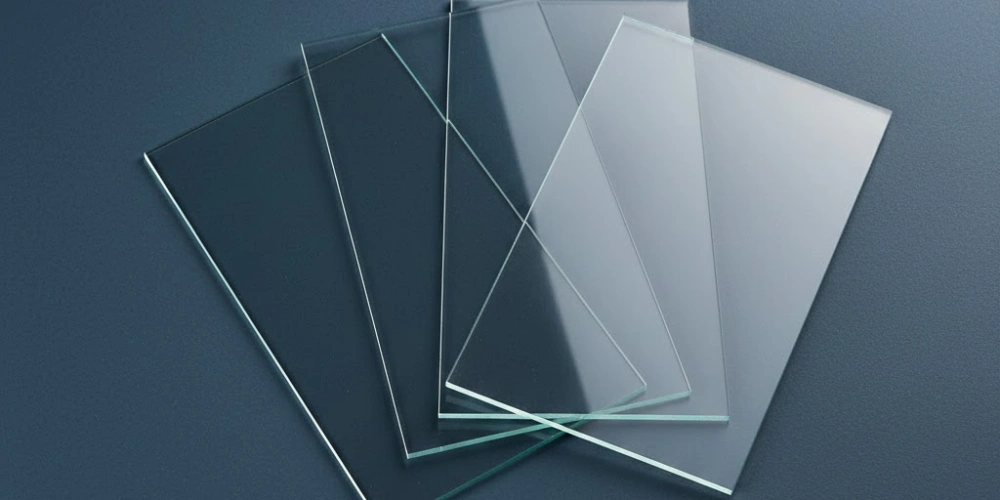
What Quartz Glass Plate Actually Is
Before any parameter comparison holds scientific validity, the material under examination must be defined with precision, because the terminology surrounding silica-based glasses is notoriously inconsistent across suppliers, datasheets, and even academic literature.
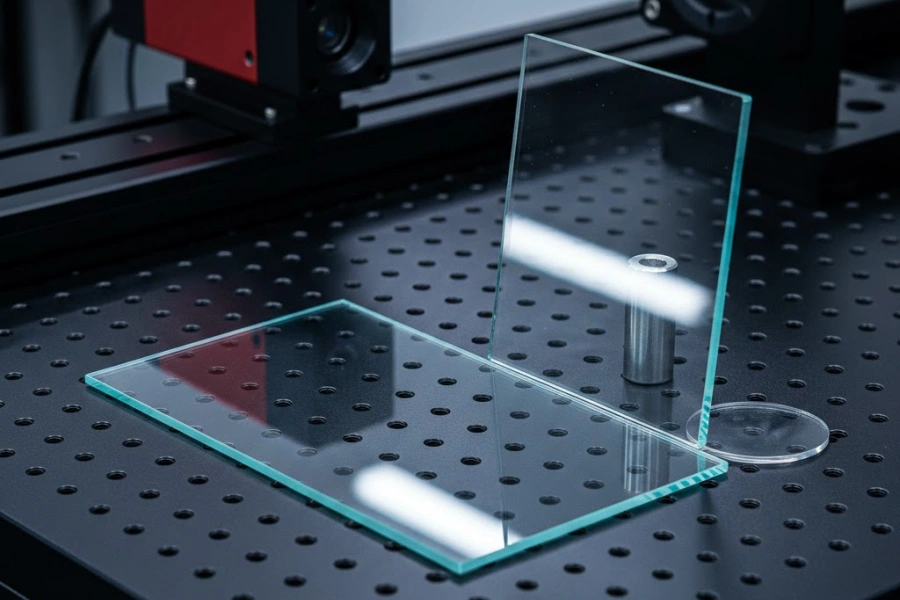
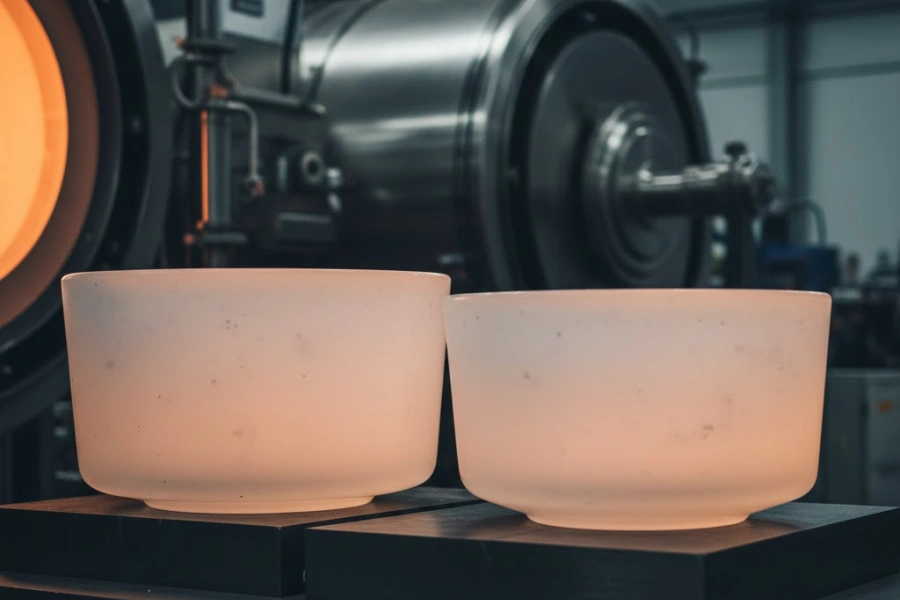
Quartz glass plate is a flat substrate fabricated from amorphous silicon dioxide (SiO₂) with a purity typically ≥ 99.9%, produced by melting naturally occurring crystalline quartz sand at temperatures exceeding 1,700 °C. The resulting material is non-crystalline, optically isotropic, and free from the grain boundaries that characterize polycrystalline ceramics. Standard commercial quartz glass plates are available in thicknesses ranging from 0.5 mm to 25 mm, with lateral dimensions extending beyond 300 × 300 mm, and surface flatness specifications expressed in fractions of a wavelength (λ/4 to λ/10 at 633 nm for optical grades).
A persistent source of confusion in engineering procurement and laboratory practice is the interchangeable use of quartz glass, fused quartz, fused silica, and silica glass. The distinction is material: quartz glass plate and fused quartz plate are both derived from natural crystalline quartz feedstock, whereas fused silica plate is synthesized from high-purity silicon-containing chemical precursors such as SiCl₄ via flame hydrolysis or CVD. Both end products are amorphous SiO₂, but their OH content, metallic impurity levels, and deep-UV transmission differ measurably—differences that become consequential in sub-200 nm optical applications. Throughout this article, quartz glass plate refers specifically to the naturally sourced, amorphous SiO₂ substrate unless otherwise qualified.
Soda-lime glass plate contains approximately 72% SiO₂ with significant additions of Na₂O (~14%) and CaO (~10%), which dramatically alter its thermal and optical behavior. Borosilicate glass plate replaces much of the alkali content with B₂O₃ (typically 12–13%), yielding intermediate performance. Fused silica plate, as noted, represents the highest-purity synthetic end of the silica spectrum. These four materials form the complete comparison set examined in the sections that follow.
Optical Transmission across Quartz Glass Plate and Its Rivals
Spectral transmission is frequently the first parameter an optical engineer records when evaluating a substrate, and the differences between these four materials are most dramatic—and most consequential—in the ultraviolet region. Consequently, understanding transmission behavior across the full relevant spectrum is indispensable before any other parameter is weighed.
UV-Range Transmission Where Quartz Glass Plate Excels
The ultraviolet transmission window of a substrate material determines its eligibility for an entire class of photonic and photochemical applications.
Quartz glass plate transmits usefully from approximately 150 nm through to 4,000 nm, with transmission values exceeding 90% per millimeter of path length at wavelengths above 200 nm when surfaces are polished to optical grade. At 250 nm, a 1 mm thick quartz glass plate typically exhibits internal transmittance above 93%. Borosilicate glass, by contrast, exhibits a sharp UV absorption edge near 300–320 nm, rendering it essentially opaque to deep-UV radiation. Soda-lime glass cuts off even earlier, at approximately 340–360 nm, owing to the strong UV absorption introduced by iron impurities and the alkali network modifiers. These cutoff positions are not soft gradients—they represent regions where absorption coefficients rise by several orders of magnitude within a narrow spectral interval, making the materials functionally unusable for UV-dependent processes regardless of sample thickness.
The practical consequence for engineers is unambiguous: any process or instrument operating below 320 nm—UV-C sterilization chambers, 248 nm KrF laser windows, 254 nm mercury lamp spectroscopy cells, or 365 nm UV lithography systems—is physically incompatible with borosilicate or soda-lime substrates. Quartz glass plate remains the technically viable choice across all of these wavelengths.
Fused silica plate, synthesized via chemical vapor deposition from ultra-pure precursors, extends the usable transmission window slightly further into the vacuum ultraviolet, reaching below 150 nm in the highest-grade synthetic variants. However, for the 180–400 nm range that encompasses the overwhelming majority of industrial UV applications, the transmission curves of quartz glass plate and optical-grade fused silica plate are functionally equivalent.
Visible and Near-IR Transmission Compared
Beyond the ultraviolet boundary, the transmission behavior of all four materials converges substantially, though meaningful differences persist into the near-infrared.
In the visible spectrum (400–700 nm), all four substrates exhibit high transmission, typically above 90% for standard thicknesses, making substrate selection in this range less critical from a transmission standpoint alone. The more consequential divergence reappears in the near-infrared. Soda-lime glass begins exhibiting measurable absorption bands above approximately 2,000 nm, and its transmission drops below 50% by 2,500 nm due to the vibrational overtones of the network modifier oxides. Borosilicate glass performs somewhat better, retaining useful transmission to approximately 2,700 nm before borate absorption bands attenuate the signal significantly. Quartz glass plate, with its near-pure SiO₂ network, maintains transmission above 80% through approximately 3,500 nm before the fundamental Si-O stretching absorption dominates near 4,000 nm.
Engineers designing broadband systems—Fourier-transform infrared spectrometers, multi-wavelength laser systems, or solar simulator optics spanning UV through near-IR—benefit directly from the extended spectral range of quartz glass plate. The absence of network modifier oxides removes the primary mechanism responsible for mid-IR absorption in glass compositions, extending the useful spectral window by more than 1,500 nm compared to soda-lime glass.
Homogeneity and Absorption Bands Affecting Transmission
Within the quartz glass plate category itself, a further subdivision governs application suitability: the distinction between high-OH and low-OH variants.
Natural quartz feedstock typically yields quartz glass plates with hydroxyl (OH) group concentrations between 150 and 400 ppm by weight. These OH groups introduce a characteristic absorption band centered near 2.72 μm, with overtone absorptions appearing at approximately 1.38 μm and 0.95 μm. For systems operating in the 2.5–3.0 μm near-infrared window—certain laser cutting applications or specific molecular spectroscopy bands—this OH absorption represents a meaningful transmission penalty. Synthetic fused silica can be manufactured with OH concentrations below 1 ppm, essentially eliminating this absorption feature.
Conversely, high-OH quartz glass plate transmits more efficiently at wavelengths below 180 nm than low-OH variants, because residual metallic impurities (which absorb in the deep UV) are partially displaced by the OH incorporation process during melting. Engineers specifying quartz glass plates for deep-UV applications should therefore request high-OH grades, while those targeting 2.5–4.0 μm infrared windows should specify low-OH or synthetic fused silica variants explicitly in their procurement documents.
Transmission Summary across All Four Substrates
| Matériau | Coupure UV (nm) | Visible Transmission (%) | NIR Limit (μm) | Teneur en OH (ppm) |
|---|---|---|---|---|
| Quartz Glass Plate | ~150 | >92 | ~3.5 | 150-400 |
| Fused Silica Plate | ~150 | >93 | ~3.5 | <1 (synthetic) |
| Borosilicate Glass Plate | ~300 | >90 | ~2.7 | N/A |
| Soda-Lime Glass Plate | ~340 | >89 | ~2.0 | N/A |
Thermal Expansion Coefficients Across All Four Substrates
Thermal expansion governs dimensional integrity whenever a substrate experiences temperature variation, and the differences between these four materials span nearly two orders of magnitude. That span has direct consequences for thermal shock resistance, mechanical fit in housings, and long-term dimensional stability in precision assemblies.
CTE Data for Quartz Glass Plate, Borosilicate, Soda-Lime and Fused Silica
The coefficient of thermal expansion (CTE) is the single most discriminating thermal parameter among the four substrates under comparison.
Quartz glass plate carries a CTE of approximately 0.55 × 10⁻⁶ /K across the 0–300 °C range—a value nearly identical to that of fused silica plate (0.55 × 10⁻⁶ /K), reflecting their shared SiO₂ network structure. Borosilicate glass plate, represented by the widely used Pyrex 7740 composition, exhibits a CTE of approximately 3.3 × 10⁻⁶ /K—six times higher than quartz. Soda-lime glass plate, with its high alkali modifier content, reaches 8.5–9.0 × 10⁻⁶ /K, more than fifteen times the CTE of quartz glass plate. These are not marginal differences; they represent fundamentally different thermomechanical behaviors when the same temperature excursion is applied.
The engineering implication of CTE scales directly with temperature differential. A quartz glass plate measuring 200 mm across will expand by approximately 22 μm when subjected to a 200 °C temperature rise. The same plate in soda-lime glass would expand by approximately 360 μm under identical conditions—a sixteen-fold difference in linear displacement. For substrates mounted in rigid metallic frames or bonded to dissimilar materials, this differential expansion generates interfacial stress; with soda-lime glass, those stresses routinely exceed the material's modulus of rupture1.
CTE and Derived Thermal Properties
| Matériau | CTE (×10⁻⁶ /K, 0–300 °C) | Conductivité thermique (W/m-K) | Specific Heat (J/g·K) |
|---|---|---|---|
| Quartz Glass Plate | 0.55 | 1.38 | 0.74 |
| Fused Silica Plate | 0.55 | 1.38 | 0.74 |
| Borosilicate Glass Plate | 3.3 | 1.14 | 0.83 |
| Soda-Lime Glass Plate | 8.5–9.0 | 1.05 | 0.84 |
Thermal Shock Resistance Derived from Low CTE in Quartz Glass Plate
Thermal shock resistance is a derived property, but one that directly determines whether a material survives rapid temperature transitions without catastrophic fracture.
The resistance to thermal shock is governed by the ratio of tensile strength to the product of CTE, elastic modulus, and thermal conductivity—a relationship encoded in the thermal shock resistance parameter R. Quartz glass plate, with its extremely low CTE, achieves an R value sufficient to withstand instantaneous temperature differentials exceeding 1,000 °C without fracture under standard thickness conditions. Documented laboratory and industrial data confirm that 2 mm thick quartz glass plates survive repeated quenching from 1,000 °C into room-temperature water—a test that shatters soda-lime glass at differentials above approximately 80 °C and borosilicate glass above approximately 160 °C. These are not theoretical projections; they reflect decades of operational experience in high-temperature furnace viewport applications where the material record is unambiguous.
Borosilicate glass plate performs creditably in moderate thermal shock environments, making it the conventional choice for laboratory glassware exposed to Bunsen burner heating—but it reaches its fracture threshold at temperature differentials well below those encountered in industrial process windows, plasma reactors, or rapid thermal annealing chambers. Soda-lime glass plate, despite its low cost and wide availability, is categorically excluded from any application involving deliberate or accidental thermal shock; its high CTE guarantees fracture under conditions that quartz glass plate handles routinely.
The implication for process engineers is straightforward: any viewport, window, or substrate exposed to rapid heating or cooling cycles—furnace startup and shutdown, laser pulse exposure, or direct flame impingement—requires quartz glass plate as the minimum-specification material unless weight or cost constraints force a deliberate performance compromise at known risk.
Dimensional Stability in Precision Optical Assemblies
In precision optical instruments, dimensional stability under thermal variation is not a safety concern but a performance parameter that directly determines measurement accuracy and system repeatability.
An interferometer flat plate fabricated from soda-lime glass experiencing a 10 °C ambient temperature fluctuation—common in laboratory environments without active thermal control—will undergo a linear dimensional change of approximately 85–90 nm per millimeter of plate width. For a 100 mm diameter reference flat, that translates to a surface figure error on the order of several wavelengths at 633 nm, rendering the flat unusable for precision wavefront reference applications. The same temperature excursion applied to a quartz glass plate of identical dimensions produces a dimensional change of approximately 5.5 nm per millimeter—more than fifteen times smaller. In systems where wavefront error budgets are allocated in fractions of a nanometer, this difference is determinative.
Quartz glass plate and fused silica plate are effectively indistinguishable in CTE, meaning both are technically suitable for precision optical mounts. The selection between them in dimensional stability-critical applications then shifts to other parameters: internal homogeneity, stress birefringence, and surface quality—discussed in subsequent sections. For the majority of precision optical assembly applications, quartz glass plate delivers dimensional stability that is inaccessible to either borosilicate or soda-lime substrates.
Dimensional Change per 100 mm Width at ΔT = 50 °C
| Matériau | Linear Dimensional Change (μm) | Suitability for Precision Optics |
|---|---|---|
| Quartz Glass Plate | 2.75 | Haut |
| Fused Silica Plate | 2.75 | Haut |
| Borosilicate Glass Plate | 16.5 | Modéré |
| Soda-Lime Glass Plate | 42.5–45.0 | Faible |
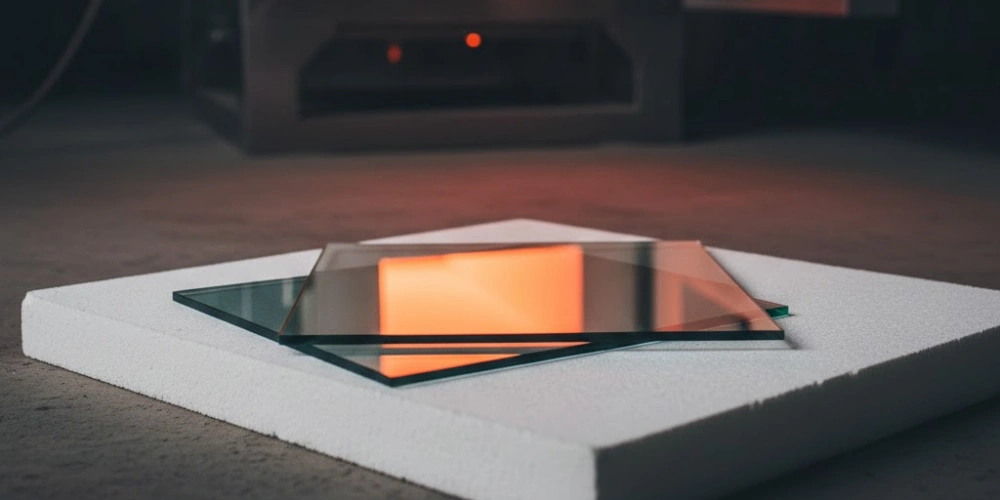
Maximum Service Temperatures for Quartz Glass Plate in Demanding Environments
Temperature capability defines the absolute boundary of a material's deployment envelope, and in this parameter, the gap between quartz glass plate and its two common competitors—borosilicate and soda-lime—is so substantial that it effectively places them in different material categories for thermal applications.
Continuous-Use and Softening-Point Data for Each Material
The thermal capability of a glass substrate is typically characterized by three reference temperatures: the strain point (below which stress relaxation is negligible), the annealing point (at which internal stresses relax within minutes), and the softening point (at which the material begins to deform under its own weight).
Quartz glass plate exhibits a softening point of approximately 1,665 °C, an annealing point near 1,140 °C, and a strain point around 1,070 °C. In continuous service, quartz glass plates are routinely operated at temperatures up to 1,050–1,100 °C without measurable deformation, provided the mechanical load is minimal. This capability derives directly from the high-purity SiO₂ network: without low-melting network modifiers such as Na₂O or CaO, the glass viscosity remains astronomically high until temperatures far exceeding those encountered in most industrial processes. Borosilicate glass, with a softening point near 820 °C and a practical continuous service limit of approximately 450–500 °C, begins exhibiting viscous deformation at temperatures that quartz glass plate sustains without consequence. Soda-lime glass, with a softening point around 730 °C and a continuous service limit of approximately 250–300 °C, is thermally excluded from all high-temperature engineering contexts.
Fused silica plate carries thermal reference temperatures nearly identical to quartz glass plate (softening point ~1,665 °C), confirming that both materials share the same SiO₂ network origin and that their high-temperature performance is essentially equivalent.
Thermal Reference Temperatures for All Four Substrates
| Matériau | Strain Point (°C) | Point de recuit (°C) | Point de ramollissement (°C) | Max Continuous Service (°C) |
|---|---|---|---|---|
| Quartz Glass Plate | ~1,070 | ~1,140 | ~1,665 | ~1,050 |
| Fused Silica Plate | ~1,075 | ~1,140 | ~1,665 | ~1,050 |
| Borosilicate Glass Plate | ~515 | ~565 | ~820 | ~450 |
| Soda-Lime Glass Plate | ~470 | ~514 | ~730 | ~250 |
Performance of Quartz Glass Plate in High-Temperature Process Windows
Abstract temperature limits become meaningful only when mapped against the actual thermal profiles of industrial and scientific processes where substrate selection is consequential.
Semiconductor diffusion furnaces operating at 900–1,100 °C for dopant drive-in and oxidation processes require viewport and tube materials that remain dimensionally stable throughout process cycles lasting hours. Quartz glass plate substrates installed as observation windows in these furnaces accumulate thousands of thermal cycles without fracture or optical degradation, a service record established over more than four decades of semiconductor manufacturing. Borosilicate viewports installed in identical positions, where attempted in early process development, exhibited viscous sag within tens of hours at 500 °C—a failure mode that contaminates process chambers and requires unscheduled maintenance downtime. The failure is not marginal; it is categorical.
High-temperature vacuum chambers used in physical vapor deposition and electron beam evaporation frequently reach substrate temperatures of 600–800 °C, with radiant heat loads that raise viewport temperatures to 400–600 °C even with water cooling on the outer frame. Quartz glass plate maintains optical clarity and mechanical integrity throughout these conditions. Additionally, industrial combustion observation windows—installed in glass-melting furnaces, cement kilns, and petrochemical reformers where flame temperatures exceed 1,400 °C—rely exclusively on quartz glass plate for the observation port material, because no alternative flat glass substrate survives direct exposure to these radiant environments.
Application Temperature Demands versus Material Capability
| Application | Process Temperature (°C) | Required Viewport Temp Tolerance (°C) | Quartz Glass Plate Suitable | Borosilicate Suitable | Soda-Lime Suitable |
|---|---|---|---|---|---|
| Semiconductor Diffusion Furnace | 900–1,100 | ≥800 | Oui | Non | Non |
| RTP Chamber Window | 800-1,200 | ≥700 | Oui | Non | Non |
| Industrial Combustion Viewport | 1,200–1,600 | ≥600 | Oui | Non | Non |
| Vacuum PVD Chamber | 300–600 | ≥400 | Oui | Marginal | Non |
| UV Lamp Housing | 200-400 | ≥300 | Oui | Oui | Non |
Refractive Index and Dispersion Properties of Quartz Glass Plate
Optical design is built on the refractive index, and even small differences in index value or dispersion across wavelength can accumulate into significant aberrations in high-precision systems. Mapping these values across all four substrates reveals where quartz glass plate positions itself in the optical design landscape.
Refractive Index Values across Wavelengths for All Four Materials
Refractive index values are wavelength-dependent, and meaningful comparison requires data at standardized reference wavelengths.
Quartz glass plate exhibits a refractive index of approximately 1.4584 at 589 nm (the sodium D line), 1.4570 at 632.8 nm (HeNe laser), and 1.4496 at 1,064 nm (Nd:YAG fundamental). These values are nearly identical to those of fused silica plate (1.4584 at 589 nm), confirming their structural equivalence. Borosilicate glass plate carries a higher index of approximately 1.472 at 589 nm, while soda-lime glass plate ranges from 1.512 to 1.520 at 589 nm depending on exact composition. The Abbe number—a measure of chromatic dispersion, where higher values indicate lower dispersion—for quartz glass plate is approximately 67.8, compared to ~64 for borosilicate and ~58–64 for soda-lime. This higher Abbe number means that quartz glass plate introduces less chromatic aberration2 per unit of optical power than either competing glass type, an advantage in broadband imaging systems and multi-wavelength laser applications.
For optical engineers designing systems with minimal chromatic aberration, the combination of low refractive index and high Abbe number makes quartz glass plate a preferred plane-parallel window material, because any residual wedge in the substrate introduces smaller chromatic displacement than an equivalent wedge in soda-lime or borosilicate glass.
Refractive Index and Dispersion Data
| Matériau | n @ 589 nm | n @ 632.8 nm | n @ 1,064 nm | Abbe Number (Vd) |
|---|---|---|---|---|
| Quartz Glass Plate | 1.4584 | 1.4570 | 1.4496 | ~67.8 |
| Fused Silica Plate | 1.4584 | 1.4570 | 1.4496 | ~67.8 |
| Borosilicate Glass Plate | 1.472 | 1.470 | 1.462 | ~64.2 |
| Soda-Lime Glass Plate | 1.512–1.520 | 1.510–1.518 | 1.500–1.508 | ~58–64 |
Birefringence in Quartz Glass Plate versus Amorphous Substrates
Birefringence is among the most frequently misunderstood optical properties when engineers specify silica-based substrates, and the source of confusion is systematic.
Quartz glass plate is amorphous and therefore optically isotropic—it possesses no intrinsic birefringence. This distinguishes it fundamentally from crystalline quartz (α-quartz), which is a uniaxial crystal with a birefringence of approximately 0.009 at 589 nm and is used intentionally in wave plates and polarization optics. Engineers who inadvertently specify crystalline quartz instead of quartz glass plate in polarization-sensitive systems introduce a birefringent element where none was intended—a substitution error with measurable consequences in ellipsometry, polarimetry, and coherence-sensitive interferometry. The two materials share a name but not a crystal structure, and they are not interchangeable.
Residual stress birefringence—induced by thermal gradients during manufacturing or by mechanical clamping in service—is present to varying degrees in all four amorphous substrates. Quartz glass plate manufactured to optical grade typically exhibits stress birefringence below 5 nm/cm of optical path, a level acceptable for most polarization-sensitive applications. Fused silica plate achieves comparable or slightly lower values in the highest synthetic grades. Borosilicate and soda-lime glass plates, with higher CTE values, accumulate larger internal stress gradients during annealing, and their stress birefringence values can reach 10–20 nm/cm in standard float glass production—a level that introduces measurable polarization state errors in precision polarimetric instruments.
For engineers specifying substrates in ellipsometers, Mueller matrix polarimeters, or stress-birefringence-sensitive laser cavities, quartz glass plate or optical-grade fused silica plate with documented birefringence certification is the appropriate material class; standard borosilicate and soda-lime plates are not.
Birefringence and Isotropy Summary
| Matériau | Intrinsic Birefringence | Residual Stress Birefringence (nm/cm) | Suitable for Polarimetry |
|---|---|---|---|
| Quartz Glass Plate (amorphous) | Aucun | <5 (optical grade) | Oui |
| Fused Silica Plate | Aucun | <2 (premium grade) | Oui |
| Borosilicate Glass Plate | Aucun | 10-15 | Limitée |
| Soda-Lime Glass Plate | Aucun | 15-20 | Non |
| Quartz cristallin | 0.009 | - | Only as intended element |
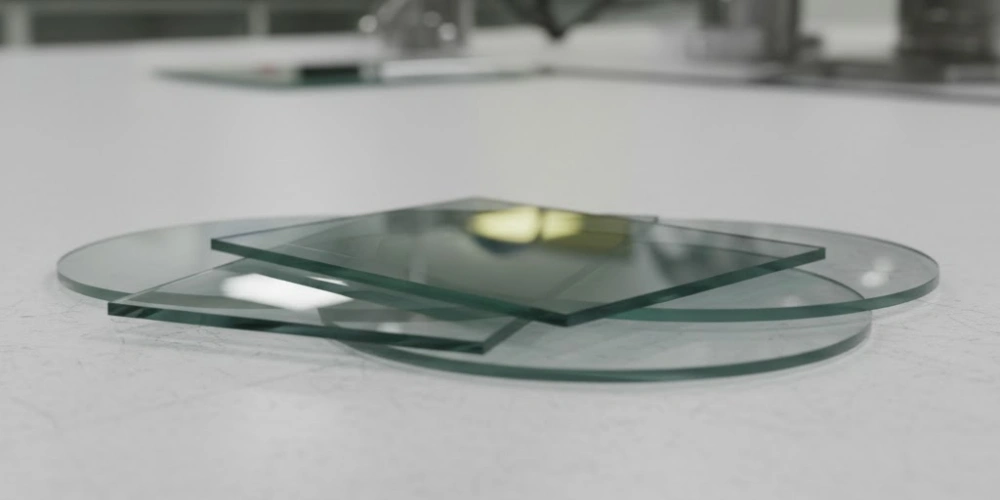
Chemical Resistance and Surface Stability of Quartz Glass Plate
Chemical exposure represents a decisive selection criterion in semiconductor wet processing, chemical vapor deposition, and analytical chemistry environments where substrates contact aggressive reagents routinely. Evaluating resistance across acid, base, and solvent exposure categories is therefore essential before any substrate is cleared for chemical process service.
Acid and Alkali Resistance Compared across Substrate Types
The high purity of the SiO₂ network in quartz glass plate confers strong resistance to most mineral acids under standard process conditions.
-
Hydrochloric acid (HCl): Quartz glass plate exhibits negligible dissolution rates in HCl at concentrations up to 37% and temperatures up to 100 °C. Measured weight loss is typically below 0.01 mg/cm² per day under these conditions. Borosilicate glass performs similarly due to its relatively low alkali content. Soda-lime glass, with its high Na₂O content, exhibits measurable leaching of sodium ions and network dissolution at rates exceeding 0.5 mg/cm² per day in concentrated HCl, leading to surface hazing. Standard quartz glass plate survives RCA-1 (NH₄OH/H₂O₂/H₂O) and RCA-2 (HCl/H₂O₂/H₂O) semiconductor cleaning sequences—repeated hundreds of times per substrate lifetime—without detectable optical or dimensional degradation.
-
Hydrofluoric acid (HF): All four silica-based substrates are attacked by HF because fluoride ions (F⁻) break Si-O bonds directly, converting SiO₂ to volatile SiF₄ and soluble H₂SiF₆. Quartz glass plate is not chemically resistant to HF, and neither are borosilicate, soda-lime, or fused silica plates. The dissolution rate of quartz in 5% HF at 25 °C is approximately 0.5–1.0 μm/min per surface. This is not a weakness unique to quartz—it is a universal characteristic of all SiO₂-based materials.
-
Alkali resistance: Strong alkaline solutions (NaOH, KOH at pH > 12) attack SiO₂ networks by hydroxyl-mediated hydrolysis of Si-O bonds. Quartz glass plate dissolves measurably in concentrated NaOH solutions above 60 °C. Borosilicate glass, with its lower SiO₂ content and borate network, actually exhibits lower alkali resistance than quartz in strongly basic environments. Soda-lime glass, paradoxically, shows moderate alkali resistance because surface leaching rapidly creates a silica-rich protective layer. For sustained alkali exposure above pH 13 at elevated temperatures, none of the four substrate types qualifies as chemically inert without additional protective measures. A useful transition: where strong alkali resistance is mandatory alongside UV transmission and thermal capability, quartz glass plate combined with an appropriate coating strategy remains the closest available solution among flat optical substrates.
Chemical Resistance Rating Summary
| Matériau | Resistance to HCl/H₂SO₄/HNO₃ | Resistance to HF | Resistance to NaOH (conc.) | Semiconductor Process Compatibility |
|---|---|---|---|---|
| Quartz Glass Plate | Excellent | Poor (universal) | Modéré | Haut |
| Fused Silica Plate | Excellent | Poor (universal) | Modéré | Haut |
| Borosilicate Glass Plate | Bon | Poor (universal) | Faible | Modéré |
| Soda-Lime Glass Plate | Pauvre | Poor (universal) | Modéré | Faible |
Surface Contamination and Cleaning Protocols Specific to Quartz Glass Plate
Surface cleanliness of quartz glass plate carries optical consequences that do not apply to substrates used purely as structural elements.
Organic contamination on quartz glass plate surfaces—hydrocarbon films, fingerprint residues, and adsorbed pump oils—absorbs UV radiation in the 200–300 nm range with extinction coefficients sufficient to reduce measured transmission by several percent per nanometer of contamination thickness. In UV spectroscopy cells or laser window applications, this translates directly to measurement error or beam attenuation. Metallic contamination (Fe, Cu, Na) introduced from handling or poorly controlled cleaning chemistry diffuses into the near-surface region of quartz at elevated temperatures, creating color centers that absorb broadband radiation and are not removable by surface cleaning after thermal processing.
Quartz glass plate is uniquely compatible with piranha cleaning (H₂SO₄:H₂O₂, 3:1 at 120 °C), which oxidizes and removes organic contamination without attacking the SiO₂ surface at measurable rates under controlled exposure durations. RCA cleaning sequences, standard in semiconductor fabrication, are similarly compatible. Borosilicate glass survives piranha cleaning but exhibits measurable boron leaching after repeated treatments, gradually altering the near-surface composition. Soda-lime glass is incompatible with piranha chemistry at elevated temperatures because the combination of strong oxidizer and heat accelerates alkali leaching and surface roughening.
The surface hydroxyl density of cleaned quartz glass plate—typically expressed as silanol (Si-OH) groups per nm²—governs its hydrophilic character and bonding affinity for organic silane coupling agents. Freshly piranha-cleaned quartz glass plate exhibits silanol densities of approximately 4–5 OH groups/nm², enabling effective functionalization for biosensor surfaces, PDMS microfluidic bonding, and UV-curable adhesive interfaces. This surface chemistry versatility has no equivalent in soda-lime glass and only partial equivalence in borosilicate.
Cleaning Protocol Compatibility
| Méthode de nettoyage | Quartz Glass Plate | Fused Silica Plate | Borosilicate Glass Plate | Soda-Lime Glass Plate |
|---|---|---|---|---|
| Piranha (H₂SO₄/H₂O₂) | Compatible | Compatible | Compatible (limited cycles) | Incompatible at high T |
| RCA-1 (NH₄OH/H₂O₂) | Compatible | Compatible | Compatible | Marginal |
| RCA-2 (HCl/H₂O₂) | Compatible | Compatible | Compatible | Incompatible |
| HF Etch | Etches surface | Etches surface | Etches surface | Etches surface |
| UV-Ozone | Compatible | Compatible | Compatible | Compatible |
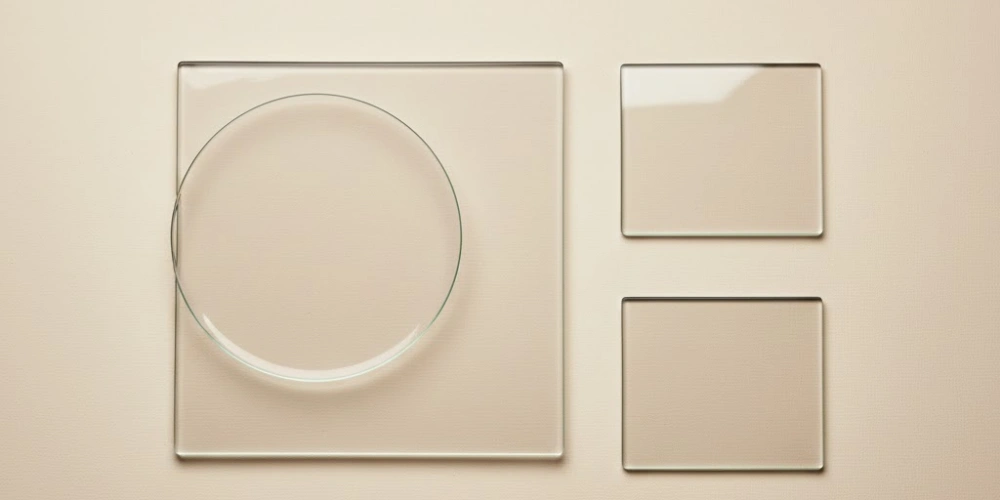
Mechanical Properties Distinguishing Quartz Glass Plate
Mechanical parameters govern machining tolerances, mounting design, and abrasion resistance in service—properties that must be quantified before a substrate enters fabrication or assembly.
-
Hardness: Quartz glass plate registers approximately 1,050–1,100 HV on the Vickers scale, corresponding to Mohs hardness 7. This places it among the hardest oxide glasses in common use. By comparison, borosilicate glass measures approximately 750–850 HV (Mohs ~6), and soda-lime glass falls in the 530–600 HV range (Mohs ~5.5). Higher hardness translates directly to scratch resistance under abrasive contact, a practical benefit in environments where substrates are handled repeatedly or cleaned with contact methods. Fused silica plate matches quartz glass plate at approximately 1,050–1,100 HV.
-
Fracture toughness: Despite its hardness advantage, quartz glass plate carries a fracture toughness (K_IC) of approximately 0.70–0.75 MPa·m½, marginally lower than borosilicate glass (~0.80–0.90 MPa·m½) and significantly lower than most crystalline ceramics. This low fracture toughness means that edge chips, surface scratches, and point-contact loads all represent crack initiation sites that can propagate catastrophically under tensile stress. Engineers mounting quartz glass plates in metallic frames must avoid direct metal-to-glass contact, instead using compliant elastomeric gaskets or PTFE spacers to distribute clamping forces and prevent stress concentrations at edges.
-
Elastic modulus and density: Quartz glass plate exhibits a Young's modulus of approximately 72 GPa and a density of 2,20 g/cm³. Soda-lime glass is denser at approximately 2.50 g/cm³ with a modulus near 70–74 GPa, while borosilicate glass falls at approximately 2.23 g/cm³ and 63–66 GPa. The low density of quartz glass plate is advantageous in weight-sensitive optical mounts and aerospace-adjacent instrumentation, where mass budgets are constrained.
The combination of high hardness and low fracture toughness demands that quartz glass plate substrates be handled with the same care protocols applied to optical flats and precision mirrors—dedicated storage fixtures, edge-protected packaging, and no direct contact between substrates during transport. The mechanical performance signature of quartz glass plate is therefore best described as durable under distributed loads and abrasive contact, but brittle under concentrated or impact loads, a characterization that should inform every mounting and handling procedure specification.
Mechanical Properties Summary
| Propriété | Quartz Glass Plate | Fused Silica Plate | Borosilicate Glass Plate | Soda-Lime Glass Plate |
|---|---|---|---|---|
| Dureté Vickers (HV) | 1,050–1,100 | 1,050–1,100 | 750–850 | 530–600 |
| Dureté Mohs | 7 | 7 | ~6 | ~5.5 |
| Fracture Toughness K_IC (MPa·m½) | 0.70–0.75 | 0.70–0.75 | 0.80-0.90 | 0.75–0.82 |
| Young's Modulus (GPa) | 72 | 73 | 63–66 | 70–74 |
| Densité (g/cm³) | 2.20 | 2.20 | 2.23 | 2.50 |
Typical Engineering Applications Suited for Quartz Glass Plate
Having established the complete parameter profile, the logical next step is mapping those parameters to real engineering environments where substrate selection has measurable consequences for process integrity, instrument accuracy, or system longevity. Each application below is examined against the specific property set that makes quartz glass plate the technically correct material choice.
Semiconductor Fabrication Processes Relying on Quartz Glass Plate
The semiconductor industry represents the most technically demanding application environment for flat optical substrates, imposing simultaneous requirements across thermal, optical, and chemical performance dimensions.
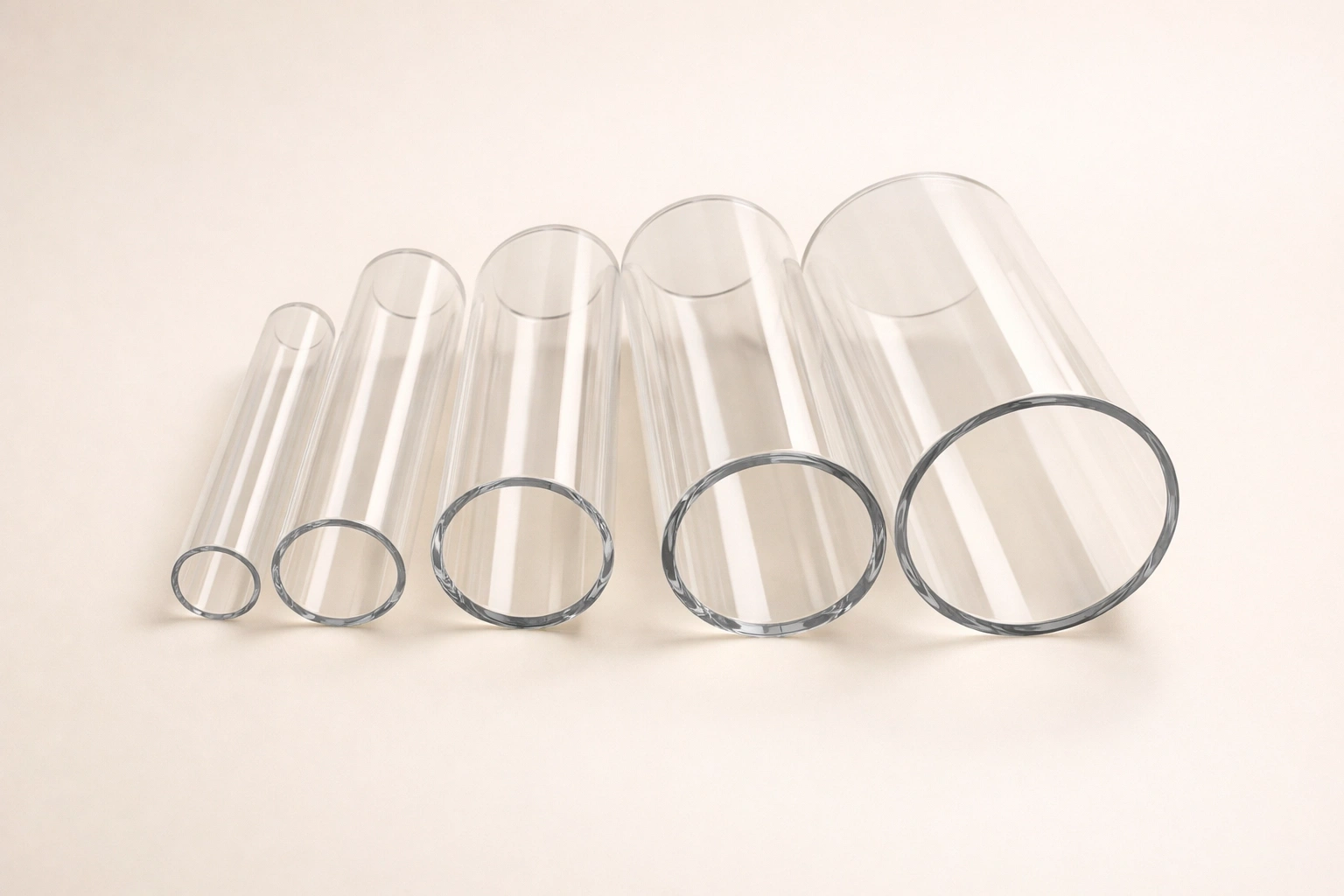
Dopant diffusion furnaces operating at 900–1,100 °C demand substrate materials that remain chemically inert to the dopant gases (phosphine, diborane, arsine) and oxidizing ambient (O₂, H₂O vapor) while maintaining dimensional stability across thousands of thermal cycles. Quartz glass plate and quartz tube products fulfill all three requirements simultaneously—no other flat glass substrate does. Borosilicate glass deforms viscously above 500 °C and releases boron into the furnace atmosphere, which constitutes an unacceptable contamination source in dopant-controlled processes.
UV photolithography systems employing mercury arc lamps (365 nm i-line, 248 nm KrF) require illumination path windows with transmission above 85% at the working wavelength, low fluorescence background, and thermal stability under continuous UV irradiation. Quartz glass plate satisfies all three: its UV transmission at 248 nm exceeds 88% per mm of thickness, its fluorescence emission under UV excitation is negligible compared to borosilicate glass (which exhibits measureable UV-excited emission from trace iron and cerium impurities), and its low CTE prevents focal shift caused by thermal expansion of the window element during extended exposure runs.
Rapid thermal processing (RTP) chambers subject substrates to temperature ramp rates of 50–300 °C/second, reaching peak temperatures of 1,000–1,200 °C within seconds. The thermal shock resistance of quartz glass plate—derived from its ultralow CTE of 0.55 × 10⁻⁶ /K—is the singular reason this material class has served as the standard RTP viewport and susceptor support material for more than three decades of semiconductor volume manufacturing without a technically competitive alternative.
Semiconductor Application Requirements vs. Quartz Glass Plate Capability
| Processus | Exigence clé | Quartz Glass Plate Parameter | Performance |
|---|---|---|---|
| Four à diffusion | T > 900 °C, chemical inertness | Service T ~1,050 °C, high acid resistance | Qualified |
| UV Lithography Window | >85% T @ 248–365 nm | >88% T @ 248 nm | Qualified |
| RTP Chamber Viewport | ΔT > 500 °C/s shock resistance | Survives ΔT > 1,000 °C quench | Qualified |
| Wet Bench Process Carrier | HCl/H₂SO₄ resistance | Negligible dissolution in mineral acids | Qualified |
Laser and Spectroscopic Systems Using Quartz Glass Plate
Photonic and spectroscopic instrument designers require substrates that introduce minimal optical aberration, survive laser-induced thermal loading, and transmit across the target wavelength without parasitic absorption.
Deep-UV excimer laser systems operating at 193 nm (ArF) and 248 nm (KrF) require window materials with transmission above 80% at the operating wavelength, resistance to UV-induced color center formation (solarization), and thermal stability under repetitive pulse heating. Quartz glass plate satisfies these requirements at a substantially lower material cost than synthetic fused silica, making it the dominant window material in research-grade excimer laser enclosures, UV exposure chambers, and photochemical reactors where throughput requirements do not mandate the marginal additional transparency of synthetic fused silica below 180 nm. Soda-lime and borosilicate glass substrates are not optically viable at these wavelengths and have no role in this application space.
Spectroscopie Raman3 cells and fluorescence cuvettes impose stringent requirements on background luminescence: any substrate-generated fluorescence signal overlaps with the analyte spectrum, raising the noise floor and reducing sensitivity. Quartz glass plate exhibits intrinsic Raman scattering and negligible broadband fluorescence under 532 nm, 633 nm, and 785 nm laser excitation—the three most common Raman excitation lines. Borosilicate glass generates measurable fluorescence background under 532 nm excitation that degrades signal-to-noise ratios in low-concentration analyte measurements by factors of 2–5×. Soda-lime glass is essentially excluded from spectroscopic cell applications due to its high fluorescence background and UV cutoff. The substitution of quartz glass plate for borosilicate in Raman cells has been documented to reduce background fluorescence counts by approximately 60–70% in direct comparative measurements—a quantitative performance advantage with direct analytical consequences.
Solar simulators and UV irradiance calibration standards require flat optical windows with stable, calibrated transmission that does not drift under prolonged UV exposure. Solarization—the formation of UV-absorbing color centers under sustained short-wavelength irradiation—affects all glass types to different degrees. Quartz glass plate, particularly low-OH variants, exhibits significantly lower solarization rates than borosilicate glass under equivalent 254 nm UV dose, with transmission change below 0.5% per 10⁸ J/m² of UV fluence in documented aging studies.
Spectroscopic and Laser System Suitability
| System | Operating Wavelength (nm) | Quartz Glass Plate T (%) | Borosilicate T (%) | Soda-Lime T (%) | Quartz Suitable |
|---|---|---|---|---|---|
| ArF Excimer Laser | 193 | ~75–80 | <1 | <1 | Oui |
| KrF Excimer Laser | 248 | ~88 | <5 | <1 | Oui |
| Mercury i-line | 365 | >92 | ~70 | <30 | Oui |
| Raman (532 nm) | 532 | >93 | >90 | >89 | Yes (low fluorescence) |
| Nd:YAG | 1,064 | >93 | >92 | >90 | Oui |
High-Temperature Industrial Viewports and Process Windows
Beyond the semiconductor sector, quartz glass plate serves a broader class of industrial processes characterized by elevated temperatures, corrosive atmospheres, and continuous operational cycles measured in thousands of hours.
Glass-melting and float glass furnaces operate with melt temperatures of 1,400–1,600 °C and combustion spaces where radiant heat loads are extreme. Observation viewports installed in the furnace crown or side walls—used for flame monitoring, temperature pyrometry, and visual process inspection—experience sustained surface temperatures of 500–900 °C on the process-facing side. Quartz glass plate viewports in these installations have documented service lives of 12–24 months before replacement is required due to surface devitrification (crystallization of the amorphous SiO₂ surface layer), whereas no alternative flat glass substrate survives more than hours under equivalent thermal exposure. The devitrification limit—not the softening point—typically governs the replacement interval for quartz glass plate in sustained high-temperature viewport service.
Petrochemical reformer and cracking furnace viewports present a combined challenge of high temperature (600–900 °C skin temperatures) and reducing gas atmospheres containing H₂, CH₄, and CO. Quartz glass plate is chemically stable in reducing atmospheres up to its service temperature limit, unlike borosilicate glass, which exhibits boron volatilization in high-temperature reducing conditions. Replacement intervals for quartz glass viewports in these environments average 18 months under continuous operation—a maintenance frequency that defines the economic basis for selecting higher-purity quartz grades with enhanced devitrification resistance for critical installations.
Plasma processing chambers used in reactive ion etching (RIE) and inductively coupled plasma (ICP) deposition expose viewport materials to fluorine-containing plasma species (CF₄, SF₆) at elevated substrate temperatures. Quartz glass plate viewports in these chambers experience slow but measurable surface erosion from fluorine radical attack at rates of approximately 0.1–0.3 μm/hour depending on plasma density—a known consumable behavior that is managed through scheduled replacement rather than eliminated, because no commercially practical flat optical material is immune to fluorine plasma erosion at these energy densities.
High-Temperature Industrial Viewport Performance
| Application | Process-Side Temperature (°C) | Atmosphère | Quartz Glass Plate Service Life | Borosilicate Service Life |
|---|---|---|---|---|
| Glass-Melting Furnace Viewport | 500–900 | Oxidizing | 12–24 months | Hours |
| Petrochemical Reformer Viewport | 600-900 | Réduction | ~18 months | Not applicable |
| Plasma RIE Chamber | 200-400 | Fluorine plasma | Scheduled replacement | Not applicable |
| Industrial Combustion Monitor | 400-700 | Oxidizing/hot gas | 6–18 months | Weeks |
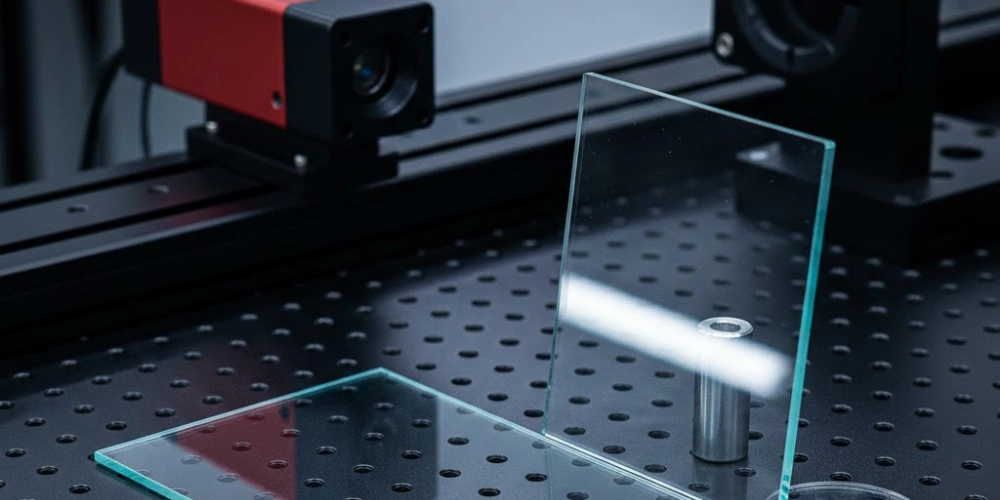
When Fused Silica Outweighs a Standard Quartz Glass Plate
Across the full parameter range examined in this article, quartz glass plate and fused silica plate perform equivalently in most industrial and laboratory applications. However, four specific conditions exist where synthetic fused silica plate delivers performance that standard quartz glass plate cannot match, and engineers operating in those regimes should understand the distinctions precisely.
-
Deep-UV transmission below 180 nm: Synthetic fused silica produced by flame hydrolysis achieves useful transmission at wavelengths as short as 150 nm or below in vacuum ultraviolet (VUV) applications. Natural quartz glass plate, despite its similar SiO₂ composition, contains trace metallic impurities and structural inhomogeneities from the natural feedstock that create absorption centers in the 150–180 nm range. For ArF laser lithography at 193 nm, quartz glass plate is adequate. For VUV spectroscopy or F₂ laser applications at 157 nm, only the highest-grade synthetic fused silica is optically viable.
-
OH content precision below 1 ppm: Applications requiring near-infrared transmission in the 2.5–3.5 μm window with minimal OH-related absorption at 2.72 μm demand OH concentrations below 1 ppm—achievable only through synthetic fused silica production. Standard quartz glass plate carries 150–400 ppm OH regardless of grade, making it unsuitable for this specific spectral requirement.
-
Internal homogeneity for wavefront-sensitive applications: Interferometer reference flats, laser resonator etalons, and wavefront sensors operating at precision levels below λ/20 at 633 nm require materials with refractive index variations below approximately 1 × 10⁻⁶ per centimeter of path. Synthetic fused silica produced by CVD achieves index homogeneity in the range of 0.5–1 × 10⁻⁶/cm, whereas standard quartz glass plate, melted from natural feedstock, typically exhibits index variations of 2–5 × 10⁻⁶/cm due to feedstock composition gradients. For precision wavefront applications, synthetic fused silica is the correct specification.
-
Judgment for standard engineering applications: Where operating wavelengths fall between 200 nm and 2,500 nm, process temperatures remain below 1,000 °C, and wavefront precision requirements are at the λ/4–λ/10 level, quartz glass plate provides equivalent functional performance to synthetic fused silica at a cost that is consistently 30–60% lower depending on dimensions and surface finish specification. Engineers should not automatically specify fused silica when quartz glass plate fully satisfies the process requirements.
Material Selection Criteria for Quartz Glass Plate in Practice
Drawing together all parameter comparisons, a coherent material selection framework emerges—one that allows engineers to position quartz glass plate correctly within the substrate landscape without ambiguity or over-specification.
The selection logic follows three primary axis criteria: operating wavelength, maximum service temperature, and chemical environment. When any application requires UV transmission below 320 nm, the field immediately narrows to quartz glass plate or fused silica—soda-lime and borosilicate are disqualified by their UV absorption edges. When the service temperature exceeds 450 °C, borosilicate is eliminated; above 300 °C, soda-lime is eliminated. When the chemical environment demands resistance to mineral acids without HF, quartz glass plate and fused silica both qualify; soda-lime is excluded. The result is that any application requiring two or more of these conditions simultaneously—UV transmission plus high temperature, UV transmission plus chemical resistance, or high temperature plus chemical resistance—arrives at quartz glass plate (or fused silica) as the only compliant material class.
Within that narrowed field, the choice between quartz glass plate and fused silica plate is resolved by secondary criteria: whether deep-UV below 180 nm is required (select fused silica), whether OH absorption at 2.72 μm is a concern (select low-OH fused silica), or whether index homogeneity below 1 × 10⁻⁶/cm is specified (select fused silica). In the absence of these specific requirements—which characterize the majority of semiconductor, laser, spectroscopic, and industrial viewport applications—quartz glass plate is the technically sufficient and economically rational substrate selection.
Consolidated Material Selection
| Selection Criterion | Quartz Glass Plate | Fused Silica Plate | Borosilicate Glass Plate | Soda-Lime Glass Plate |
|---|---|---|---|---|
| UV transmission (200–320 nm) | ✓ | ✓ | ✗ | ✗ |
| UV transmission (<180 nm) | Limitée | ✓ | ✗ | ✗ |
| Service temperature >500 °C | ✓ | ✓ | ✗ | ✗ |
| Service temperature >1,000 °C | ✓ | ✓ | ✗ | ✗ |
| Résistance aux chocs thermiques | Excellent | Excellent | Modéré | Pauvre |
| Mineral acid resistance | Excellent | Excellent | Bon | Pauvre |
| Index homogeneity <1×10⁻⁶/cm | Limitée | ✓ | ✗ | ✗ |
| OH control <1 ppm | ✗ | ✓ (synthetic) | ✗ | ✗ |
| Hardness (abrasion resistance) | Haut | Haut | Modéré | Faible |
Conclusion
Quartz glass plate occupies a uniquely capable position among flat optical substrates because its UV transparency, ultralow CTE, high service temperature, chemical inertness, and mechanical hardness converge in a single material without requiring synthetic precursors or specialized processing. Against borosilicate glass plate and soda-lime glass plate, the performance differential is categorical across every critical parameter examined. Against fused silica plate, the performance is functionally equivalent across the majority of engineering applications, with fused silica warranting selection only when deep-UV transmission below 180 nm, sub-1 ppm OH content, or interferometric-grade index homogeneity are explicitly required. For engineers validating substrate suitability in UV photonics, high-temperature process environments, semiconductor fabrication, or chemical process observation, quartz glass plate satisfies the combined optical and thermal demands of those applications with a technical record measured in decades of industrial deployment.
FAQ
What is the difference between quartz glass plate and fused silica plate?
Both materials are amorphous SiO₂ with nearly identical refractive index (~1.4584 at 589 nm), CTE (~0.55 × 10⁻⁶ /K), and service temperature (~1,050 °C continuous). The distinction lies in feedstock: quartz glass plate is produced from natural crystalline quartz sand, whereas fused silica plate is synthesized from chemical precursors such as SiCl₄. Synthetic fused silica achieves lower metallic impurity levels, controllable OH content below 1 ppm, and superior deep-UV transmission below 180 nm—properties that matter only in a specific subset of demanding applications.
Can quartz glass plate be used in direct flame contact applications?
Quartz glass plate withstands instantaneous temperature differentials exceeding 1,000 °C without fracture, making it suitable for flame observation windows and applications involving direct radiant heat exposure. Its softening point of approximately 1,665 °C means structural integrity is maintained in all standard industrial combustion environments. Sustained devitrification (surface crystallization) at temperatures above approximately 1,050 °C defines the practical service life limit, typically 12–24 months in continuous high-temperature viewport service.
Why does quartz glass plate transmit UV light while borosilicate glass does not?
The UV absorption in borosilicate glass arises from the borate network modifiers (B₂O₃) and trace transition metal impurities that create electronic absorption bands in the 250–320 nm range. Quartz glass plate, composed of ≥99.9% SiO₂, lacks these network modifiers, and its electronic absorption edge falls below 150 nm—well outside the UV-C, UV-B, and UV-A ranges. The result is that quartz glass plate transmits more than 88% of incident radiation at 248 nm, where borosilicate transmits less than 5%.
Is quartz glass plate chemically resistant to all acids?
Quartz glass plate is highly resistant to mineral acids including HCl, H₂SO₄, and HNO₃, with dissolution rates typically below 0.01 mg/cm² per day at standard process concentrations. It is not resistant to hydrofluoric acid (HF), which attacks all SiO₂-based materials by breaking Si-O bonds. Concentrated alkali solutions (NaOH, KOH) at elevated temperatures also cause measurable dissolution. For applications involving HF or strong alkali exposure, no standard flat glass substrate—including quartz—provides immunity without protective coatings or alternative material selection.
Références :
-
The modulus of rupture defines the maximum bending stress a brittle material can sustain before fracture, establishing the stress threshold beyond which differential thermal expansion in glass substrates causes catastrophic failure. ↩
-
Chromatic aberration results from the wavelength dependence of refractive index in optical materials, and substrates with higher Abbe numbers such as quartz glass plate introduce proportionally smaller chromatic displacement in broadband optical systems. ↩
-
Raman spectroscopy relies on inelastic light scattering to identify molecular vibrational signatures, and the negligible fluorescence background of quartz glass plate under laser excitation makes it the preferred substrate material for Raman cell windows and sample carriers. ↩