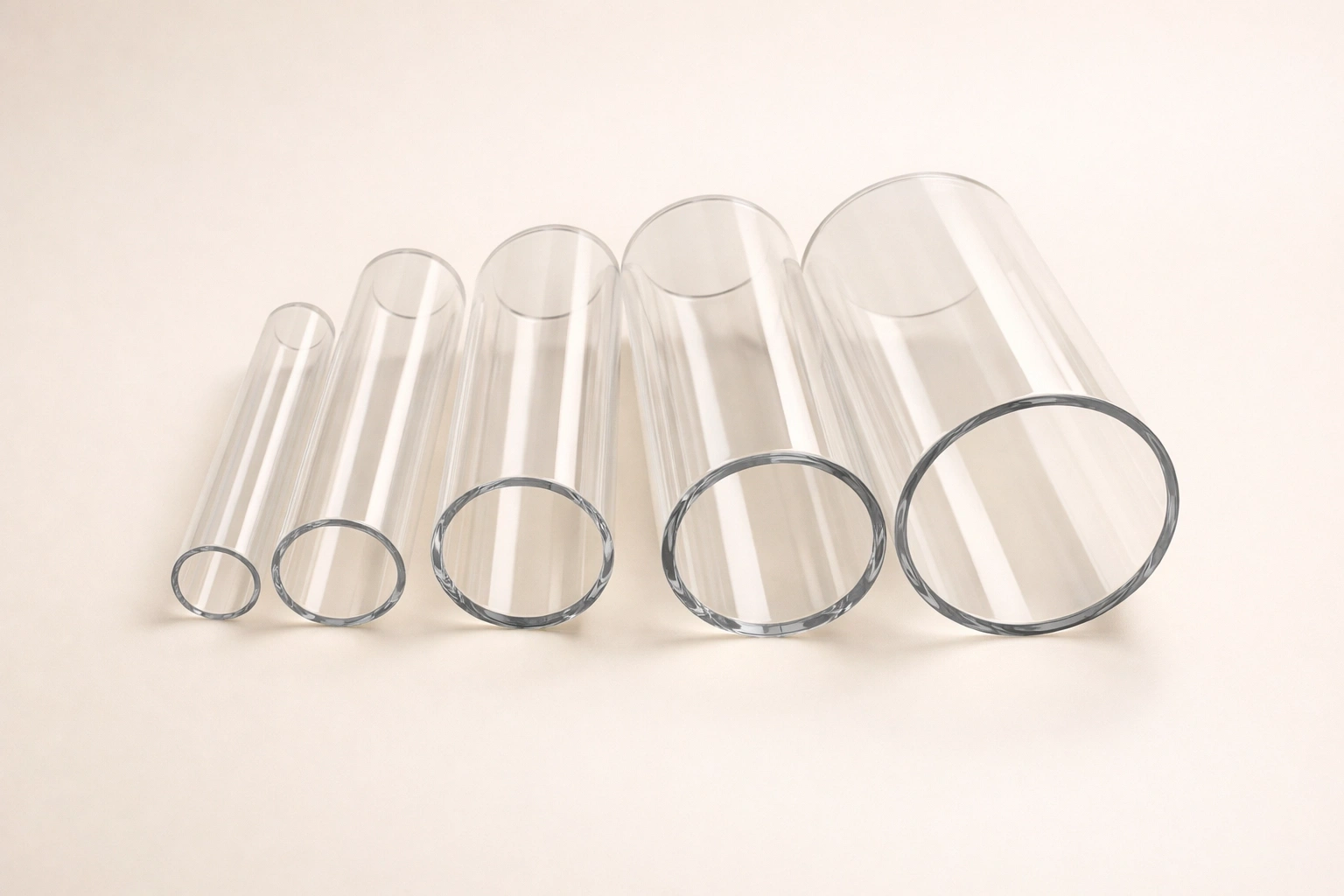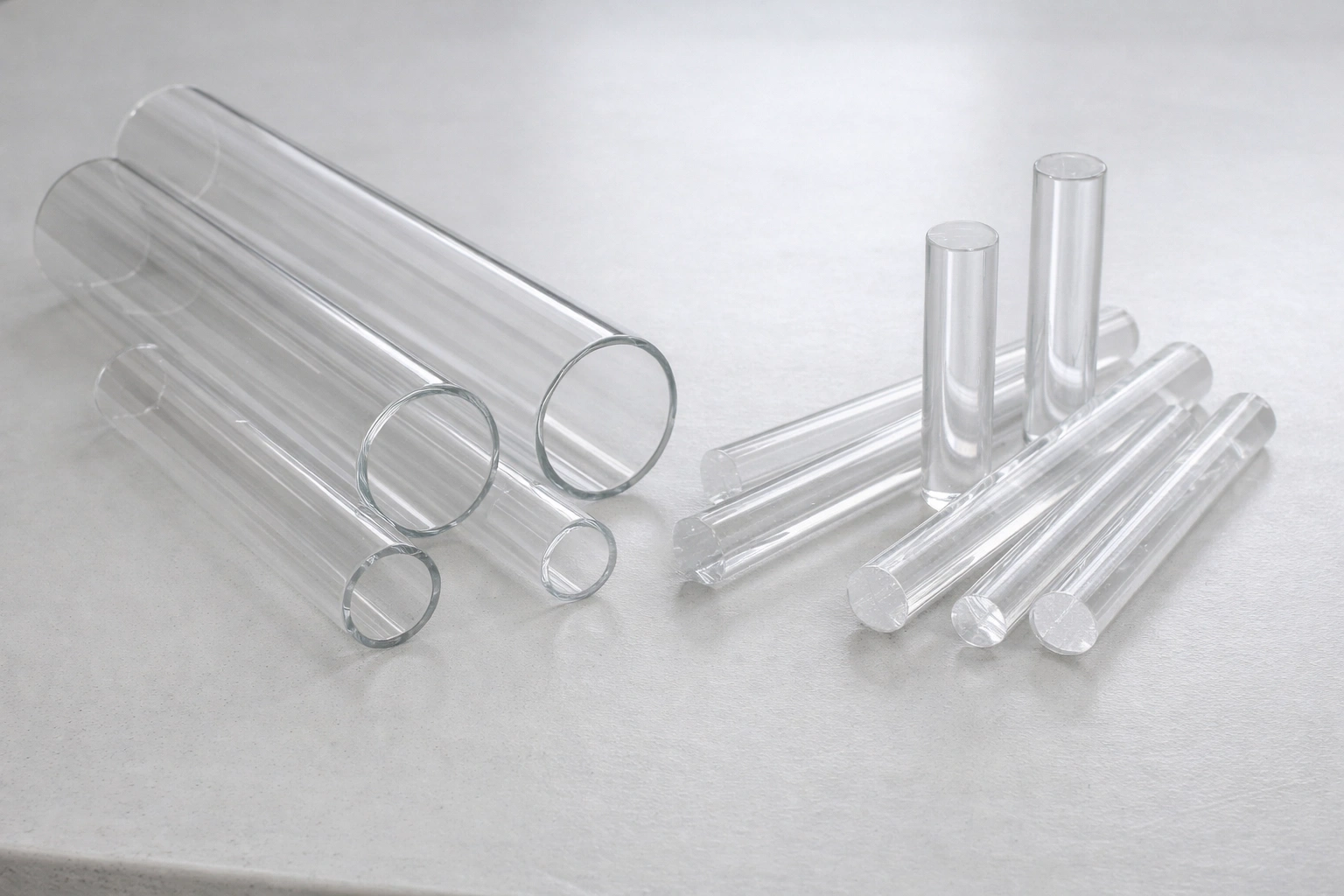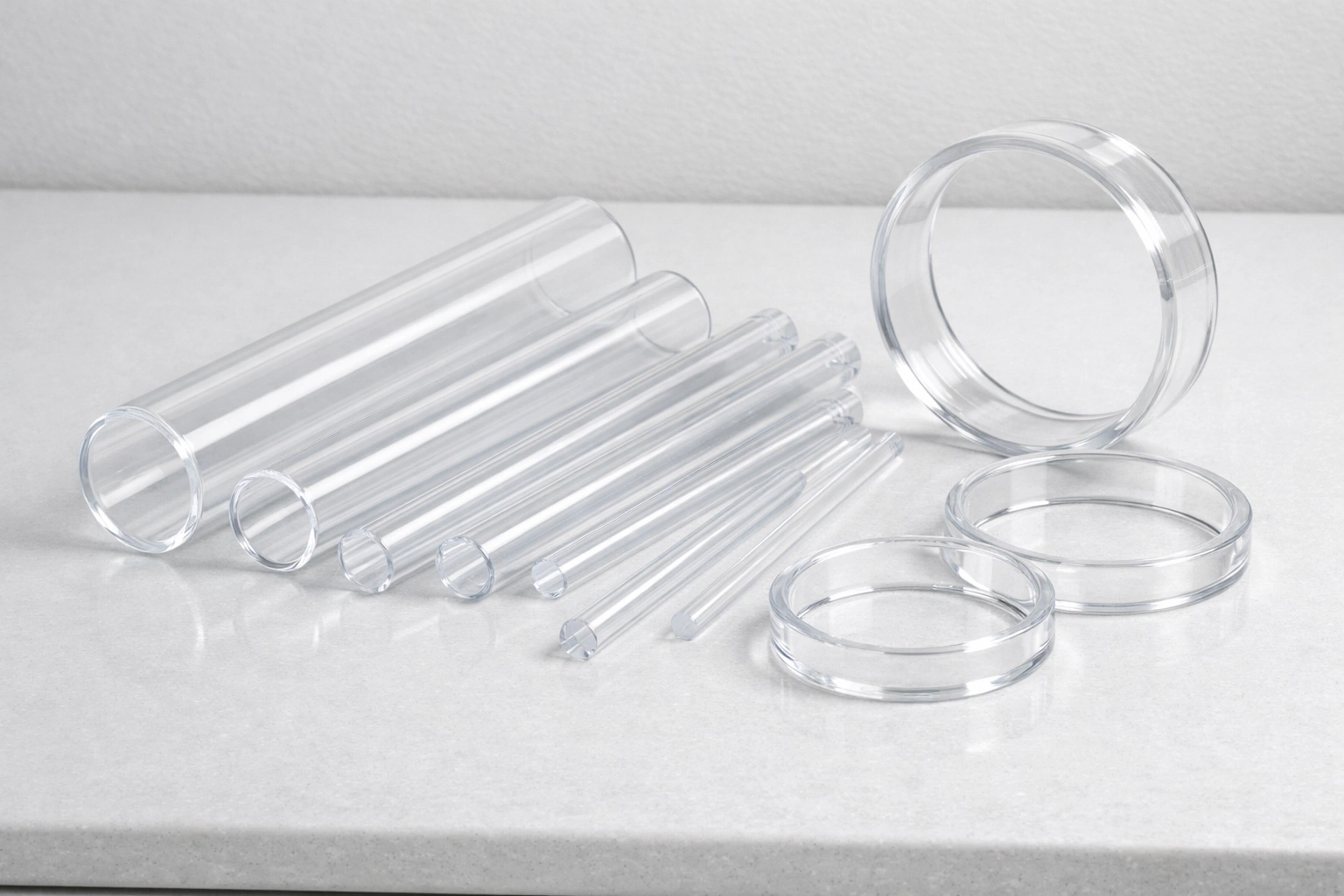

La pureza de transmisión uv de los discos de cuarzo desempeña un papel vital en las aplicaciones ultravioletas profundas. Para un rendimiento óptimo por debajo de 200 nm, el cuarzo fundido uv debe alcanzar un mínimo de 99,995% de sílice fundida con menos de 5 ppm de impurezas metálicas totales. Incluso cantidades minúsculas de cromo o cobre pueden provocar pérdidas de absorción significativas, por lo que es esencial realizar controles estrictos de elementos específicos. Los científicos seleccionan los materiales de las láminas para ventanas ópticas basándose en estas normas de pureza para garantizar altos índices de transmisión en la gama UV profunda.
Principales conclusiones
Los discos de cuarzo deben tener una pureza mínima de 99,995% SiO₂ y menos de 5 ppm de impurezas metálicas totales para una transmisión UV óptima por debajo de 200 nm.
Incluso pequeñas cantidades de impurezas como el cromo y el cobre pueden reducir significativamente la transmisión de la radiación UV, por lo que es esencial un control estricto.
La brecha de banda electrónica de la sílice fundida permite la transmisión de luz ultravioleta hasta 150 nm, superando al vidrio normal.
Los fabricantes utilizan métodos avanzados como ICP-MS y espectrofotometría para verificar la pureza y el rendimiento de los discos de cuarzo.
Mantener un bajo contenido de OH en la sílice fundida es crucial para conseguir una alta transmisión UV y evitar pérdidas de absorción.
¿Cuáles son los fundamentos de la transmisión UV por debajo de 200 nm en la óptica de cuarzo?

Los discos de cuarzo desempeñan un papel crucial en las aplicaciones de UV profunda, pero no todos los materiales pueden transmitir luz por debajo de 200 nm. Comprender las propiedades físicas y químicas del vidrio de sílice fundida ayuda a explicar por qué destaca para estos usos tan exigentes. Esta sección explora lo que permite al cuarzo óptico de transmisión ultravioleta funcionar tan bien en el rango ultravioleta profundo.
Brecha de banda electrónica y límites de transmisión UV en sílice fundida
La brecha de banda electrónica de la sílice fundida establece el límite fundamental para la transmisión de UV. La sílice fundida tiene una separación de banda de unos 8,3 eV, lo que significa que puede transmitir luz UV hasta casi 150 nm antes de que aumente bruscamente la absorción. Esta propiedad permite que el vidrio de sílice fundida supere al vidrio normal, que bloquea la luz UV por debajo de 300 nm.
La brecha de banda actúa como una barrera que sólo pueden atravesar los fotones de menor energía, por lo que los fotones de mayor energía son absorbidos. Como resultado, la sílice fundida permite aplicaciones que requieren luz ultravioleta profunda, como la espectroscopia y la fotolitografía.
Puntos clave:
La brecha de banda de 8,3 eV de la sílice fundida permite la transmisión UV hasta 150 nm.
El vidrio normal absorbe los rayos UV por debajo de 300 nm, lo que limita su uso en óptica UV profunda.
El band gap determina directamente el corte UV de los discos de cuarzo.
Mecanismos de absorción de fotones en el vidrio de cuarzo en longitudes de onda ultravioleta profundas
La absorción de fotones en la sílice fundida se produce cuando la energía de los fotones supera la banda prohibida, lo que hace que los electrones salten a estados de mayor energía. Por debajo de 200 nm, incluso pequeñas impurezas o defectos pueden introducir nuevos niveles de energía, aumentando la absorción y reduciendo la transmisión. Esta sensibilidad hace que el control de la pureza sea esencial para la óptica UV de alto rendimiento.
Los fabricantes deben minimizar las impurezas metálicas porque estos elementos crean estados localizados que absorben los fotones UV profundos. La presencia de hierro, titanio o cromo puede provocar pérdidas de transmisión significativas, incluso en concentraciones bajas.
Mecanismo | Causa | Efecto en la transmisión UV |
|---|---|---|
Banda de absorción | Energía de los fotones > 8,3 eV | Caída brusca de la transmisión por debajo de 150 nm |
Absorción de impurezas | Iones metálicos o defectos | Aumento de la absorción por debajo de 200 nm |
Ventajas de la estructura amorfa para la transparencia UV en discos de cuarzo
La estructura amorfa del vidrio de sílice fundida le confiere una ventaja única en cuanto a transparencia UV. Esta estructura carece de límites de grano y tiene una disposición atómica uniforme, lo que reduce la dispersión y absorción de la luz. Como resultado, la sílice fundida transmite más de 90% de luz UV y visible con un espesor de 1 mm.
El cuarzo cristalino, por el contrario, contiene bordes de grano y más defectos, que dispersan la luz y reducen la transmisión. La uniformidad a escala atómica de la sílice fundida garantiza un rendimiento constante en aplicaciones UV exigentes.
Puntos clave:
El vidrio de sílice fundida amorfa presenta defectos mínimos y carece de límites de grano.
Esta estructura permite una transmisión UV superior a 90% con un grosor de 1 mm.
El cuarzo cristalino transmite menos UV debido a una mayor dispersión y absorción.
¿Cómo provocan las impurezas metálicas la pérdida de absorción UV por debajo de 200 nm?

Las impurezas metálicas desempeñan un papel fundamental en la reducción de la transmisión UV en discos de cuarzoespecialmente en longitudes de onda inferiores a 200 nm. Estas impurezas introducen defectos en la estructura cristalina, que crean nuevos estados energéticos que absorben fotones UV. Comprender los efectos específicos de cada impureza ayuda a los científicos a seleccionar la sílice fundida adecuada para aplicaciones de UV profundo.
Bandas de absorción UV características de las impurezas de Fe, Ti y Al
El hierro, el titanio y el aluminio crean bandas de absorción únicas en el cristal de cuarzo. Estas bandas aparecen porque los átomos de impurezas sustituyen al silicio en la red cristalina, lo que cambia la forma en que el material interactúa con la luz UV. La presencia de estas impurezas provoca cambios visibles de color y una mayor absorción de la luz ultravioleta.
La siguiente tabla muestra cómo afecta cada impureza al espectro de absorción y coloración del vidrio de cuarzo:
Impureza | Características de la banda de absorción UV |
|---|---|
Hierro (Fe) | Se relaciona con la coloración de la amatista, en particular porque los iones Fe3+ sustituyen a los Si4+. |
Titanio (Ti) | Influye en el espectro de absorción, contribuyendo a las variaciones de color en el vidrio de cuarzo. |
Aluminio (Al) | Afecta a las propiedades de coloración y absorción del vidrio de cuarzo, a menudo junto con el hierro y el titanio. |
Estas bandas de absorción provocan directamente pérdidas de transmisión en la gama UV profunda. Cuantas más impurezas haya, mayor será la pérdida.
Cálculo de las pérdidas de transmisión a partir de las concentraciones de impurezas metálicas
Los científicos pueden estimar la pérdida de transmisión UV midiendo las concentraciones de impurezas en la sílice fundida. Cada impureza tiene un coeficiente de extinción conocido, que describe la intensidad con la que absorbe la luz UV. Aplicando la ley de Beer-Lambert, pueden predecir cuánta luz se perderá en longitudes de onda específicas.
Por ejemplo, un disco de cuarzo con 1 ppm de hierro puede perder hasta 3% de transmisión a 190nm. El titanio y el aluminio tienen efectos similares, pero su impacto depende de su concentración y de la longitud de onda. La medición precisa de las impurezas permite a los fabricantes controlar la calidad y garantizar un alto rendimiento UV.
Puntos clave:
La pérdida de transmisión aumenta con mayores concentraciones de impurezas.
La ley de Beer-Lambert ayuda a predecir la absorción UV en la sílice fundida.
El control preciso de las impurezas garantiza un rendimiento UV profundo fiable.
Efectos de los metales de transición en la absorción ultravioleta profunda del vidrio de cuarzo
Los metales de transición, como el hierro y el titanio, tienen un efecto mucho mayor en la absorción de UV que otras impurezas. Estos metales crean estados energéticos localizados que absorben fotones con longitudes de onda inferiores a 200 nm, que la sílice fundida pura transmitiría normalmente. La presencia de estos metales puede reducir la transmisión de UV en varios puntos porcentuales, incluso en concentraciones muy bajas.
Los estudios científicos demuestran que las impurezas metálicas como el Al y el Fe introducen defectos en la red cristalina. Estos defectos permiten que el cuarzo absorba luz UV en longitudes de onda que el SiO2 puro no puede absorber, debido a su gran brecha de banda óptica. Esta absorción se traduce en una pérdida de transmisión significativa para las aplicaciones de UV profundo.
Metal de transición | Crea defectos | Absorbe UV por debajo de 200 nm | Causas de la pérdida de transmisión |
|---|---|---|---|
Hierro (Fe) | Sí | Sí | Sí |
Titanio (Ti) | Sí | Sí | Sí |
Los metales de transición siguen siendo las impurezas más críticas que hay que controlar para conseguir una transmisión UV óptima en la sílice fundida.
¿Qué niveles críticos de pureza de sílice minimizan la pérdida de transmisión en aplicaciones de menos de 200 nm?
La pureza de transmisión uv de los discos de cuarzo determina directamente la cantidad de luz ultravioleta profunda que atraviesa una lámina de ventana óptica. Seleccionar el nivel de pureza adecuado para la sílice fundida garantiza una alta transmitancia y un rendimiento fiable en espectroscopia y fotolitografía. Esta sección explica qué umbrales de pureza y métodos de verificación garantizan los mejores resultados por debajo de 200 nm.
Métodos de análisis ICP-MS y de verificación de la pureza de grado óptico
Los fabricantes utilizan el análisis ICP-MS para medir trazas de impurezas en la sílice fundida, lo que ayuda a verificar el grado óptico de los discos de cuarzo. Este método detecta elementos metálicos en concentraciones muy bajas, a menudo por debajo de 1 ppm, lo que garantiza que el material cumple las estrictas normas de pureza para una alta transmitancia. La medición precisa de impurezas contribuye a la producción de materiales de láminas para ventanas ópticas con un rendimiento constante.
Los resultados de ICP-MS muestran la concentración de cada impureza, como hierro, titanio y aluminio, que pueden afectar a la pureza de transmisión uv de los discos de cuarzo. A continuación, las pruebas espectrofotométricas confirman la transmisión UV real midiendo cuánta luz pasa a través del disco en longitudes de onda específicas. Estos dos métodos juntos proporcionan una imagen completa de la calidad del material.
Método de ensayo | Qué mide | Por qué es importante |
|---|---|---|
ICP-MS | Trazas de impurezas metálicas | Garantiza la pureza para una alta transmitancia |
Espectrofotometría | Porcentaje de transmisión UV | Confirma el rendimiento de la hoja de ventana óptica |
Equilibrio coste-rendimiento en la selección de la pureza de los discos de cuarzo
La pureza de transmisión uv de los discos de cuarzo mejora a medida que disminuyen los niveles de impurezas, pero el coste de la sílice fundida aumenta considerablemente en los grados más altos. Para aplicaciones por debajo de 190 nm, los fabricantes recomiendan ≥99,995% SiO₂ y menos de 5 ppm de metales totales, mientras que las aplicaciones de 190-200 nm pueden utilizar ≥99,985% SiO₂ y hasta 10 ppm de metales. Este equilibrio permite a los usuarios seleccionar la lámina de ventana óptica adecuada a sus necesidades sin gastar más de la cuenta.
En la tabla siguiente se indican los umbrales prácticos de pureza para las distintas gamas de UV y su repercusión en el rendimiento:
Tipo de impureza | Umbrales para < 190nm | Umbrales para 190-200nm |
|---|---|---|
SiO₂ Pureza | ≥ 99,995% | ≥ 99.985% |
Total Metales | < 5 ppm | < 10 ppm |
Fe | < 3 ppm | < 5 ppm |
Ti | < 1 ppm | < 3 ppm |
Al | < 3 ppm | < 5 ppm |
La elección del nivel de pureza correcto garantiza una alta transmitancia, al tiempo que mantiene unos costes manejables para cada aplicación de láminas para ventanas ópticas.
Requisitos de contenido de OH para aplicaciones de espectroscopia UV de gran pureza
La presencia de grupos hidroxilo (OH) en la sílice fundida puede reducir la pureza de transmisión uv de los discos de cuarzo, especialmente por debajo de 200 nm. Los grupos OH absorben la luz ultravioleta y aumentan la absorción general, lo que reduce la alta transmitancia necesaria para una espectroscopia precisa. Los fabricantes controlan el contenido de OH para mantener el rendimiento de cada lámina de ventana óptica.
Los discos de cuarzo con menos de 10 ppm de contenido de OH son los preferidos para aplicaciones de alta pureza porque minimizan la absorción y permiten un análisis espectral preciso. Los niveles más altos de OH pueden causar desvitrificación y comprometer tanto la integridad como la precisión de la lámina de la ventana óptica. La siguiente tabla resume los límites de contenido de OH recomendados y sus efectos:
OH Nivel de contenido | Recomendación | Impacto en el rendimiento |
|---|---|---|
Menos de 10 ppm | Preferido para aplicaciones de gran pureza | Minimiza los efectos de absorción y facilita un análisis espectral preciso |
Niveles superiores | No recomendado | Acelera la desvitrificación, comprometiendo la integridad del tubo y la precisión analítica. |
Mantener un bajo contenido de OH en la sílice fundida garantiza que la pureza de transmisión uv de los discos de cuarzo siga siendo alta para usos exigentes de espectroscopia y láminas de ventanas ópticas.
¿Cómo influyen los oligoelementos en el rendimiento óptico por debajo de 200 nm más allá de las simples medidas de pureza?
Los oligoelementos pueden cambiar drásticamente el comportamiento de los discos de cuarzo en aplicaciones UV profundas. Los científicos estudian estos elementos porque afectan al rendimiento óptico de formas que van más allá de los simples números de pureza. Entender qué hace cada oligoelemento ayuda a los usuarios a seleccionar sílice fundida que cumpla los estrictos requisitos de transmisión por debajo de 200 nm.
Impacto diferencial de las impurezas de cromo y cobre en la absorción UV
El cromo y el cobre destacan como oligoelementos que provocan una fuerte absorción UV en la sílice fundida. Estos metales crean bandas de absorción intensas cerca de 190 nm y 185 nm, que pueden reducir el rendimiento óptico incluso en concentraciones inferiores a 1 ppm. Los investigadores descubrieron que el cromo a 0,5 ppm puede reducir la transmisión hasta 4% a 190nm.
El cobre también tiene un efecto significativo, con colas de absorción que se extienden hasta el rango UV profundo. Ambos elementos interactúan con la matriz de sílice, formando estados de energía localizados que atrapan los fotones UV. Este proceso provoca pérdidas apreciables en la transmisión para aplicaciones de alta precisión.
Puntos clave:
El cromo y el cobre provocan una fuerte absorción UV en concentraciones muy bajas.
Estos oligoelementos pueden reducir el rendimiento óptico en varios puntos porcentuales.
La sílice fundida con trazas de metales controladas favorece una mejor transmisión de los rayos UV profundos.
Límites de impurezas específicos de cada elemento para aplicaciones de cuarzo UV profundo
Establecer límites estrictos para cada oligoelemento ayuda a mantener un alto rendimiento óptico en los discos de cuarzo. Los fabricantes utilizan los datos de los análisis ICP-MS para definir qué niveles son aceptables para el trabajo con UV profunda. Por ejemplo, recomiendan mantener el cromo por debajo de 0,5 ppm y el cobre por debajo de 1 ppm para evitar una absorción excesiva.
Los límites específicos por elemento permiten a los usuarios centrarse en las impurezas más problemáticas. Este enfoque garantiza que la sílice fundida satisfaga las necesidades de la espectroscopia y la fotolitografía. Los científicos confían en estos límites para predecir el rendimiento de un disco de cuarzo en entornos exigentes.
Elemento | Límite recomendado (ppm) | Efecto sobre el rendimiento óptico |
|---|---|---|
Cromo | < 0.5 | Evita una fuerte absorción a 190 nm |
Cobre | < 1 | Reduce la pérdida de transmisión a 185 nm |
Hierro | < 2 | Minimiza la absorción de rayos UV |
Los fabricantes utilizan estos límites para orientar la producción y el control de calidad de los discos de cuarzo UV profundos.
Contribuciones de los elementos de tierras raras a los espectros de absorción UV-Visible
Los elementos de tierras raras como el cerio y el neodimio pueden influir en el rendimiento óptico, pero su impacto suele ser menos grave que el de los metales de transición. Estos elementos crean líneas de absorción muy marcadas en el espectro UV-visible, que pueden afectar a las mediciones en aplicaciones sensibles. Los científicos controlan los niveles de tierras raras para garantizar que la sílice fundida siga siendo adecuada para la espectroscopia.
La mayoría de las sílices fundidas de gran pureza contienen menos de 0,5 ppm de elementos de tierras raras. Esta baja concentración mantiene la absorción al mínimo y favorece un rendimiento óptico fiable. Los investigadores utilizan la espectrofotometría para comprobar las características de absorción no deseadas.
Elemento de tierras raras | Concentración típica (ppm) | Impacto en la absorción UV-Visible |
|---|---|---|
Cerio | < 0.5 | Líneas de absorción agudas menores |
Neodimio | < 0.5 | Efecto mínimo en el rendimiento óptico |
Praseodimio | < 0.5 | Impacto insignificante |
El cuidadoso control del contenido de tierras raras ayuda a mantener los elevados estándares exigidos para las aplicaciones de sílice fundida UV profunda.
¿Qué procesos de fabricación optimizados consiguen discos de cuarzo de gran pureza para aplicaciones de UV profunda?
Los fabricantes utilizan procesos avanzados para crear discos de cuarzo con una pureza excepcional para aplicaciones de UV profundo. Cada paso de la producción tiene como objetivo minimizar la contaminación y maximizar el rendimiento óptico. Estos métodos optimizados garantizan que los discos de cuarzo cumplan estrictas normas de uso científico e industrial.
Síntesis en fase vapor para una mayor pureza de los discos de cuarzo UV
La síntesis en fase de vapor destaca como método líder para producir discos de cuarzo de gran pureza. Este proceso utiliza compuestos de silicio ultrapuros en un entorno controlado para formar sílice fundida con impurezas metálicas mínimas. El resultado es un cuarzo con niveles de pureza que superan los conseguidos con las técnicas de fundición tradicionales.
Los ingenieros prefieren la síntesis en fase vapor porque proporciona discos de cuarzo con un contenido de impurezas metálicas inferior a 2 ppm. Estos discos presentan una transmitancia en el ultravioleta lejano superior a 85% a 185-200 nm y mantienen una uniformidad óptica mejor que 2×10^-6. La resistencia a la radiación también supera los 15 años, lo que hace que estos discos sean fiables para un uso a largo plazo.
Característica | Valor |
|---|---|
Contenido de impurezas metálicas | |
Transmitancia UV (185-200 nm) | ≥85% |
Uniformidad óptica | Mejor que 2×10^-6 |
Resistencia a la radiación | Más de 15 años |
La síntesis en fase vapor permite a los fabricantes satisfacer los exigentes requisitos de los sistemas ópticos de UV profundo.
Controles de sala limpia para evitar la contaminación durante la fabricación de discos
Los controles de las salas blancas desempeñan un papel vital en el mantenimiento de la pureza del cuarzo durante la fabricación. Los trabajadores operan en entornos con una estricta filtración de aire y control de partículas para evitar la contaminación por polvo y metales. En cada paso, desde el esmerilado hasta el pulido, se utilizan equipos especializados y productos químicos de gran pureza.
Los técnicos siguen protocolos que incluyen el uso de agua desionizada y herramientas no metálicas. Estas medidas reducen el riesgo de introducir impurezas como aluminio, hierro o sodio. El proceso de cloración en caliente también tiene lugar en un atmósfera controlada, lo que requiere una manipulación experta para evitar la contaminación.
Puntos clave:
Los controles de la sala blanca evitan la contaminación durante el esmerilado y el pulido.
Los trabajadores utilizan productos químicos de gran pureza y herramientas no metálicas.
Las atmósferas controladas protegen los discos de cuarzo de impurezas críticas.
Las estrictas prácticas de sala blanca ayudan a los fabricantes a alcanzar la alta pureza necesaria para los discos de cuarzo de UV profunda.
Pruebas químicas y ópticas combinadas para verificar la pureza final
Los fabricantes verifican la pureza de los discos de cuarzo mediante pruebas químicas y ópticas. El análisis ICP-MS detecta trazas de impurezas metálicas a niveles inferiores a 1 ppm, lo que confirma que los discos cumplen normas estrictas. Las pruebas espectrofotométricas miden la transmisión UV, garantizando que cada disco funciona como se espera en los sistemas ópticos.
Los equipos de control de calidad comprueban que el grosor sea uniforme y las superficies lisas mediante técnicas avanzadas de esmerilado y pulido. El corte por láser proporciona tamaños precisos, y el alisado de bordes mejora la seguridad y la facilidad de uso. Estos pasos garantizan que cada disco cumpla las especificaciones requeridas para aplicaciones UV profundas.
Método de ensayo | Propósito | Resultado |
|---|---|---|
Análisis ICP-MS | Detecta trazas de impurezas | Confirma la pureza química |
Espectrofotometría | Mide la transmisión UV | Verifica el rendimiento óptico |
Acabado de precisión | Garantiza un grosor y unos bordes uniformes | Se ajusta a las normas de aplicación |
Las pruebas combinadas garantizan que sólo los discos de cuarzo con pureza y rendimiento verificados lleguen a los usuarios científicos e industriales.
Los discos de cuarzo para transmisión UV profunda requieren una pureza de SiO₂ de al menos 99,995% y un total de impurezas metálicas inferior a 5 ppm. Los fabricantes deben controlar tanto la calidad del material como los pasos de procesamiento para lograr una alta transmisión UV. La verificación química y óptica garantiza que cada disco cumpla las estrictas normas.
Tipo de cuarzo | Transmisión UV por debajo de 265 nm | Transmisión UV hasta 200 nm |
|---|---|---|
Cuarzo de calidad inferior | Descenso significativo | N/A |
Cuarzo de calidad óptica | Más de 85% | Sí |
La selección de cuarzo de calidad óptica y el mantenimiento de condiciones de sala blanca ayudan a los usuarios a obtener resultados fiables en aplicaciones exigentes.
PREGUNTAS FRECUENTES
¿Qué nivel de pureza es el mejor para la transmisión UV por debajo de 200 nm?
Los discos de cuarzo con al menos 99,995% SiO₂ y menos de 5 ppm de impurezas metálicas totales proporcionan la mejor transmisión UV por debajo de 200 nm. Esta elevada pureza garantiza una absorción mínima y un rendimiento fiable en aplicaciones de UV profunda.
¿Por qué son tan importantes los metales traza como el cromo y el cobre?
El cromo y el cobre absorben fuertemente la luz ultravioleta, incluso a niveles inferiores a 1 ppm. Estos metales pueden reducir la transmisión en varios puntos porcentuales, por lo que es esencial un control estricto para usos ópticos de alta precisión.
Puntos clave:
Los metales traza provocan una fuerte absorción de UV.
Incluso pequeñas cantidades reducen la transmisión.
Unos límites estrictos protegen el rendimiento óptico.
¿Cómo comprueban los fabricantes la pureza de los discos de cuarzo?
Los fabricantes utilizan ICP-MS para medir los metales traza y espectrofotometría para comprobar la transmisión UV. Estos métodos confirman que cada disco cumple estrictas normas de pureza y rendimiento para trabajar con UV profunda.
¿Qué papel desempeña el contenido de OH en los discos de cuarzo?
Un bajo contenido de OH, normalmente por debajo de 10 ppm, ayuda a mantener una alta transmisión UV. Los niveles altos de OH aumentan la absorción y pueden dañar el disco durante su uso.
OH Contenido | Efecto en la transmisión UV |
|---|---|
< 10 ppm | Mantiene una transmisión elevada |
> 10 ppm | Aumenta la absorción |
¿Se puede utilizar el cuarzo natural para aplicaciones UV profundas?
El cuarzo natural suele contener más impurezas metálicas. Esto reduce la transmisión UV por debajo de 200 nm. Para los UV profundos se prefiere la sílice fundida sintética, ya que ofrece una pureza mucho mayor y un mejor rendimiento óptico.