Most laboratories and procurement teams treat these two materials as interchangeable — that assumption leads to analytical errors, premature tube failure, and wasted resources.
Quartz capillary tubes and fused silica capillary tubes share the same chemical formula (SiO₂) yet diverge fundamentally in raw material origin, purity, optical transmission, thermal ceiling, and surface chemistry. This article resolves every technical distinction with quantified data so that material selection becomes a defensible engineering decision rather than a guess.
The performance gap between these two materials is not marginal. Across UV transmission, devitrification resistance, and surface reactivity, the differences are measurable, application-critical, and in several high-stakes contexts, irreversible if the wrong material is specified. The sections below address each performance dimension in sequence, building from composition through to a consolidated selection framework.
Quartz Capillary Tubes vs Fused Silica Capillary Tubes Start with Different Raw Materials
Raw material origin is the single most consequential variable separating these two tube types, and understanding it prevents every downstream specification error.
Natural crystalline quartz and synthetically produced fused silica both yield amorphous SiO₂ glass after melting, yet the impurity profiles they carry into that glass are categorically different. Consequently, identical tube geometries produced from these two feedstocks deliver measurably different optical, thermal, and chemical performance — a distinction that no post-fabrication treatment can fully erase.
How Natural Quartz Crystal Becomes a Capillary Tube
Natural quartz originates as crystalline silicon dioxide (α-SiO₂) mined from pegmatite veins and hydrothermal deposits worldwide. The transformation from mineral to capillary tube involves crushing, acid leaching, electrostatic separation, and zone refining — a sequence designed to reduce, but never entirely eliminate, the metallic contaminants locked within the crystal lattice at the atomic level.
The mineral is melted at temperatures exceeding 1,700 °C and drawn into capillary geometries using graphite or tungsten mandrels. Typical draw speeds range from 0.5 to 5 m/min depending on target inner diameter, with tighter bores requiring slower draws to maintain dimensional consistency. The resulting glass retains the impurity signature of its geological source: aluminum concentrations of 10–50 ppm, iron at 0.5–5 ppm, and titanium at 1–10 ppm are common in commercial-grade natural quartz feedstock.
These trace metals are not removable after vitrification. They are chemically bonded into the silica network, meaning that a quartz capillary tube carries its impurity profile from manufacture through to end-of-life. This geological inheritance is the foundational variable that separates quartz from its synthetic counterpart.
The Synthetic Route behind Fused Silica and Why It Matters
Fused silica is not mined — it is chemically constructed. The two principal synthesis routes are flame hydrolysis of silicon tetrachloride (SiCl₄) and chemical vapor deposition (CVD), both of which begin with semiconductor-grade precursors that have been purified to metallic impurity levels below 0.1 ppm. This starting point is three to four orders of magnitude cleaner than natural quartz feedstock.
In the flame hydrolysis route, SiCl₄ vapor reacts with an oxyhydrogen flame to produce SiO₂ soot, which is then consolidated into clear glass. The OH content of the resulting material is directly controlled by the hydrogen-to-oxygen ratio in the flame, yielding either high-OH glass (>800 ppm, "wet" process) or low-OH glass (<10 ppm, "dry" process) depending on application requirements. This tunability has no equivalent in natural quartz processing.
The synthetic origin of fused silica means that its purity is an engineered specification, not a geological lottery. Lot-to-lot consistency in metallic impurities, OH content, and refractive index uniformity is achievable at a level that natural quartz cannot match, and this consistency is what makes fused silica the material of choice wherever analytical reproducibility is non-negotiable.
Why the Industry Still Uses Both Terms Interchangeably
The nomenclature confusion between "quartz" and "fused silica" has a traceable historical origin. ISO/DIS 10629 and its predecessors grouped all amorphous SiO₂ glass under broad categories without mandating that commercial suppliers distinguish between natural and synthetic feedstocks at the product labeling level. As a result, marketing conventions in the 1970s and 1980s established "quartz" as a generic descriptor for any transparent SiO₂ tube, regardless of feedstock origin.
Several major manufacturers still label synthetic fused silica tubing as "quartz glass tubing" in their commercial catalogs, particularly in markets where "quartz" carries a premium perception. In practice, the only reliable way to determine whether a tube is natural-origin or synthetic is to request a Certificate of Analysis specifying OH content (ppm), metallic impurity assay (ppm by ICP-MS1), and feedstock synthesis route. Absent that documentation, the term "quartz capillary tube" on a product label is ambiguous and should be treated as requiring verification.
Purity Levels Separating Quartz Capillary Tubes from Fused Silica
Purity is not merely a quality metric — it is the variable that governs every performance difference discussed in this article, from optical cutoff wavelengths to devitrification onset temperatures.
The metallic impurity concentration in a quartz capillary tube and the OH content in a fused silica tube are not independent product attributes. They are the direct chemical consequences of feedstock origin, and they propagate through every downstream performance parameter in a physically predictable way. Establishing these numbers quantitatively is therefore a prerequisite for any application-based material selection.
Metallic Impurity Profiles Inherent to Quartz Capillary Tubes
Commercial-grade natural quartz capillary tubes typically carry aluminum concentrations between 10 and 60 ppm, iron between 0.3 and 8 ppm, titanium between 1 and 12 ppm, and potassium between 5 and 30 ppm. High-purity grades produced from Brazilian or Norwegian lascas quartz reduce these figures by roughly one order of magnitude, but do not reach the sub-0.1 ppm metallic impurity levels achievable with synthetic feedstocks.
These impurities are not uniformly distributed throughout the glass matrix. Iron and titanium tend to cluster at grain boundaries during the early stages of vitrification, creating localized absorption centers that produce wavelength-specific attenuation in the UV range. Aluminum, which substitutes isomorphically for silicon in the silica network, modifies the network connectivity in a way that subtly raises the effective softening point while simultaneously increasing susceptibility to radiation-induced color centers — a phenomenon observed in synchrotron beamline components after extended high-flux UV exposure.
The practical consequence for analytical applications is that natural quartz capillary tubes exhibit batch-to-batch variability in UV transmission that is traceable directly to geological source variability. Two tubes labeled identically from the same supplier may differ by 5–15% in absorbance at 200 nm if sourced from different mining lots — a discrepancy that introduces systematic error in quantitative spectrophotometric measurements.
OH Concentration as the Defining Variable in Fused Silica
Hydroxyl content in fused silica is not a contaminant in the conventional sense — it is a structural variable that is deliberately engineered during synthesis. High-OH fused silica, produced via flame hydrolysis with a water-rich flame, typically contains 800–1,200 ppm OH. Low-OH grades produced by plasma CVD or electric fusion of SiCl₄ contain less than 10 ppm, and ultra-low-OH grades used in deep-UV optics may contain less than 1 ppm.
The OH group absorbs infrared radiation at 2.73 μm and 3.5 μm with extinction coefficients of approximately 50 and 5 L·mol⁻¹·cm⁻¹ respectively, making high-OH fused silica unsuitable for near-infrared laser transmission applications even though its UV transparency is excellent. Conversely, low-OH fused silica transmits in the 2–4 μm range with less than 1 dB/m attenuation and is therefore the standard material for Er:YAG laser delivery fibers and FTIR light pipes.
Natural quartz glass does not offer this tunability. Its OH content is a residual artifact of mining and purification conditions, typically falling between 150 and 400 ppm in commercial grades — a range that is neither optimized for UV nor for IR applications, placing it in an intermediate zone that underperforms both high-OH and low-OH synthetic fused silica in their respective target spectral windows.
Purity Thresholds Demanded by Semiconductor and Analytical Instrumentation
SEMI Standard F47 specifies that quartz components used in diffusion furnaces and CVD reactors must contain less than 20 ppm total metallic impurities, with iron below 1 ppm and aluminum below 5 ppm. High-purity natural quartz capillary tubes can meet these thresholds, but only material from select geological sources with documented ICP-MS assay certification. Synthetic fused silica routinely achieves total metallic impurity levels below 0.5 ppm and meets SEMI F47 with substantial margin.
In capillary electrophoresis instrumentation, instrument manufacturers including Agilent, Beckman Coulter, and Waters specify inner wall surface chemistry tolerances that are achievable only with synthetic fused silica. The electroosmotic flow (EOF) in a CE capillary is governed by the surface silanol density, which in natural quartz tubes is modulated unpredictably by subsurface aluminum — a phenomenon documented in peer-reviewed CE literature as "aluminum-induced EOF suppression" at concentrations as low as 20 ppm bulk aluminum.
The purity threshold for laser optics is even more stringent. Deep-UV optical components operating at 193 nm require fused silica with less than 0.05 ppm iron and less than 0.01 ppm titanium to prevent radiation-induced absorption (RIA) growth during ArF excimer laser2 exposure. No natural quartz source currently certified for this specification exists in commercial supply.
Purity Comparison across Material Grades
| Parâmetro | Natural Quartz (standard) | Natural Quartz (high-purity) | Synthetic Fused Silica |
|---|---|---|---|
| Total Metallic Impurities (ppm) | 50-200 | 5–25 | < 0.5 |
| Aluminum (ppm) | 10–60 | 2–8 | < 0.1 |
| Iron (ppm) | 0.3–8 | 0.1–1 | < 0.05 |
| Titanium (ppm) | 1–12 | 0.2–2 | < 0.01 |
| Conteúdo de OH (ppm) | 150-400 | 150-400 | 1–1,200 (tunable) |
| Feedstock Consistency | Geological batch variation | Geological batch variation | Engineered specification |
Spectral Transmission of Quartz Capillary Tubes Measured against Fused Silica
Optical performance is where the purity gap between these two materials becomes directly measurable in laboratory settings, and where a misspecified tube produces quantifiably degraded analytical results.
The transmission spectrum of a silica-based capillary tube is a direct readout of its impurity and OH content. Metallic contaminants create discrete absorption bands in the UV, while OH groups create characteristic absorption features in the infrared — and the position of these features relative to an application's working wavelength determines whether the tube is fit for purpose or categorically unsuitable.
UV Transmission in Quartz Capillary Tubes and Where Fused Silica Pulls Ahead
A standard commercial quartz capillary tube with 1 mm wall thickness transmits approximately 50–70% of incident radiation at 250 nm, declining to near zero below 160 nm due to the intrinsic absorption edge of the SiO₂ network. However, the transmission curve is not smooth — iron impurities produce a broad absorption band centered near 220 nm with a secondary feature at 380 nm, while Ti³⁺ contributes absorption below 300 nm. These features manifest as elevated baseline absorbance in spectrophotometric applications and as reduced signal-to-noise ratios in UV-detection CE systems.
Synthetic fused silica with less than 0.05 ppm iron transmits greater than 90% at 200 nm (1 mm path length), compared to 40–60% for a typical natural quartz sample at the same wavelength. The practical consequence is a detection limit improvement of approximately 0.3–0.5 absorbance units in on-column UV detection when switching from natural quartz to high-purity synthetic fused silica capillary tubing.
The cutoff wavelength — defined as the wavelength at which transmission drops below 10% — is approximately 160 nm for high-purity synthetic fused silica and 170–180 nm for commercial natural quartz, representing a 10–20 nm disadvantage that eliminates natural quartz from deep-UV and VUV applications entirely.
Infrared Absorption in Quartz vs OH-Driven Attenuation in Fused Silica
In the near-infrared and mid-infrared spectral regions, the dominant absorber shifts from metallic impurities to hydroxyl groups, and the comparison between quartz and fused silica inverts in a counterintuitive way. Natural quartz capillary tubes, with OH content of 150–400 ppm, exhibit moderate IR absorption at 2.73 μm — significant enough to limit usefulness in IR laser transmission but moderate enough that short-path applications are sometimes feasible.
High-OH synthetic fused silica (>800 ppm OH) absorbs even more strongly at 2.73 μm, with absorption coefficients approximately 3–4 times higher than natural quartz. Conversely, low-OH fused silica (<10 ppm OH) shows less than 0.001 cm⁻¹ absorption at 2.73 μm, making it essentially transparent in this band and the only viable material for Er:YAG (2.94 μm) and CO laser (5.4 μm) delivery through capillary waveguides.
The practical selection rule for IR applications is therefore not simply "fused silica over quartz" but specifically "low-OH fused silica over everything else." Natural quartz occupies an intermediate OH range that is too absorbing for precision IR work yet lacks the UV advantage of high-OH synthetic fused silica, placing it in a spectral no-man's land for photonic applications.
Vacuum UV Transmission Where Quartz Capillary Tubes Reach Their Limit
Below 200 nm, the transmission hierarchy between natural quartz and synthetic fused silica becomes absolute rather than gradational. Natural quartz capillary tubes exhibit a practical transmission cutoff at approximately 170 nm, driven by the combined absorption of Fe³⁺, Al³⁺, and Ti⁴⁺ impurity centers that accumulate dose-dependent absorption under prolonged VUV irradiation through a process known as solarization.
Synthetic fused silica produced by plasma CVD with sub-0.01 ppm metallic impurities transmits measurably down to 157 nm — the operating wavelength of F₂ excimer lasers used in 90 nm node semiconductor lithography. At 193 nm (ArF excimer laser), high-purity synthetic fused silica achieves initial transmission greater than 99.5% per cm, while natural quartz at the same wavelength typically transmits 85–92% and degrades by an additional 3–8% per 10⁸ laser pulses due to radiation-induced color center formation.
Synchrotron beamline optical components, deep-UV microscopy objectives, and 193 nm immersion lithography projection systems all mandate synthetic fused silica with certified radiation hardness data — a specification category that no natural quartz source commercially satisfies. For any application operating below 200 nm, natural quartz capillary tubes are categorically excluded on both transmission and radiation-stability grounds.
Spectral Transmission Summary by Wavelength Region
| Região espectral | Faixa de comprimento de onda | Natural Quartz Capillary Tube | Synthetic Fused Silica (high-OH) | Synthetic Fused Silica (low-OH) |
|---|---|---|---|---|
| Vacuum UV (VUV) | 150–200 nm | Poor (cutoff ~170 nm) | Excellent (cutoff ~155 nm) | Excellent (cutoff ~155 nm) |
| UV profundo | 200-250 nm | Moderate (50–70%) | Excellent (>90%) | Excellent (>90%) |
| Near UV / Visible | 250–800 nm | Good (>85%) | Excellent (>92%) | Excellent (>92%) |
| Near IR | 800–2,500 nm | Bom | Bom | Excelente |
| Mid IR (2.7 μm band) | 2,500–3,500 nm | Moderate absorption | High absorption | Very low absorption |
Thermal Performance of Quartz Capillary Tubes Relative to Fused Silica
Among all performance dimensions, thermal behavior generates the most consequential specification errors — because failures in high-temperature environments are often sudden, irreversible, and contaminating to surrounding process equipment.
Impurity content does not merely degrade optical clarity; it directly lowers the temperature at which the glass network begins to reorganize, devitrify, or mechanically yield. The thermal performance gap between quartz and fused silica is therefore a direct thermodynamic consequence of the purity differences established in the preceding section.
Softening Points and Continuous Use Temperature in Quartz Capillary Tubes
The annealing point of commercial natural quartz glass is approximately 1,120 °C, compared to 1,140 °C for high-purity synthetic fused silica — a difference of 20 °C that reflects the network-weakening effect of aluminum and alkali metal impurities in natural quartz. The softening point (the temperature at which viscosity reaches 10⁷·⁶ Pa·s) is approximately 1,665 °C for natural quartz and 1,683 °C for synthetic fused silica.
The practical continuous-use temperature ceiling for natural quartz capillary tubes is 1,050–1,100 °C in oxidizing atmospheres and approximately 950–1,000 °C where devitrification risk must be controlled. Synthetic fused silica can be used continuously at 1,100–1,150 °C in the same atmospheric conditions. In diffusion furnace applications at 1,050 °C, a natural quartz furnace tube typically survives 150–250 thermal cycles before dimensional distortion becomes measurable, while a synthetic fused silica tube under identical conditions shows no measurable creep after 500 cycles.
Short-term excursions above the continuous-use ceiling are permissible but carry cumulative structural risk. At 1,150 °C, natural quartz glass creeps at a rate approximately 3× faster than synthetic fused silica of comparable geometry — a difference that becomes significant in thin-walled capillary tubes where wall collapse or ovality development can compromise flow characteristics or optical path length.
Coefficient of Thermal Expansion and Precision Dimensional Requirements
Both natural quartz glass and synthetic fused silica exhibit extremely low coefficients of thermal expansion (CTE), and this is one of the few parameters where the two materials appear nominally equivalent. The CTE of natural quartz glass is 0.54–0.58 × 10⁻⁶/°C, while high-purity synthetic fused silica measures 0.52–0.55 × 10⁻⁶/°C — a difference of approximately 0.03–0.05 × 10⁻⁶/°C.
At the scale of a standard capillary tube (e.g., 350 μm OD, 250 μm wall thickness), this CTE difference produces a dimensional deviation of approximately 0.002 μm per degree Celsius per millimeter of tube length. Over a 300 mm capillary subjected to a 200 °C temperature swing, the accumulated length differential between quartz and fused silica is approximately 1.2 μm — negligible for most industrial applications but potentially significant in microfluidic channel geometries where critical dimensions are specified to ±0.5 μm tolerances.
The more operationally important consequence of this CTE difference is in bonded assemblies. When a quartz capillary tube is bonded to metal or ceramic ferrules using glass frit or adhesive, the CTE mismatch between tube and fixture generates interfacial stress during thermal cycling. Selecting the wrong tube material relative to the fixture CTE is a documented cause of ferrule seal failures in high-temperature analytical instruments.
Devitrification Risk in Quartz Capillary Tubes under Thermal Cycling
Devitrification — the nucleation and growth of crystalline cristobalite within an amorphous silica glass — is one of the primary life-limiting failure mechanisms for capillary tubes used in high-temperature cyclic applications. In natural quartz capillary tubes, metallic impurities (particularly iron and aluminum) function as heterogeneous nucleation sites for cristobalite, reducing the devitrification onset temperature to approximately 1,050–1,100 °C in commercial-grade material.
High-purity synthetic fused silica, free of effective nucleation sites, resists devitrification up to approximately 1,200–1,250 °C under equivalent atmospheric and time-temperature conditions. The practical implication is that a natural quartz capillary tube cycled between room temperature and 1,100 °C will develop visible surface devitrification patches (appearing as white, opaque crystalline deposits) within 20–50 thermal cycles, while a synthetic fused silica tube under identical conditions typically shows no devitrification for 200+ cycles.
Once cristobalite nucleates, it propagates rapidly and irreversibly. The cristobalite-to-glass volume mismatch generates tensile stress in the surrounding amorphous matrix during cooling, accelerating crack initiation at the devitrified zone boundary. In capillary tube geometries where wall thickness is 0.1–0.5 mm, a devitrification patch covering 5% of the inner wall surface area is sufficient to reduce burst pressure by 30–40%.
Thermal Properties Comparison
| Thermal Parameter | Natural Quartz Capillary Tube | Synthetic Fused Silica Capillary Tube |
|---|---|---|
| Ponto de recozimento (°C) | ~1,120 | ~1,140 |
| Ponto de amolecimento (°C) | ~1,665 | ~1,683 |
| Max Continuous Use Temp (°C) | 1,050-1,100 | 1,100–1,150 |
| CTE (× 10⁻⁶/°C) | 0.54–0.58 | 0.52–0.55 |
| Devitrification Onset (°C) | 1,050-1,100 | 1,200–1,250 |
| Thermal Cycles to Devitrification | 20–50 (at 1,100 °C) | >200 (at 1,100 °C) |
Mechanical Integrity and Surface Properties of Quartz Capillary Tubes
Beyond optical and thermal performance, the mechanical and surface characteristics of these tubes directly affect system reliability, reproducibility of analytical results, and the practical usability of tubes in sensitive instrumentation.
Both natural quartz and synthetic fused silica are brittle materials, yet their fracture behavior and surface chemistry differ in ways that matter for capillary electrophoresis, microfluidic fabrication, and high-pressure chromatographic systems.
-
Modulus of rupture: Natural quartz capillary tubes exhibit a modulus of rupture of approximately 50–65 MPa in four-point bend testing, while synthetic fused silica achieves 55–70 MPa under equivalent conditions. The ~10% advantage of fused silica is attributable to its lower subsurface defect density, as metallic inclusions in natural quartz act as stress concentrators that initiate fracture at lower applied loads. In practice, this difference becomes significant in high-pressure capillary LC applications where internal pressures exceed 600 bar.
-
Surface roughness and inner wall quality: The inner wall Ra (arithmetic mean roughness) of drawn quartz capillary tubes is typically 1–5 nm for synthetic fused silica and 5–15 nm for natural quartz, measured by atomic force microscopy on cleaved cross-sections. This roughness difference is consequential in capillary electrophoresis, where wall roughness introduces heterogeneous surface potential that broadens analyte peaks and degrades plate count. In CE systems optimized for protein separations, switching from a natural quartz tube to a synthetic fused silica tube with equivalent inner diameter has been shown to improve theoretical plate counts by 15–25%.
-
Surface silanol density and polyimide coating: The surface Si-OH (silanol) density on synthetic fused silica inner walls is approximately 4.6–5.0 Si-OH groups per nm², consistent with the fully hydroxylated amorphous silica surface. Natural quartz inner walls show silanol densities of 3.5–4.2 Si-OH/nm², reduced by subsurface aluminum that blocks silanol formation through local network distortion. The lower silanol density in natural quartz produces a weaker and less reproducible EOF in CE applications. Externally, the polyimide coating applied to flexible capillary tubes — typically 12 μm or 24 μm thickness — is applied identically to both material types and provides flexibility (bend radius down to 2 cm for 350 μm OD tubes) and protection up to 360 °C continuous temperature.
Chemical Resistance of Quartz Capillary Tubes in Aggressive Analytical Media
Chemical durability under the corrosive conditions encountered in analytical laboratories and industrial reactors is a decisive selection criterion, particularly where sample integrity or system longevity is non-negotiable.
Both natural quartz and fused silica are chemically inert under most laboratory conditions, but the presence of metallic impurities in natural quartz introduces reactivity pathways that are absent in high-purity synthetic fused silica — pathways that manifest as sample contamination, catalytic side reactions, and accelerated surface degradation.
-
Corrosion rates in acidic and alkaline media: Both materials dissolve in hydrofluoric acid at comparable rates — approximately 0.3–0.5 μm/min at room temperature in 40% HF. However, in strongly alkaline solutions (1 M NaOH, 80 °C), natural quartz dissolves at 0.8–1.2 μm/h, approximately 20–30% faster than high-purity synthetic fused silica at 0.6–0.9 μm/h. This accelerated dissolution in natural quartz is attributed to the network-weakening effect of aluminum, which destabilizes Si-O-Si bonds adjacent to Al³⁺ substitution sites under alkaline hydrolysis conditions. In high-temperature steam environments (above 600 °C), both materials experience accelerated hydroxylation, but natural quartz exhibits measurable grain boundary attack at trace metal clusters, creating localized pitting that synthetic fused silica does not show.
-
Catalytic side reactions from metallic impurities: Iron impurities in natural quartz capillary tubes can catalyze Fenton-type reactions3 in the presence of hydrogen peroxide — a reagent used routinely in oxidative sample digestion and certain CE buffer systems. Fe²⁺/Fe³⁺ cycling at the tube wall generates hydroxyl radicals that degrade organic analytes, reducing recovery rates for sensitive biomolecules by 5–20% in documented studies. Titanium impurities similarly catalyze photoreduction reactions under UV illumination, introducing artifact peaks in UV-detection chromatography at trace analyte concentrations below 1 ppb.
-
Protein adsorption and surface modification compatibility: The lower silanol density on natural quartz inner walls (3.5–4.2 Si-OH/nm² versus 4.6–5.0 Si-OH/nm² for synthetic fused silica) paradoxically increases non-specific protein adsorption in some CE applications. Silanol groups that are blocked by subsurface aluminum present as neutral siloxane bridges rather than ionizable silanols, creating hydrophobic patches that adsorb proteins via hydrophobic interaction rather than electrostatic repulsion. Silanization with octadecylsilane (ODS) or polyacrylamide grafting proceeds with approximately 15% lower surface coverage on natural quartz versus synthetic fused silica due to the reduced available silanol density, reducing the effectiveness of surface passivation and making synthetic fused silica the preferred substrate for coated-capillary CE methods.
Application Scenarios Matching Quartz Capillary Tubes or Fused Silica to Specific Demands
Every performance parameter discussed in the preceding sections converges here into actionable material selection decisions — scenarios where selecting the wrong tube material produces measurable analytical degradation or premature mechanical failure.
The mapping between material properties and application requirements is not always intuitive, and several scenarios exist where natural quartz capillary tubes are the technically correct and economically rational choice. The sections below address each major application domain with quantitative criteria.
Where Quartz Capillary Tubes Remain the Practical Material of Choice
In high-temperature industrial applications operating below 1,050 °C, natural quartz capillary tubes deliver adequate thermal performance at a material cost that is typically 30–50% lower than equivalent-geometry synthetic fused silica. CVD reactor inlet tubes, atmospheric diffusion furnace liners operating at 900–1,000 °C, and flame photometry sample introduction capillaries all fall within the temperature and purity envelope where high-purity natural quartz (total metallic impurities <25 ppm) is a defensible specification.
The cost-performance boundary shifts when application temperatures exceed 1,050 °C or when thermal cycling frequency exceeds approximately 100 cycles per year. Above this threshold, the accelerated devitrification and creep rate of natural quartz produces total cost of ownership figures that approach or exceed those of synthetic fused silica when replacement frequency is factored in. Quartz capillary tubes used in tube furnaces for thermogravimetric analysis (TGA) at 1,000 °C represent a canonical application where the material's limitations are well-characterized and manageable through periodic inspection and scheduled replacement.
In applications where UV transmission below 220 nm is not required and metallic catalytic activity is not a concern, natural quartz capillary tubes remain technically competitive. Hydrogen flame ionization detector (FID) capillary inlets, sample conditioning lines for gas analyzers operating above 300 °C, and optical emission spectrometry torch bodies are all established applications where quartz capillary tube performance is proven and synthetic fused silica provides no measurable operational benefit.
Gas Chromatography Columns and the Dominance of Fused Silica
Gas chromatography columns represent perhaps the most complete displacement of natural quartz by synthetic fused silica in any single application domain. Since Dandeneau and Zerenner demonstrated the fused silica open tubular column in 1979, synthetic fused silica has been the universal substrate for GC capillary columns, and the technical reasons for this dominance are quantifiable.
Iron and aluminum impurities in natural quartz catalyze the thermal decomposition of labile analytes — particularly pesticides, steroids, and thermally sensitive pharmaceutical compounds — at column temperatures above 200 °C. Studies using ¹⁴C-labeled organochlorine pesticides demonstrated recovery rates of 45–65% on natural quartz columns versus 92–98% on synthetic fused silica columns under identical temperature programs, attributable entirely to metal-catalyzed decomposition at the column inner wall.
The polyimide-coated synthetic fused silica column also offers a flexibility advantage that no natural quartz tube can match: a 30 m × 0.25 mm ID GC column must be wound to a coil of approximately 15–20 cm diameter, requiring a minimum bend radius of approximately 2 cm — achievable only with the combination of thin-walled (0.15–0.20 mm wall) synthetic fused silica and polyimide coating. Natural quartz tubes of equivalent geometry fracture at bend radii below 8–10 cm, making them physically incompatible with standard GC oven configurations.
Capillary Electrophoresis and Microfluidic Channels Requiring Fused Silica
Capillary electrophoresis is an application where the consequences of selecting natural quartz over synthetic fused silica are measurable at the level of individual experimental runs rather than aggregate system lifetime. The electroosmotic flow in a bare fused silica CE capillary at pH 8.5 is approximately 2.0–2.5 × 10⁻⁴ cm²/(V·s), reproducible to within ±2% run-to-run in a well-conditioned synthetic fused silica tube. In natural quartz capillary tubes of equivalent geometry, EOF reproducibility degrades to ±8–15% due to subsurface aluminum modifying local surface potential, translating directly into migration time irreproducibility that compromises quantitative analysis.
The impact on protein analysis is particularly acute. At pH values below 5, where protein-surface interactions are electrostatic, the irregular silanol density of natural quartz inner walls creates adsorption patches that cause peak tailing with theoretical plate counts of 50,000–80,000 N/m, compared to 150,000–200,000 N/m achievable in high-quality synthetic fused silica CE capillaries under identical buffer conditions. These adsorption patches cannot be reliably eliminated by conditioning protocols, whereas synthetic fused silica surfaces respond predictably to standard NaOH conditioning sequences.
Microfluidic channel fabrication using wet etching introduces an additional constraint. HF etching of natural quartz produces surface roughness of 10–30 nm Ra due to preferential etching at metallic impurity clusters, while synthetic fused silica etches to 1–5 nm Ra under identical conditions. In microfluidic devices where channel depth is 20–50 μm, a 10–30 nm wall roughness represents 0.02–0.15% of channel depth — sufficient to introduce measurable hydrodynamic dispersion in electrophoretic separations and to cause variability in droplet formation behavior in digital microfluidic systems.
Optical Fiber Preforms and Laser Systems Built on Low-OH Fused Silica
The fiber optics industry pioneered the specification of OH content as a primary material parameter, and the requirements established for telecommunications fiber have propagated into capillary-format optical waveguides, laser delivery fibers, and sensing elements used in process spectroscopy. The OH-related absorption at 1,383 nm — the "water peak" in optical fiber transmission spectra — produces attenuation of approximately 35–40 dB/km per ppm OH in synthetic fused silica, making OH content the dominant variable governing transmission loss in the 1,300–1,600 nm telecommunications window.
Natural quartz glass, with its fixed OH content of 150–400 ppm, produces attenuation at 1,383 nm of approximately 5,000–14,000 dB/km — several orders of magnitude above the 0.3–0.5 dB/km specification of modern single-mode telecommunications fiber. For laser delivery applications at 1,550 nm, low-OH synthetic fused silica capillary fibers achieve propagation losses below 1 dB/m, while natural quartz tubes are entirely unsuitable for waveguide applications in this wavelength range.
The ArF excimer laser (193 nm) application imposes the most stringent fused silica specification in commercial use. Projection optics for 193 nm immersion lithography require synthetic fused silica with less than 0.05 ppm Fe, less than 0.01 ppm Ti, OH content between 600 and 1,000 ppm (to suppress compaction under UV irradiation), and certified radiation-induced absorption (RIA) growth rate below 0.003 cm⁻¹ per 10⁹ pulse fluence. This specification excludes natural quartz entirely and applies to only a handful of synthetic fused silica grades produced by plasma CVD under semiconductor clean-room conditions.
Application-Material Selection Summary
| Aplicativo | Recommended Material | Critical Parameter | Natural Quartz Viable |
|---|---|---|---|
| GC capillary columns | Synthetic fused silica (low-OH) | Metal inertness, flexibility | Não |
| Capillary electrophoresis | Synthetic fused silica (bare or coated) | EOF reproducibility, silanol uniformity | Não |
| Microfluidic channels | Sílica sintética fundida | Inner wall roughness (<5 nm Ra) | Não |
| CVD furnace tubes (<1,050 °C) | High-purity natural quartz | Cost-thermal balance | Sim |
| TGA/thermal analysis tubes | Natural quartz | Temperature to 1,000 °C | Sim |
| Near-IR laser delivery | Low-OH synthetic fused silica | OH < 10 ppm | Não |
| ArF excimer optics (193 nm) | Ultra-pure synthetic fused silica | Fe < 0.05 ppm, RIA certified | Não |
| Flame photometry inlets | Natural quartz | Resistência à temperatura | Sim |
| Telecommunications fiber | Low-OH synthetic fused silica | OH < 1 ppm | Não |
Standard Dimensions and Tolerances across Quartz Capillary Tube Specifications
Dimensional accuracy in capillary tube specifications directly affects system performance in ways that are often underestimated during the material selection phase — a 5% OD variation in a 0.32 mm tube translates to a 16 μm absolute deviation that can prevent proper ferrule sealing or alter column efficiency.
Both natural quartz and synthetic fused silica capillary tubes are available across overlapping dimensional ranges, but the achievable tolerances differ by material and grade in ways that matter for high-precision applications.
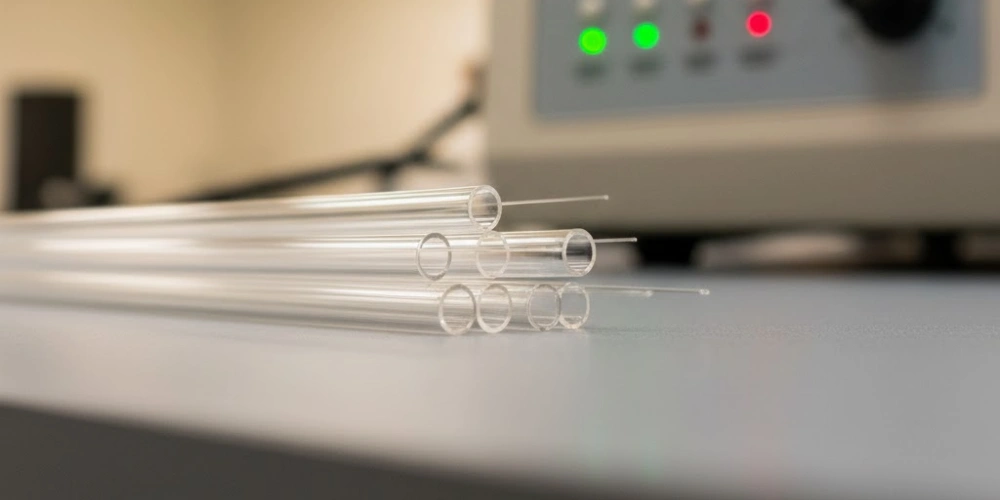
Commercial quartz capillary tubes are available in outer diameters ranging from 0.10 mm to 25 mm, with inner diameters typically ranging from 10% to 80% of OD depending on application. The standard ID/OD ratio for flexible polyimide-coated GC-type capillaries is 0.60–0.72 (e.g., 0.25 mm ID / 0.36 mm OD), while rigid precision tubes for spectroscopy use ratios of 0.80–0.92. Wall thickness uniformity — expressed as the concentricity tolerance — is ±3% of nominal wall thickness for standard grades and ±1% for precision grades, measurable by laser micrometry on cross-sectioned samples. Standard cut lengths range from 50 mm to 1,500 mm with ±0.5 mm length tolerance, while custom lengths are achievable via ultrasonic or laser scribing to ±0.1 mm.
Polyimide coating — the amber-colored external jacket applied to flexible capillary formats — is available in 12 μm and 24 μm nominal thickness, with ±2 μm tolerance. The 12 μm coating is standard for GC columns and CE capillaries; the 24 μm coating provides additional mechanical protection for field-deployed optical fibers and process analyzer sample lines. Both coating thicknesses are rated to 360 °C continuous temperature and 400 °C short-term excursion. SEMI Standard M1 specifies quartz capillary tube dimensional tolerances for semiconductor applications: OD tolerance ±0.05 mm for tubes below 5 mm OD, wall thickness uniformity ±5%, and ovality (maximum minus minimum OD at a given cross-section) below 0.5% of nominal OD — requirements that are achievable with high-purity natural quartz from certified semiconductor-grade suppliers but that synthetic fused silica meets with greater consistency across production lots.
A Selection Framework for Quartz Capillary Tube Specifications by Application
All preceding performance data converges in this final section into a structured decision framework — one that translates material property differences into application-specific selection criteria without ambiguity.
The framework below is organized around the five technical parameters that most frequently determine material selection outcomes: operating temperature, required UV transmission wavelength, metallic sensitivity of the analyte or process, surface chemistry requirements, and mechanical format. Each parameter maps to a binary or threshold decision that progressively narrows the viable material specification.
A Parameter Matrix Positioning Quartz Capillary Tubes against Fused Silica
Material Performance Comparison Matrix
| Performance Parameter | Natural Quartz Capillary Tube | Synthetic Fused Silica (high-OH) | Synthetic Fused Silica (low-OH) |
|---|---|---|---|
| Total Metallic Impurities (ppm) | 50-200 | < 0.5 | < 0.5 |
| UV Cutoff Wavelength (nm) | ~170–180 | ~155 | ~155 |
| UV Transmission at 200 nm (1 mm) | 40–60% | > 90% | > 90% |
| IR Transmission at 2.73 μm | Moderado | Poor (high OH absorption) | Excelente |
| Ponto de amolecimento (°C) | ~1,665 | ~1,683 | ~1,683 |
| Max Continuous Use Temp (°C) | 1,050-1,100 | 1,100–1,150 | 1,100–1,150 |
| CTE (× 10⁻⁶/°C) | 0.54–0.58 | 0.52–0.55 | 0.52–0.55 |
| Devitrification Onset (°C) | 1,050-1,100 | 1,200–1,250 | 1,200–1,250 |
| Inner Wall Ra (nm) | 5-15 | 1-5 | 1-5 |
| Surface Silanol Density (Si-OH/nm²) | 3.5–4.2 | 4.6–5.0 | 4.6–5.0 |
| EOF Reproducibility in CE (RSD) | ±8–15% | ±2% | ±2% |
| Radiation Hardness at 193 nm | Ruim | Good (with RIA cert.) | Good (with RIA cert.) |
| Relative Material Cost Index | 1.0× | 2.5–4.0× | 3.0–5.5× |
Critical Specification Questions before Committing to a Capillary Tube Material
Before finalizing a capillary tube specification, five technical questions determine whether natural quartz or synthetic fused silica is the appropriate material — and in several cases, which grade of synthetic fused silica is required.
What is the maximum operating temperature, and how frequently will thermal cycling occur? For continuous use below 950 °C with fewer than 50 annual thermal cycles, high-purity natural quartz capillary tubes are thermally adequate. Above 1,050 °C or with more than 100 annual cycles, synthetic fused silica is required to avoid premature devitrification and creep.
Does the application require UV transmission below 220 nm? If the answer is yes — as in CE with UV detection at 200 nm, deep-UV spectroscopy, or 193 nm laser optics — synthetic fused silica is mandatory. Natural quartz transmission in this range is insufficient and inconsistent across production lots.
Are the analytes or process gases sensitive to trace metal contamination at the ppb level? Organochlorine pesticides, hormones, and thermally labile pharmaceutical compounds decompose measurably on natural quartz surfaces above 200 °C. Any application requiring metal-inert surfaces — including GC, CE, and high-temperature catalytic studies — requires synthetic fused silica.
Does the application require near-infrared or mid-infrared transmission between 2 and 4 μm? If yes, low-OH synthetic fused silica (< 10 ppm OH) is the only viable material. Neither natural quartz nor high-OH fused silica is acceptable in this spectral window.
Is surface chemistry uniformity critical for EOF reproducibility, protein recovery, or microfluidic channel etching? Where run-to-run reproducibility requirements are below ±3%, only synthetic fused silica with certified silanol density provides the surface consistency required. Natural quartz is not an acceptable substitute for CE separations of proteins, nucleic acids, or enantiomers.
Conclusão
Natural quartz and synthetic fused silica are both amorphous SiO₂ materials, but their performance envelopes overlap only partially. Natural quartz capillary tubes deliver cost-effective performance in high-temperature industrial applications below 1,050 °C where metallic sensitivity and UV transparency are not critical requirements. Synthetic fused silica is mandatory wherever UV transmission below 220 nm, run-to-run analytical reproducibility, metal-inert surfaces, or infrared transmission between 2–4 μm defines the application requirement. The selection decision reduces to five quantifiable criteria: temperature ceiling, UV cutoff, metallic sensitivity, OH-dependent IR transmission, and surface silanol uniformity. Each criterion maps unambiguously to one of the three material grades — natural quartz, high-OH fused silica, or low-OH fused silica — presented in this article.
PERGUNTAS FREQUENTES
Is a quartz capillary tube the same as a fused silica capillary tube?
No. Both are amorphous SiO₂ glass, but natural quartz capillary tubes are derived from mined crystalline quartz and contain 50–200 ppm metallic impurities, while synthetic fused silica is chemically synthesized from high-purity SiCl₄ with total metallic impurities below 0.5 ppm. The purity difference drives measurable differences in UV transmission, thermal devitrification resistance, and surface chemistry.
What is the maximum temperature for a quartz capillary tube?
Commercial-grade natural quartz capillary tubes can be used continuously at 1,050–1,100 °C in oxidizing atmospheres, with a softening point of approximately 1,665 °C. Above 1,050 °C in cyclic thermal applications, devitrification onset becomes a practical concern. Synthetic fused silica extends the safe operating ceiling to approximately 1,100–1,150 °C with substantially lower devitrification risk.
Why do GC columns use fused silica instead of quartz?
Gas chromatography columns require a metal-inert inner surface to prevent catalytic decomposition of labile analytes above 200 °C. Synthetic fused silica, with total metallic impurities below 0.5 ppm, provides this inertness. Natural quartz capillary tubes at 50–200 ppm metallic impurities cause measurable analyte decomposition, particularly for pesticides, hormones, and thermally sensitive pharmaceutical compounds, reducing recovery rates to 45–65% versus 92–98% on fused silica.
What does OH content mean in fused silica capillary tubes?
OH content refers to the concentration of hydroxyl (Si-OH) groups incorporated into the fused silica glass network during synthesis. High-OH grades (>800 ppm) transmit well in the UV but absorb strongly in the infrared at 2.73 μm. Low-OH grades (<10 ppm) are transparent in the 2–4 μm infrared window and are required for near-infrared laser delivery and telecommunications fiber applications. Natural quartz contains 150–400 ppm OH — an intermediate range that is not optimized for either UV or IR applications.
Referências:
-
This entry describes inductively coupled plasma mass spectrometry, the analytical technique used to quantify metallic impurity concentrations at the sub-ppm level in both natural quartz and synthetic fused silica materials. ↩
-
This reference explains the operating principles of ArF (193 nm) and F₂ (157 nm) excimer laser sources, whose stringent optical material requirements — sub-0.05 ppm Fe, certified RIA growth rate — make synthetic fused silica the only qualifying capillary tube material in these systems. ↩
-
This entry explains the iron-catalyzed generation of hydroxyl radicals from hydrogen peroxide, directly underlying the analyte degradation mechanism observed when oxidative reagents contact iron-containing natural quartz capillary tube walls in CE buffer systems. ↩